How to find the right resume keywords in a job ad
Recruiters search their applicant database by keyword. Here is how to work out which words they will actually type, and where those words belong on your resume.
- Keywords
- Résumé writing
- ATS
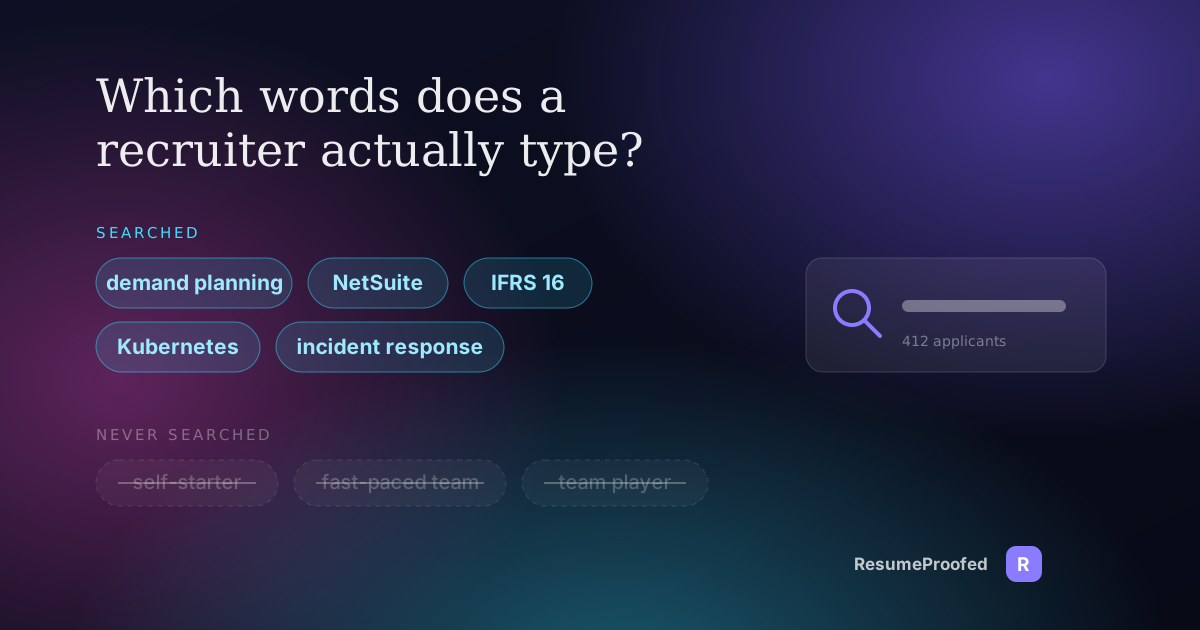
The mechanism that decides whether a recruiter ever sees your resume is unglamorous. They open a database of 400 applicants and type a word into a search box.

That is it. That is the filter people spend enormous energy theorising about. Which makes the practical question quite narrow and quite answerable: which words will they type?
Not all keywords are equal
Most keyword advice treats a job advert as a bag of words to be matched. It is not. Some phrases are load bearing and some are wallpaper, and knowing which is which is most of the skill.
Sort every candidate phrase into one of four buckets.
Searchable specifics. Proper nouns and named things: Kubernetes, NetSuite, IFRS 16, HL7, Salesforce Marketing Cloud, CPA, AS/NZS 3000, Series B. These are what recruiters actually type, because they are unambiguous and they narrow a list fast. This is your highest value category by a wide margin, and it is the one most people underuse because each term feels too narrow to bother writing down.
Role vocabulary. The phrases the industry uses for the work itself: incident response, demand planning, clinical governance, category management, revenue assurance. Searched often, and they signal that you speak the language of the field.
Seniority and scope markers. Team lead, P&L ownership, enterprise, multi site, regulated environment, matrix organisation. Searched less directly, but used heavily in the human read to place you at a level.
Wallpaper. Fast paced environment, team player, excellent communication skills, self starter, passionate, detail oriented. Nobody has ever searched an applicant database for "self starter". These phrases cost you space and credibility. Ignore them completely.
If you take one thing from this article: the searchable specifics are where the leverage is.
Hard skills and soft skills are not equal either
This is worth stating plainly, because a great deal of advice implies otherwise. Hard skills, meaning named tools, standards, systems and qualifications, are searchable and verifiable. Soft skills, meaning communication, leadership, adaptability, are neither.
That does not mean soft skills are irrelevant to hiring. They frequently decide the outcome at interview. It means that asserting them on a resume achieves close to nothing, because every applicant asserts the same ones and none of them can be searched or checked.
The way to convey a soft skill on a resume is to demonstrate it inside a hard achievement. "Led a team of 14 through a 9 month restructure with no unplanned attrition" says more about leadership than the word "leadership" ever will, and it happens to be searchable for team leadership and scope.
Reading the advert properly

A few habits surface the real keywords quickly.
Weight by position. The first three bullets of a responsibilities list are usually the actual job. The last three are often aspirational padding written by someone editing an old advert.
Watch for repetition across sections. If a concept appears in the summary, in the responsibilities and again in the requirements, it is the spine of the role. Lead with it.
Note the exact form of the word. "Stakeholder engagement" and "stakeholder management" are different search strings. So are ML, machine learning and MLOps. Match the form the advert uses, and where an abbreviation is common, include both forms once: "SQL Server Integration Services (SSIS)". A recruiter might search either, and spelling it out once makes you findable for both.
Read three other adverts for the same role at other companies. Vocabulary common to all four is industry standard language. Vocabulary unique to your target is their internal dialect. You want the common terms for findability and a few dialect terms for recognition.
Check the company's own website. How they describe their products, customers and market. If they say "members" rather than "customers", and you have genuinely worked somewhere with members, use their word.
Look at who else holds the role. Public professional profiles of people with the same job title at that company will show you the vocabulary that organisation actually uses day to day, which is often more accurate than the advert.
A worked example
Here is a fragment of a fairly typical advert:
We are looking for a passionate, detail oriented Supply Chain Analyst to join our fast paced team. You will own demand planning across our 6 distribution centres, maintain forecasting models in NetSuite, work with cross functional stakeholders, and support our transition to IBP. Experience with S&OP processes essential. Excellent communication skills required.
Sorted into the four buckets:
- Searchable specifics: NetSuite, IBP (integrated business planning), S&OP.
- Role vocabulary: demand planning, forecasting models, supply chain analyst.
- Scope markers: 6 distribution centres, which signals multi site.
- Wallpaper: passionate, detail oriented, fast paced team, excellent communication skills.
Four discarded phrases, six worth acting on. Now the test is which of those six you can genuinely evidence. Suppose you have done demand planning and S&OP in NetSuite across multiple sites, but have never touched IBP. You cover five, you leave IBP out, and you have learned something useful about how strong a candidate you are before spending an evening on the application.
Where keywords belong

Having found them, placement decides whether they help or hurt.
Inside evidence bullets, always the first choice. A keyword in a sentence that demonstrates the skill does double duty: it is findable and it is persuasive.
Rebuilt demand planning in NetSuite across 6 distribution centres, cutting stockouts 31% and shortening the S&OP cycle from 10 days to 6.
That single line is searchable for demand planning, NetSuite, S&OP and multi site scope, and it gives a human a reason to keep reading. Compare it to "NetSuite" sitting alone in a list at the bottom, which is findable but proves nothing.
In your summary, for the two or three that define you. The top of page one is the most read real estate on the document. It should contain the words that place you in the right category immediately.
In a genuine skills section, for tools that do not fit a bullet. A compact, honest list is useful for technologies, certifications and languages. Keep it short, keep it true, and do not let it become a dumping ground.
In your job titles, which matter more than people think. Recruiters search titles constantly. If your real title is company specific, such as "Growth Ninja" or "Member Experience Consultant", you are invisible to a search for the standard term. The honest fix is a clarifier rather than a rewrite: "Member Experience Consultant (Customer Success Manager)".
What not to do
Do not stuff. White text, hidden keyword blocks, a phrase repeated fifteen times. It is built for an automatic scorer that does not exist, and when a human sees it, and they will, it reads as an attempt to cheat.
Do not claim tools you have only read about. The interview will find out. "Exposure to" and "familiar with" are legitimate, honest calibrations. Use them rather than implying mastery you cannot demonstrate.
Do not abandon your own vocabulary entirely. A resume that is purely the advert reflected back reads as generic and slightly desperate. The keywords make you findable. Your specifics make you memorable.
Do not treat the skills list as the main event. It is a supplement to your evidence, not a substitute for it.
A ten minute pass
- Paste the advert somewhere you can mark it up.
- Highlight every proper noun and named tool, standard or credential.
- Highlight role vocabulary that appears more than once.
- Cross out all wallpaper.
- Split the highlights into two piles: things you have genuinely done, and things you have not.
- For each item you have, find the bullet in your history that proves it, and make sure the advert's exact wording appears in that bullet.
- Put the two or three defining terms into your summary line.
- For the second pile, decide honestly whether there is adjacent true experience worth surfacing, or whether this is simply a gap.
Step eight is where most of the temptation lives, and the arithmetic is worth being blunt about. The downside of not claiming a skill you lack is that you might miss one interview. The downside of claiming it is that you get the interview, fail the question, and damage your standing with a recruiter who talks to other recruiters in your industry for a living.
Common questions
How many keywords should a resume have?
There is no correct number, and chasing one produces stuffing. Cover the genuine specifics of the advert, meaning the named tools, standards, certifications and standard role vocabulary, with each term placed inside a bullet that evidences it. A well tailored resume typically covers most of an advert's searchable specifics naturally, because a suitable candidate has genuinely done those things.
Where do I put keywords on a resume?
Inside your achievement bullets first, because that placement is both searchable and persuasive. Then your summary for the two or three terms that define you, a compact skills section for tools that do not fit a bullet, and your job titles, which recruiters search constantly.
Should I copy keywords exactly from the job description?
Match the exact form where the phrase describes something you genuinely did, because the search string a recruiter types will usually match the advert's wording. Where an abbreviation is common, include both the abbreviation and the full term once. Never copy a phrase describing work you have not done.
Do recruiters really search resumes by keyword?
Yes, constantly, and it is the main mechanism by which qualified candidates go unseen. Facing hundreds of applicants, a recruiter searches the database for the specific terms that matter for the role, then reads the much shorter result set. If your resume lacks those words, you are effectively invisible regardless of how suitable you are.
What are good keywords if I am changing careers?
Focus on the transferable searchable specifics: tools, standards, methodologies and certifications that carry across industries, such as SQL, project management methods, financial standards or safety qualifications. Then use role vocabulary from the target industry only where you genuinely have adjacent experience, and make the parallel explicit in your summary so the reader does not have to infer it.
Are soft skills keywords worth including?
Rarely as standalone assertions, because nobody searches for them and every applicant claims them. Demonstrate them inside a concrete achievement instead. "Coordinated 5 external agencies through a 6 month launch" conveys communication and coordination far more credibly than listing either word.
How we handle this
ResumeProofed's Recruiter Scan does the categorisation above automatically. It pulls the searchable specifics and role vocabulary out of a job advert, discards the wallpaper, and shows you which terms your tailored resume covers, which it misses, and, critically, which of the misses you could honestly cover from facts already sitting in your master profile.
That last part is what matters. It never suggests you add a keyword you cannot support. If a term is missing because you genuinely lack that experience, it stays missing and tells you so, which is useful information about whether this role is worth your evening at all.
ResumeProofed opens soon. Join the waitlist to be first in.