Do AI interview copilots actually work, and is it worth the risk?
Real-time AI tools that feed you interview answers exist and are growing. Amazon has already banned them, and detection is measurably rising in 2026.
- AI resumes
- Job search
- Interviews
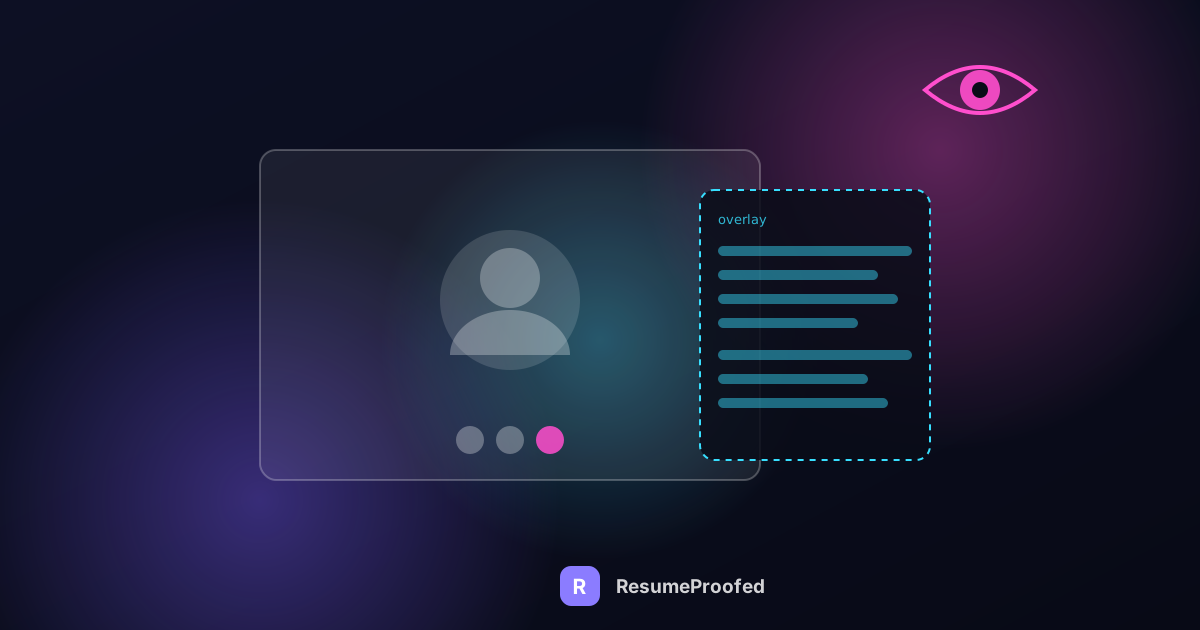
An AI interview copilot listens to your live interview, transcribes the question in real time, and feeds a suggested answer into a private overlay only you can see, usually a second window or a transparent layer on top of your video call. Tools like Final Round AI market this directly as a live teleprompter for interviews. The tempting pitch is obvious: never freeze on a question again. The part that pitch leaves out is that at least one major employer has already banned it outright, trained its interviewers to spot it, and threatened disqualification for anyone caught using it.
The position worth stating early: this is not a hypothetical risk or a slippery-slope argument. It is a documented, current policy at a company that hires at enormous scale, paired with a measurable rise in cheating-detection rates across hiring platforms more broadly. Our existing guide to AI video interviews covers being graded by AI during a recorded, one-way interview. This is a different situation entirely: using AI yourself, live, against a human interviewer, and the risk profile is not the same.
What these tools actually do, and where they break
The mechanics are consistent across most tools in this category: a browser extension or desktop overlay listens to the interview audio, transcribes the interviewer's question, sends it to a language model, and displays a suggested answer for you to read or paraphrase, typically within a few seconds.
That few-second delay is the first structural problem. A real answer starts almost immediately after a question ends; a copilot-assisted answer has a detectable lag while the system transcribes, generates, and displays. The second problem is harder to engineer around: these tools predict likely follow-up questions based on the interview so far, but they cannot always predict the specific one an interviewer actually asks. When that happens, the polished, AI-assisted answer to the original question collapses the moment a real follow-up lands, because there is nothing queued up to read from. An answer that sounded confident and specific thirty seconds ago suddenly turns vague, repetitive, or contradictory. That collapse is often more visible to an interviewer than the delay was in the first place.
Amazon has already banned this, by name
Amazon's internal guidance is direct: "please do not use GenAI tools during your interview unless explicitly permitted," with a stated consequence attached: "failure to adhere to these guidelines may result in disqualification from the recruitment process," according to reporting on Amazon's policy from ITPro. The same reporting names Final Round AI specifically as the kind of tool the policy targets, describing it as functioning like a teleprompter that prompts a candidate on "the right thing to say."
Amazon's stated reasoning is that these tools create an unfair advantage and prevent the company from assessing a candidate's actual, authentic skill, which is the same rationale most employers would apply even without a written policy. The practical takeaway is not "only Amazon cares about this." It is that at least one employer hiring at massive scale has moved past treating this as a grey area and into active enforcement, and other large employers with similarly high application volumes have every incentive to follow.
What interviewers are actually trained to watch for

According to the same ITPro reporting, Amazon trains its interviewers to watch for three specific behavioral tells: candidates typing while a question is being asked, candidates who appear to be reading a response rather than speaking naturally, and eyes that wander, typically toward a second screen displaying the overlay.
An independent explainer on interview-copilot detection corroborates the same pattern from a different angle, describing eyes "drifting to a fixed point off camera," a speaking cadence that "sounds like reading," and the follow-up collapse described above, an answer that "arrives polished and then collapses the moment the interviewer asks a follow-up the overlay did not predict," according to Four-Leaf's analysis of AI interview copilots. Two independent sources naming the same specific tells, an employer's internal guidance and a separate industry explainer, is a stronger basis for this than either alone.
The detection gap is closing, not staying still
It is not just human interviewers getting better at noticing these tells. Automated proctoring on assessment platforms is also catching more attempts. CodeSignal's own data shows cheating and fraud attempt rates on its proctored assessments "more than doubled, from 16% in 2024 to 35% in 2025, with entry-level attempt rates nearly tripling," per the same Four-Leaf analysis. That statistic is about automated coding assessments specifically, not live interviews, but it demonstrates the broader trend this sits inside: platforms are training detection systems on a rapidly growing dataset of real attempts, which means the tools interviewers and platforms have available to them are getting sharper at exactly the moment more candidates are experimenting with copilots. Betting that detection stays where it is today, when the trend line points the opposite direction, is a bet against the data.
A worked example: where the overlay actually fails

Picture a live interview for a mid-level marketing role. The interviewer asks: "Tell me about a time you had to change a campaign strategy midway through, and why." A copilot listening in transcribes the question, generates a plausible, well-structured answer about a hypothetical campaign pivot, and displays it. The candidate reads it back convincingly enough, hitting the situation, the change, and a clean result.
Then the interviewer follows up: "What was the actual number that told you it wasn't working, and how many days into the campaign was that?" This is a natural, specific follow-up any experienced interviewer asks to test whether the story is real. The overlay did not anticipate this exact number-and-timeline combination, because it cannot know facts the candidate never actually told it. The candidate either stalls while the tool catches up, generating a delayed, generic non-answer, or improvises without it and contradicts a detail the tool invented in the first answer. Either way, the follow-up is exactly the moment described above where a polished AI-assisted answer collapses, and it is also the exact moment an interviewer trained on Amazon's tells is watching most closely.
The lesson is not "copilots never work." It is that they are weakest precisely where interviews are designed to be hardest to fake: the specific, unpredictable follow-up that only someone who actually lived the story can answer cleanly.
A better routine if the real problem is interview nerves
If what's actually driving interest in these tools is fear of freezing up rather than a desire to fabricate experience, the fix that survives a follow-up question is preparation, not a live feed.
- Build a bank of five to seven real stories from your actual work history, each with a specific number or concrete detail attached, not a vague outcome. A number is exactly what survives a follow-up question; a vague claim is exactly what does not.
- Practice each story out loud, not silently. Reading your own answer in your head feels rehearsed enough; saying it out loud to another person or a recording reveals the parts that don't actually flow, which is the same gap a copilot papers over rather than fixes.
- Deliberately ask yourself the hard follow-up for each story before the interview: what's the number, what was the timeline, what would you do differently. If you can't answer your own follow-up, the interviewer's version will be harder, not easier.
- Match your prepared stories to the specific job ad, the same discipline that applies to tailoring a resume: a generic story about "improving a process" lands weaker than one that maps directly onto a responsibility listed in the ad you're interviewing for.
- Accept a genuine pause as normal. A two-second silence while you think of the right example reads as thoughtful. A convincingly fast, suspiciously fluent answer to a hard question is, per the detection tells above, more likely to draw scrutiny than a real pause ever will.
Common questions
Do AI interview copilots actually work?
They work for straightforward, predictable questions, but they are unreliable exactly where interviews get harder: specific, unpredictable follow-up questions that the tool did not anticipate. That structural weakness, combined with a detectable response delay and reading cadence, is also what interviewers are increasingly trained to notice.
Has any employer actually banned AI interview tools?
Yes. Amazon's internal guidance explicitly bans the use of generative AI tools during interviews unless specifically permitted, with disqualification from the recruitment process as the stated consequence for violating it, and its guidance names teleprompter-style tools like Final Round AI directly.
What do interviewers look for to spot an AI interview copilot?
Typing while a question is still being asked, a delivery that sounds like reading rather than speaking naturally, eyes drifting toward a second screen, a noticeable delay before answering, and an answer that suddenly loses coherence the moment a follow-up question arrives that the tool didn't predict.
Is using an AI interview copilot actually risky, or is this overblown?
It's a real and current risk, not a hypothetical one. At least one major employer enforces disqualification for it, interviewers are being specifically trained on the tells, and automated cheating detection on hiring platforms has been rising sharply, more than doubling on one major assessment platform between 2024 and 2025.
Is it different if I just use AI to prepare beforehand rather than live during the interview?
Yes, significantly. Using AI to help draft practice answers, research a company, or refine a resume before an interview carries none of the same risk, because you're not relying on a live feed during the actual conversation and any resulting answers are ones you've rehearsed and can defend under a follow-up question.
Can interviewers actually prove someone used a copilot, or is it just suspicion?
Often it's behavioral suspicion rather than hard proof in a live video call, which is exactly why employers like Amazon rely on training interviewers to notice patterns rather than trying to technically detect the software itself. On automated coding assessments, platforms increasingly do have technical detection built in, which is part of why fraud attempt rates being caught have risen so sharply.
Where ResumeProofed fits, and where it doesn't
ResumeProofed has no live interview feature and never will, an AI feeding you real-time answers during an actual conversation with a person is a different category of tool with a different risk profile than anything a resume product should touch. What it can do is make sure the resume that got you into the interview room is honest and specific enough that the stories you tell out loud line up with what a hiring manager already read, so you walk in with real, defensible answers rather than needing a live feed to invent them under pressure.
Try ResumeProofed free: two tailored applications on the house, no card required.