How to answer 'Tell me about yourself' in a job interview
A specific formula for answering 'Tell me about yourself,' with timing, a worked example, and why starting with your life story backfires.
- Interviews
- Job search
- Career advice
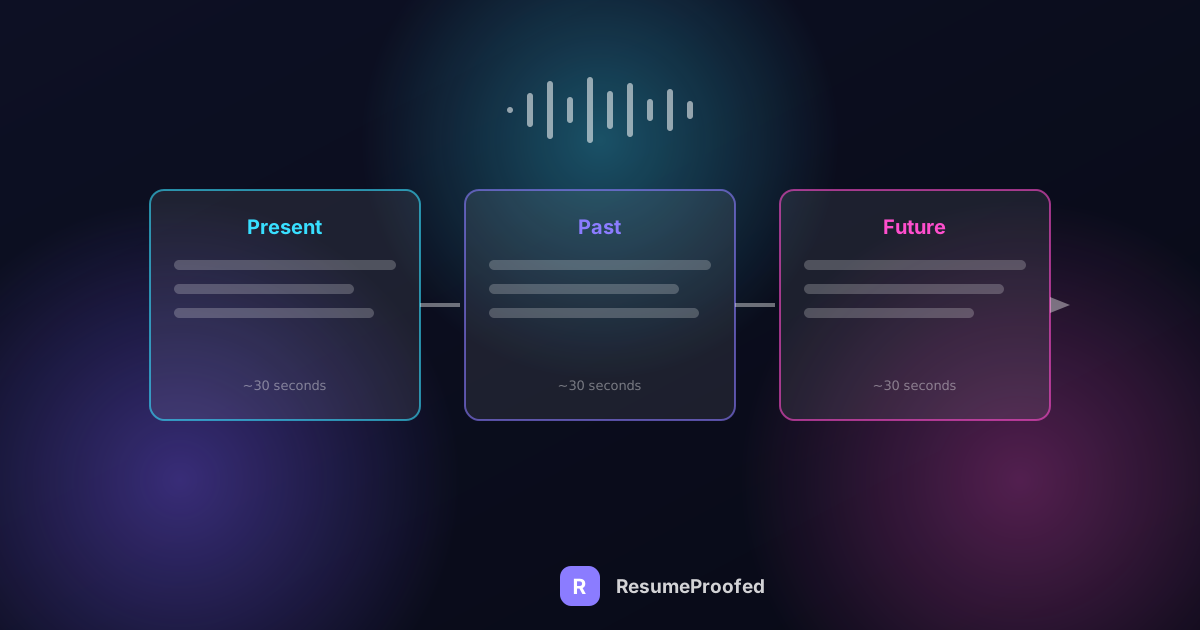
The interview starts, and the first real question is the one almost every candidate gets wrong: "Tell me about yourself." Most people either launch into a chronological life story that starts too early and loses the interviewer before it gets relevant, or freeze entirely because the question is so open that nothing feels like the right place to start. Neither failure is about having a weak background. It's about not having a structure ready before the question lands.
The position worth stating early: there's a specific, well-tested formula for this answer, it has a name, and most generic interview advice never explains why it works or how long it should actually take. It's called Present-Past-Future, developed by career coach Lily Zhang, and The Muse's guide to the question lays out why it beats the chronological instinct almost everyone defaults to: it leads with what the interviewer actually cares about first, instead of making them wait for it.
Why starting with "I was born in..." backfires
A chronological answer, starting from childhood, school, or your first job, puts the most relevant information last, if it arrives at all. Interviewers aren't neutral about when they form a view of a candidate. A 2013 CareerBuilder survey of 2,201 hiring managers and HR professionals, conducted by Harris Interactive, found that 49% of employers say they know within the first five minutes of an interview whether a candidate is a good fit, and 87% know within the first fifteen. "Tell me about yourself" is usually the very first substantive question asked, which means it's doing a disproportionate amount of work in that early window, whether your answer is structured for that or not.
A long chronological wind-up spends your best material, the part most directly relevant to the job you're interviewing for, at the point in the interview when the interviewer's attention and first impression are already most engaged. That's the opposite of how the time should be spent.
The Present-Past-Future formula
The formula flips the chronological order on its head, leading with now rather than ending there.
- Present. Open with your current role, its scope, and a recent accomplishment relevant to the job you're interviewing for. This is what the interviewer most wants to know and what most answers bury.
- Past. Briefly explain how you got to where you are, pulling out only the previous experience that's actually relevant to this specific role, not your entire work history.
- Future. Close by connecting where you're headed to why this particular role and company are the right next step, not a generic "I'm looking for growth" line.
The same Muse guide is upfront that there's no scientifically proven optimal length for this answer: the coaches it cites recommend anywhere from 30 seconds to two minutes, depending on how much relevant background you're covering. One useful marker from career coach Al Dea, cited in the same piece: people tend to start losing steam after 1.5 to 2.5 minutes of uninterrupted talking. Treat that as the window to land inside, erring shorter for a more junior background and only stretching toward two minutes if you genuinely need the room.
A worked example
Picture a candidate interviewing for a Senior Marketing Coordinator role, currently working as a Marketing Coordinator at a different company.
Present: "Right now I'm a Marketing Coordinator at a mid-sized retail brand, where I run our email and social campaigns. Over the last year I rebuilt our email segmentation, which took our open rate from 18% to 31% and added roughly $40,000 in attributable revenue last quarter."
Past: "I got into marketing through a content role at a smaller startup, where I learned the analytics side from the ground up, and that's actually what led me toward email specifically, since it's the channel where you can see the numbers move in real time."
Future: "I'm looking for a role with more ownership over strategy, not just execution, which is why this Senior Coordinator position caught my attention, especially the part of the job ad about owning the lifecycle program end to end."
Notice the specific numbers in the Present section, 18% to 31%, $40,000, last quarter, rather than a vague "I improved email performance." Our guide to quantifying resume achievements covers the same discipline in more depth: a number survives a follow-up question, an adjective doesn't, and that's exactly as true out loud in an interview as it is written on a resume.
Tailoring the formula to your situation
If you're changing careers. Spend more of the Past section explaining the throughline between your old field and the new one, rather than apologizing for the switch. "I spent four years in operations, which is where I learned to manage competing deadlines under pressure, a skill that maps directly onto project coordination" works better than leading with what you're leaving behind.
If you're applying for your first job or have no formal experience yet. The Present section can lead with your most recent and relevant activity, a degree project, a part-time role, volunteer work, rather than a job title you don't have yet. The Future section carries more weight here, since it's doing the job an extensive Past section would otherwise do: showing you've thought seriously about why this specific role fits.
If you're returning after a layoff or a gap. State the gap plainly and briefly in the Past section rather than skipping over it awkwardly, then move quickly back to Present-facing material. A one-sentence, confident mention reads as far more composed than an obvious omission the interviewer is left to wonder about.
A short practice routine
- Write out your three sections as bullet points first, not full sentences. This stops you from memorizing a script that sounds robotic when you actually say it out loud.
- Time yourself out loud, not silently. Reading an answer in your head always feels shorter than it actually sounds spoken, and the 1.5 to 2.5 minute window goes by faster than it looks on paper.
- Cut the Past section before you cut the Present or Future. If you're running long, the previous-experience detail is almost always the safest place to trim, since Present and Future are what the interviewer is actually listening for.
- Practice the transition lines, not just the content. "That's actually what led me to..." and "which is why this role caught my attention..." are the connective tissue that makes three separate facts sound like one coherent answer.
- Record yourself once, even just on your phone. Hearing your own filler words and pacing is more useful than any amount of silent rehearsal, and it's the cheapest way to catch a rambling Past section before an interviewer does.
A related discipline worth building alongside this one: preparing real, specific stories in advance rather than relying on anything generated for you in the moment. Our piece on whether AI interview copilots are worth the risk covers why a live-fed answer collapses the moment an interviewer asks an unpredictable follow-up, which is exactly the failure mode that genuine preparation, including a well-rehearsed Present-Past-Future answer, is built to avoid.
Common mistakes with this answer
- Restating your entire resume. The interviewer already has it. This answer is a narrative frame, not a recitation.
- Ending on the Past instead of the Future. A chronological habit is hard to break, and many people build a good Present and Past section, then simply stop, leaving the interviewer to ask "so what are you looking for" as a separate, slightly awkward follow-up.
- Making the Future section generic. "I'm looking for growth and a new challenge" fits every job ad ever written. Naming something specific from the actual posting or company shows you did the reading.
- Apologizing for a career change or gap instead of stating it plainly. A brief, confident sentence lands better than a long, hedged explanation.
Common questions
How long should my answer to "Tell me about yourself" be?
There's no single correct length. Career coaches The Muse cites put the useful range anywhere from 30 seconds to two minutes, and career coach Al Dea notes that most interviewers start losing steam after 1.5 to 2.5 minutes of uninterrupted talking. Aim to land inside that window rather than treating any single number as a fixed target.
What is the Present-Past-Future formula for interview answers?
It's a structure for answering open-ended interview questions like "Tell me about yourself" by opening with your current role and a recent accomplishment, briefly covering relevant past experience, and closing by connecting your trajectory to why you want this specific role. It was developed by career coach Lily Zhang and reverses the default instinct to answer chronologically from the past forward.
Should I memorize my answer word for word?
No. Memorizing bullet points for each of the three sections, then practicing the transitions between them out loud, produces an answer that sounds natural and adapts slightly each time, unlike a fully scripted answer, which tends to sound rehearsed and can fall apart if you lose your place.
What if I don't have much relevant work experience?
Lean on the Present section for your most recent relevant activity, whether that's a class project, part-time work, or volunteer experience, and put more weight on the Future section to show you've thought specifically about why this role is the right next step, rather than trying to stretch a thin Past section.
Is "Tell me about yourself" the same as "Walk me through your resume"?
They're related but not identical. "Walk me through your resume" usually expects a closer, more literal pass through your work history in order. "Tell me about yourself" is more open ended and rewards a tighter, present-forward narrative like the Present-Past-Future structure rather than a full chronological walkthrough.
Do I need a different answer for every interview?
The structure stays the same, but the content inside it should shift. The Future section especially should reference something specific from the actual job ad or company each time, since a generic version of this answer is one of the easiest tells that a candidate hasn't tailored their preparation to the specific role.
Where ResumeProofed fits, and where it doesn't
ResumeProofed doesn't coach live interview delivery, the words you say out loud and how you say them are yours to practice, not something a resume tool should script for you. What it can do is make sure the specific numbers and accomplishments you'd use in a Present-Past-Future answer, the ones that actually survive a follow-up question, are already documented and backed by real evidence from your career, confirmed once rather than reconstructed under pressure before every interview.
Try ResumeProofed free: two tailored applications on the house, no card required.