How to quantify achievements on your resume (with real examples)
Vague duty statements do not get interviews. Here is the formula for quantifying resume achievements, with worked examples and no clean numbers needed.
- Résumé writing
- Job search tools
- Career strategy

"Responsible for managing social media accounts" tells a recruiter that you had access to a login. It does not tell them anything you actually achieved. Almost every resume advice article says to "quantify your achievements," and almost none of them tell you what to do when you genuinely cannot remember the exact number, which is the actual reason so many bullet points stay vague. This is the practical version: a formula, worked examples across different kinds of work, and a routine for reconstructing a defensible number when you do not have one sitting in a spreadsheet.

The position worth stating early: quantifying a bullet is not about inflating it. It is about replacing a duty statement, something you were responsible for, with an outcome statement, something that changed because you did the work. A number is just the fastest way to prove the outcome was real, but the number has to be true, or defensible in an interview, or it does more damage than the vague version ever did.
The formula

Two versions of the same underlying formula cover almost every situation.
The simple formula: action verb + task or context + measurable result. "Increased customer retention by 25 percent over six months by improving onboarding processes" is a direct example of this shape: a strong verb, the specific area of work, and a number attached to the outcome.
The XYZ method, useful when the result is the most impressive part of the sentence and belongs first: "Accomplished [X], as measured by [Y], by doing [Z]." For example, "Increased website traffic by 40 percent in three months by launching a targeted content strategy" leads with the outcome, states how it was measured, then explains the mechanism. This version works particularly well for performance-driven roles like sales or marketing, where the result itself is the strongest hook in the sentence.
Both formulas share the same underlying shape: a number that measures a real change, attached to a specific action you took. The formula is not the hard part. Finding a true, defensible number is.
Where the number actually comes from
Most guidance on this topic assumes you already have a clean percentage sitting in a report somewhere. Most people do not. Here is where to actually look, and how to build a number when there is no report to pull it from.
Before-and-after comparison. The most common and most honest source of a number is a direct before-and-after state you can describe: response time before and after a process change, team size before and after a hire you influenced, error rate before and after a new checklist. The calculation is simple: (new number minus old number) divided by old number, multiplied by 100, gives you the percentage change. If average response time fell from 45 minutes to 22, that is a 51 percent reduction, a real, checkable figure rather than an estimate.
Scale and volume, even without a before-and-after. If you do not have a clean comparison point, scale alone is still a legitimate number. "Maintained a 98 percent on-time delivery rate across 500-plus monthly deliveries" does not need a "before" state to be meaningful, it establishes scope and reliability on its own.
A reasonable, stated estimate. If you genuinely cannot reconstruct an exact figure, an honestly labelled estimate beats an unquantified duty statement, as long as you can defend it if asked. "Reduced onboarding time by an estimated 30 percent based on manager feedback" is honest about being an estimate and still gives a recruiter something concrete. What you should never do is present a guess as a precise, unlabelled number you cannot explain if an interviewer asks where it came from.
Worked examples across different kinds of work

The formula holds up across very different jobs. Here is the same duty-to-outcome rewrite applied to a spread of roles, each with the actual reasoning behind the number.
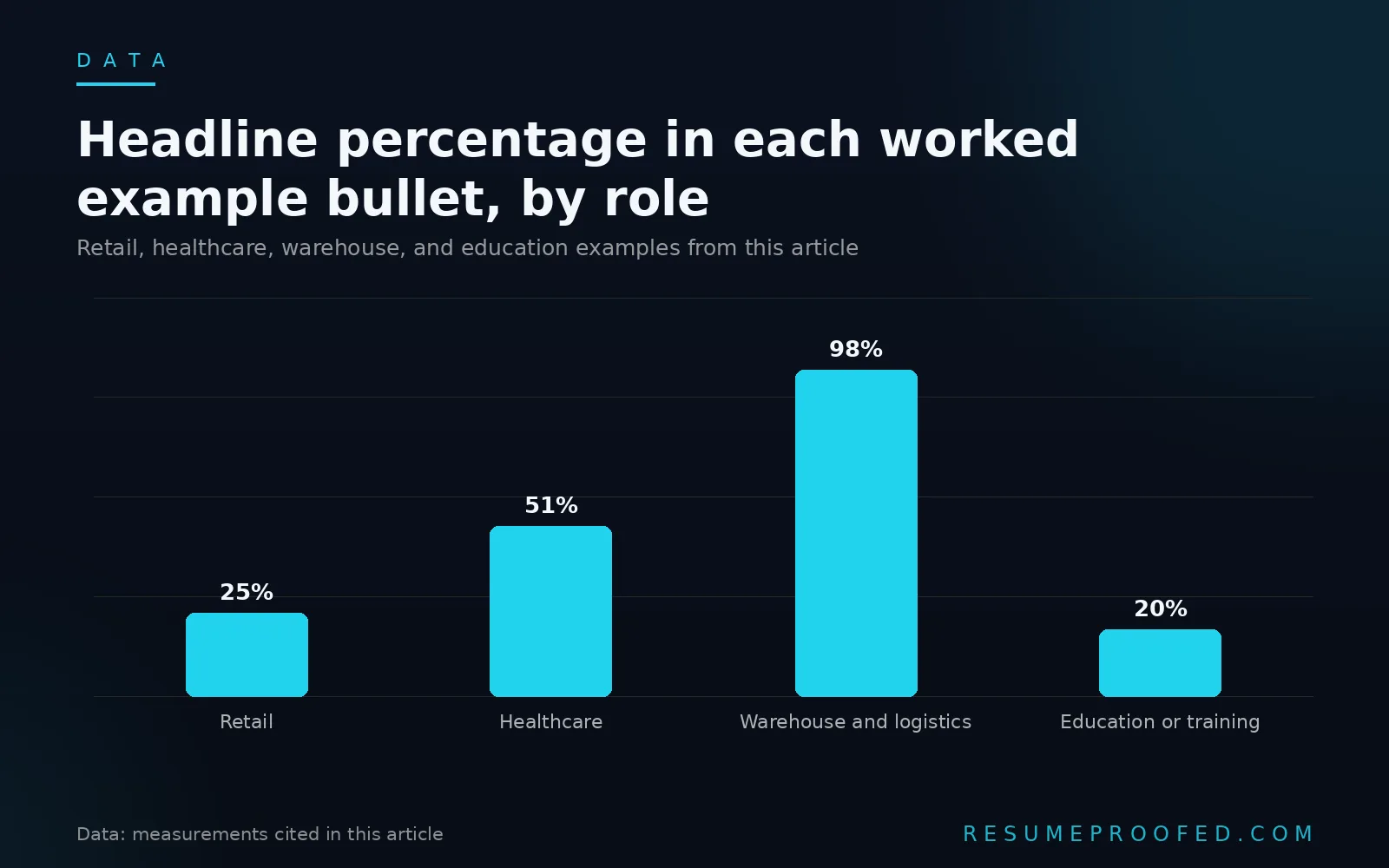
Retail. Duty version: "Responsible for merchandising and customer service on the sales floor." Quantified version: "Drove a 25 percent increase in monthly sales by redesigning product displays and improving customer service response, achieving a 90 percent positive feedback score." The number here likely comes from store sales reporting most retail environments already track, plus a customer feedback metric many retailers survey directly.
Healthcare. Duty version: "Managed patient intake and reduced wait times." Quantified version: "Cut average patient wait time from 45 minutes to 22 minutes, a 51 percent reduction, by restructuring the intake queue." This is a direct before-and-after calculation: two measured points in time, divided into a clean percentage.
Warehouse and logistics. Duty version: "Responsible for order fulfilment and delivery scheduling." Quantified version: "Maintained a 98 percent on-time delivery rate across 500-plus monthly deliveries while reducing average delivery time by 25 percent." Here the scale figure, 500-plus monthly deliveries, comes from volume the role naturally handled, no special tracking required, and the percentage is a straightforward comparison against a prior average.
Education or training. Duty version: "Delivered training sessions to new starters." Quantified version: "Delivered onboarding training resulting in a 20 percent improvement in assessment scores, with a 95 percent course completion rate." Completion and assessment figures are frequently already tracked by an LMS or a training coordinator, which makes this one of the easier categories to pull a real number from if you ask.
A worked example: rebuilding a number from memory
Say you managed a small customer support team for two years and left the role eighteen months ago. You do not have access to the old reporting dashboard anymore, and you genuinely do not remember an exact figure.
Start with what you do remember with confidence: the team went from a four-person unit answering roughly 200 tickets a week to five people answering closer to 300, and you know response time visibly improved because customers stopped escalating complaints about slow replies, a pattern your manager mentioned in a performance review at the time.
From that, you can honestly write: "Grew a customer support team from 4 to 5 members while increasing weekly ticket volume handled from approximately 200 to 300, a roughly 50 percent increase in throughput." That figure is a defensible estimate built from two things you actually remember, headcount and rough weekly volume, not an invented precise statistic. If an interviewer asks how you know, "our team lead tracked weekly ticket counts and I recall the increase clearly because we discussed it in reviews" is a true, sustainable answer. What would not survive that same question is a suspiciously precise number, like "increased throughput by 53.7 percent," invented to sound more rigorous than the memory actually supports.
What not to do
Do not invent a number you cannot explain. If an interviewer asks "how did you measure that," and your honest answer is "I made it up to sound more specific," that is worse for you than the vague duty statement would have been. A number's whole job is to be more credible than an adjective. An indefensible number is less credible than no number at all.
Do not quantify something meaningless just to have a number. "Sent over 500 emails" is a number, but it measures activity, not outcome. The formula is action plus measurable result, and the result has to be something that mattered, not just something you can count.
Do not use the same number across radically different rewrites of the same bullet. If you are tailoring a resume for different roles and one version claims a 25 percent improvement while another version of the identical achievement claims 40 percent, you have a consistency problem an attentive interviewer, or a careful reference check, will eventually find.
A short routine for quantifying your own resume
- Go through your current resume line by line and flag every bullet that describes a responsibility rather than an outcome. "Responsible for," "handled," "assisted with," and "helped with" are the most common flags.
- For each flagged bullet, ask what changed because you did that work, not what you were assigned to do.
- Look for a real before-and-after figure first. If you cannot find one, use scale or volume instead. If neither is available, build a stated, honest estimate you can explain if asked.
- Rewrite using either the simple formula, action verb plus task plus result, or the XYZ method, result first, if the outcome is the strongest part of the sentence.
- Read every rewritten bullet back and ask whether you could explain the number, calmly and specifically, to an interviewer who pushed back on it. If not, soften the claim or find a different achievement.
Keeping a running master resume with these numbers recorded as they happen, rather than reconstructed months later from memory, is what makes this exercise fast the next time you apply. It is also what makes the resume summary at the top of your resume actually credible, since a summary's accomplishment line depends on having a specific, quantified achievement ready to drop in rather than writing one from scratch under deadline pressure.
Common questions
How do I quantify my resume if I don't have exact numbers?
Start with the closest real comparison you can reconstruct, a before-and-after state, a scale or volume figure, or a percentage change calculated from two points you do remember. If none of those are available, use a clearly reasoned, honest estimate rather than an unquantified duty statement, and be ready to explain where the estimate comes from if asked.
What is the best formula for quantifying resume bullet points?
Action verb plus task or context plus measurable result is the simplest version: state what you did, in what area, and what changed as a result. The XYZ method, "accomplished X as measured by Y by doing Z," works well when the result itself is the strongest part of the sentence and should lead.
Should every bullet point on my resume have a number in it?
Not every single one, but most of your strongest bullets should. If a task genuinely has no measurable outcome, it may not belong on the resume at all, or it can be rewritten to focus on scope and complexity instead of a fabricated percentage.
What if quantifying my work would require rounding or estimating?
An honestly labelled estimate, built from something you can actually explain, is legitimate and better than leaving a bullet vague. What is not legitimate is presenting a rounded guess as a precise figure you cannot account for if an interviewer asks how you measured it.
Can quantifying achievements help with ATS keyword matching too?
Indirectly. Numbers themselves are not typically what an ATS searches for, but the process of rewriting a vague duty into a specific outcome usually surfaces the exact skill and tool keywords a job ad is looking for, since you have to name what you actually did to attach a number to it.
Is it dishonest to estimate a percentage if I don't remember the exact figure?
No, as long as the estimate is reasoned from something real and you are prepared to describe how you arrived at it if asked. What is dishonest is presenting a guess as a measured fact, or inflating a real number beyond what you could defend in an interview.
Where ResumeProofed fits, and where it doesn't
ResumeProofed cannot invent a number for you, and it will not try to. Its evidence interview specifically asks you to confirm each accomplishment, including the figure behind it, before it uses that fact in a tailored resume, rather than generating plausible-sounding, unverified numbers the way a generic AI rewrite tool might. What it does speed up is the tailoring step once your real, quantified achievements are already confirmed in your profile: matching the right ones to a specific job ad's language, every time you apply, instead of you reconstructing the same numbers from memory for each new application.
Try ResumeProofed free: two tailored applications on the house, no card required.