How to tailor one resume for several similar job ads without starting over
Applying to six near identical roles doesn't mean writing six resumes from scratch, or sending the same one six times. Here is the middle method that works.
- Résumé writing
- Tailoring
- Job search tools
You're not applying to one Customer Success Manager role this week. You're applying to six, at six different SaaS companies, all wanting roughly the same thing in slightly different words. Full tailoring from scratch for each one, at the twenty to forty minutes a properly tailored application actually takes, is two to four hours you don't have. Sending the identical document to all six is the spray-and-pray pattern that same research warns against. Neither extreme is the right answer to the specific problem you actually have, which is six roles that are similar, not identical.
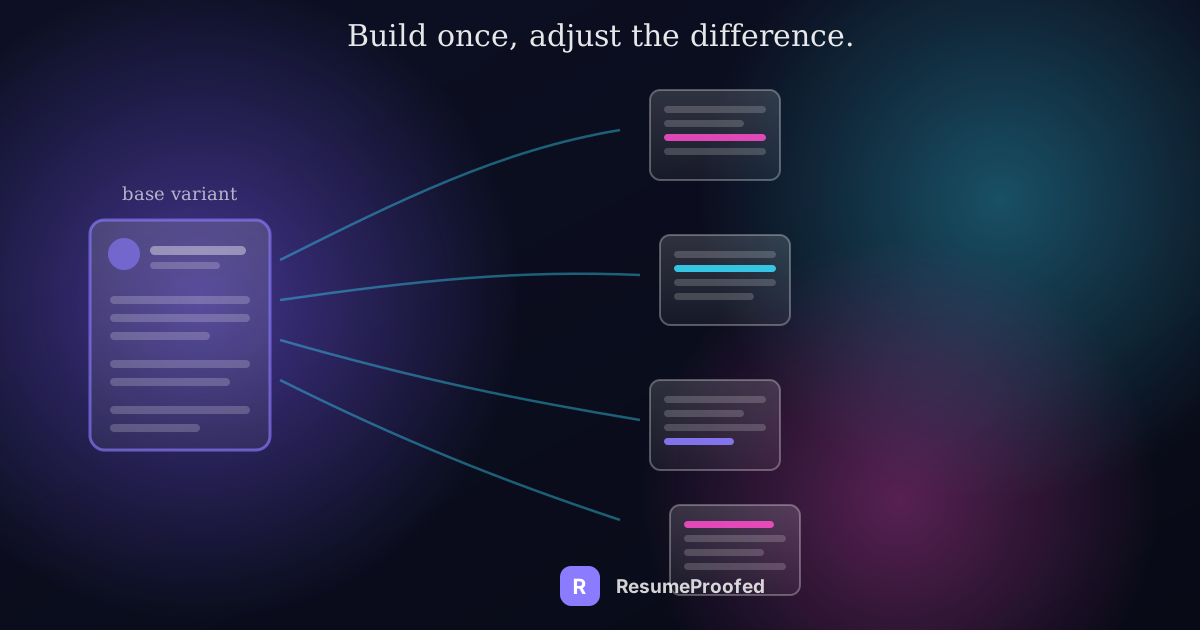
The position worth stating early: when job ads cluster tightly around the same role, the fix isn't choosing between full rebuild and no tailoring at all. It's building one well-tailored base document for that cluster of similar roles, then running a much shorter, targeted pass over each specific ad's individual differences. That two-step method is faster than rebuilding from scratch every time and meaningfully more accurate than sending one static document to all six.
Why the two obvious approaches both fail here
Rebuilding a resume from first principles for every application assumes each job ad is meaningfully different from the last one. When you're applying to a genuine cluster of similar roles, that assumption is false, and the extra time you spend rebuilding an already-solid document buys you almost nothing, because the ninety percent of the resume describing your actual work history and achievements doesn't change from ad to ad within the same role family.
Sending one static resume to all six fails for the opposite reason. Even roles that look nearly identical from a job title differ in specifics that matter: one ad emphasises churn reduction, another emphasises onboarding speed, a third names a specific tool your resume doesn't currently mention. A resume tuned to none of these specifically reads as generically competent rather than sharply matched to any one of them, and recruiters searching a database for their own ad's specific language, the mechanism covered in how to find the right resume keywords in a job ad, simply won't surface a document that never says the words they're searching for.
The role-family method
The fix sits between those two extremes, and it works because most role clusters share a large common core with a small number of genuine variations layered on top.
Step one is building a base variant for the cluster, not the individual ad. Read three or four of the job ads together, before you touch any single one, and note what's genuinely common across all of them: the core responsibilities, the seniority level, the general vocabulary. Build one strong, fully tailored resume against that common core, using your master resume as the source of achievements and evidence, following the same tailoring discipline covered in tailoring a resume to a job description. This base variant should already be strong enough to submit as-is if you had to, not a rough draft waiting to be finished.
Step two is a fast, targeted pass per individual ad, run against the base variant rather than starting over. For each specific posting, you're checking for exactly three things: a named tool, platform or certification the base variant doesn't mention that this ad specifically asks for; a differently weighted priority, where this ad leads with something your base variant only mentions in passing; and any specific phrase or terminology this employer uses that differs from your base variant's wording for the same underlying concept. Adjust only what those three checks surface. Everything else stays as-is.
This is meaningfully faster than a full rebuild because the slow part of tailoring, deciding which of your real achievements are relevant and translating them into the ad's vocabulary, already happened once during step one. Step two is editing, not composing, and editing three or four specific lines takes a fraction of the time drafting a full document does.
A worked example: six similar roles, one base variant
Say you're a mid-level Customer Success Manager looking at postings from six different SaaS companies. You read all six ads first, and the common thread is clear: managing a book of mid-market accounts, reducing churn, and running quarterly business reviews. That's your cluster's common core, and it becomes your base variant, built with real numbers pulled from your master resume: "Manage a portfolio of 45 mid-market accounts, reducing quarterly churn from 8 percent to 5.1 percent over 18 months through a proactive check-in cadence and structured onboarding handoff."
Now the fast pass. Ad one specifically names Gainsight as a required tool. Your base variant doesn't mention it by name, so you check whether you've genuinely used it, and if you have, you add the specific line: "using Gainsight to track account health scores." Ad two leads heavily with expansion revenue rather than churn, so you reorder your bullets for that application, putting an expansion-related achievement first rather than the churn one that led your base variant. Ad three uses the phrase "customer health scoring" where your base variant says "account risk tracking" for the same underlying work, so you adjust the wording to match, since it's the same true fact described differently, not a new claim to verify. Ads four through six are close enough to your base variant's common core that they need no more than a five-minute read-through to confirm nothing was missed.
Total time: perhaps ninety minutes to build the strong base variant once, then ten to fifteen minutes per ad for the targeted pass across the remaining five, well under the time a full rebuild for each of six applications would cost, and considerably more matched to each specific posting than sending the same document to all six untouched.
When this method doesn't apply
This approach only works because the underlying roles are genuinely similar. It breaks down, and you should default back to full tailoring, when the roles differ meaningfully in seniority, function or industry, even if the job titles look alike on the surface. A "Marketing Coordinator" role at an early-stage startup and a "Marketing Coordinator" role inside a large, structured marketing team can require almost entirely different evidence despite the identical title, and forcing both into one base variant produces a document that fits neither well. Before building a base variant, check that the ads you're grouping together genuinely share their core responsibilities, not just their job title, or you'll end up recreating the static-resume problem this method exists to avoid.
It's also worth being honest about where the time savings actually come from. This method is faster because the hard thinking, matching your real achievements to a role's priorities, happens once instead of six times. It doesn't work if step one is rushed or built from a thin, half-remembered version of your own experience, since a weak base variant just means six weak applications instead of one. The quality of the base variant is what the entire method's speed advantage depends on.
A step-by-step routine
- Group your target roles by genuine similarity first, reading three or four ads together before building anything, rather than assuming similar titles mean similar substance.
- Identify the common core: the responsibilities, seniority signals and vocabulary that show up across most of the ads in the group.
- Build one fully tailored base variant against that common core, pulling real, numbered achievements from your master resume, strong enough to stand on its own if submitted unchanged.
- Save the base variant as its own file, clearly labelled by role family, so it's easy to find and reuse for the next similar posting that comes up later in your search.
- For each specific ad, run the three-point check: a missing named tool or requirement, a differently weighted priority, and any vocabulary mismatch, adjusting only what those checks surface.
- Re-verify anything you add, the same way you would with a fresh tailoring pass. A tool or certification added because one ad named it specifically still needs to be genuinely true, not inserted because it might help.
Common questions
Is it dishonest to reuse most of a resume across multiple job applications?
No. Reusing an accurate description of your real work history and achievements across similar roles isn't dishonest, since the underlying facts haven't changed. What matters is that each version still genuinely matches the specific ad's stated priorities, rather than being sent unread and unadjusted.
How many similar job ads justifies building a base variant?
Three or more genuinely similar postings is usually the break-even point. Below that, the time spent grouping and building a shared base variant isn't much faster than tailoring each one individually, since there's less repeated work to amortise.
What's the difference between this and just having one generic resume?
A generic resume is built without reference to any specific ad and sent unchanged everywhere. A base variant is fully tailored to a specific cluster of genuinely similar roles, then still adjusted per ad through the targeted pass. The difference is deliberate grouping followed by real, if lighter, tailoring, not an absence of tailoring.
How do I know if two job ads are similar enough to group together?
Compare the actual responsibilities and priorities listed, not just the job title. If the core duties, required tools and seniority level overlap closely across ads, they're a genuine cluster. If the title matches but the substance differs, tailor each one separately.
Can I use this method if I'm applying across different industries for the same role type?
Sometimes, but check carefully. The core function might transfer, but industry-specific vocabulary and priorities often don't, so a base variant built for one industry may need more than a quick pass to fit a different one convincingly.
Does this save time if I only have a few similar roles to apply to?
Marginally, but the real value shows up as the number of similar roles grows. For two applications, just tailor each one directly. For five or more in the same cluster, the base variant approach compounds its time savings with every additional ad.
Where ResumeProofed fits, and where it doesn't
ResumeProofed tailors a resume to one job description at a time, drawn from your confirmed master profile, which makes it a natural fit for step two of this method: the fast, targeted pass once a strong base understanding of the role exists. It won't automatically detect that five job ads belong to the same family, that grouping judgement is yours to make, and it won't invent a tool or certification for an ad that specifically asks for one you don't actually have.
ResumeProofed opens soon. Join the waitlist to be first in.