Best resume tailoring tools (2026)
Builders design a resume. Scorers grade one. A tailoring tool rewrites yours for each job from real evidence. Here is the honest 2026 list, ranked.
- Résumé writing
- Job search tools
- Tailoring
You have a resume. You have a job ad open in the next tab. The actual problem sitting between those two documents is not that your resume is badly designed, and it is not that you do not know your match percentage. It is that nobody has rewritten your real experience, in your real words, for this specific job, and every tool you have tried so far solves a different problem than that one.

"Resume builder" is a crowded category: pick a template, fill in some fields, export a PDF. "Resume checker" is a crowded category too: paste your resume, get a score, get told what is missing. Both are genuinely useful for what they do. Neither one does the thing that actually changes an application's odds, which is producing the specific sentence that proves you can do this particular job, sourced from something you actually did. That job has a name, and almost nobody in this market claims it directly: resume tailoring. This is the honest, ranked list of the tools that do it, the tools that come close, and the free option that beats most of them if you are willing to do the manual work.
What a tailoring tool actually is, and what it isn't

Three categories get lumped together constantly, and separating them clears up most of the confusion in this market.
A resume builder helps you produce a resume from a blank page, generally once. You pick a layout, it formats your sections, and some builders add AI suggestions to help you phrase a bullet you were stuck on. The output is usually one resume, or a small number of variants you maintain by hand. Rezi and Kickresume live mostly in this category.
A resume scorer takes a resume you already have and a job ad, and reports a match rate: keywords found, keywords missing, formatting warnings. It is a diagnostic. It never writes the fix, it just tells you where the gap is and leaves the rewriting to you, every single time you apply. Jobscan is the tool that built this category and still defines it.
A resume tailoring tool does neither of those things alone. It takes your real, existing work history as structured evidence and, for each individual job ad, produces a rewritten resume (and often a cover letter) that reorders, reweights and rephrases that evidence to match what this employer is asking for. The output changes every time you paste in a new job ad, because the point is a fresh, evidence-backed document per application, not one document you tweak forever. Our piece on how to tailor a resume to a job description without lying lays out the manual version of this process, the reordering, reweighting, re-languaging and re-evidencing that a genuine tailoring tool is meant to automate.
The distinction matters because vendors blur it on purpose. A builder with an "AI assistant" button will often call itself a tailoring tool in its marketing copy, when what it actually does is generate plausible-sounding phrasing from the job ad's own language, with no connection to whether you have evidence for the claim. That is not tailoring. That is a builder wearing a tailoring tool's name, and it is worth knowing the difference before you pay for one.
What actually qualifies as a good one
Strip the marketing language away and there are four things worth checking before you trust any tool with this job.
- Evidence-based rewriting. Does the generated bullet come from a fact you confirmed, or is it invented plausible language pulled from the job ad itself? The second one is a fabrication risk with a friendly interface. Ask the tool, directly, where a given sentence's content came from.
- ATS-safe output. A rewrite that reads beautifully but exports as a two-column layout with graphics in the header can fail a parser before a human ever sees it. Templates and export format matter as much as the words.
- Per-application speed. If the tool takes as long to tailor a resume as writing one from scratch would, it has not actually saved you anything. The whole value of a genuine tailoring tool to tailor a resume to a job description is that application number nine takes minutes, not hours, because the underlying facts are already captured.
- Honest pricing per application, not per month. A US$50 monthly fee used for four applications costs more per application than a US$25 one used for twenty. Work out your real usage before you commit a card, and treat sticker price as only half the number.
A worked example: one job ad, three kinds of tool

Take a real, ordinary scenario. You are applying for a Marketing Coordinator role. The ad asks for campaign performance reporting, social scheduling across three platforms, close collaboration with a sales team, and management of a modest paid ad budget. Your current resume is from your last role, a slightly more junior marketing assistant position, and it barely mentions the sales collaboration because you never thought it was worth a whole bullet.
Run it through a builder and you get a clean, well-formatted document with a template you picked and content you typed in yourself, section by section, from scratch. If the builder has an AI assist button, it might suggest a bullet like "Collaborated cross-functionally with sales to drive campaign alignment," phrased to match the ad's language. It sounds right. Nobody checked whether it is specific, or whether it is even the sentence you would have written about what you actually did.
Run it through a scorer and you get a report: 58 percent match, missing "paid media," missing "budget management," "cross-functional" underused, formatting flagged for an image in the header. Accurate, and entirely unhelpful on its own, because you still have to remember which of your campaigns actually touched a paid budget, write that sentence, and fix the header, before you can send anything.
Run it through a tailoring tool with your real work captured as evidence, and it behaves differently. It already knows, because you told it once, that you managed a monthly A$3,000 paid social budget across two platforms and that you personally briefed the sales team every second Monday on campaign performance, even though your old resume compressed both facts into a single vague line. Paste in the Marketing Coordinator ad, and it pulls those specific, true facts forward and phrases them against this job's language: "Managed a monthly A$3,000 paid social budget across Meta and TikTok, briefing the sales team fortnightly on campaign performance." The scorer told you "budget management" was missing. The tailoring tool found the budget you already had and put it on the page, in your own true words.
That is the entire distinction this article is arguing for, and it shows up on every single application, not just the example above.
The tools, compared
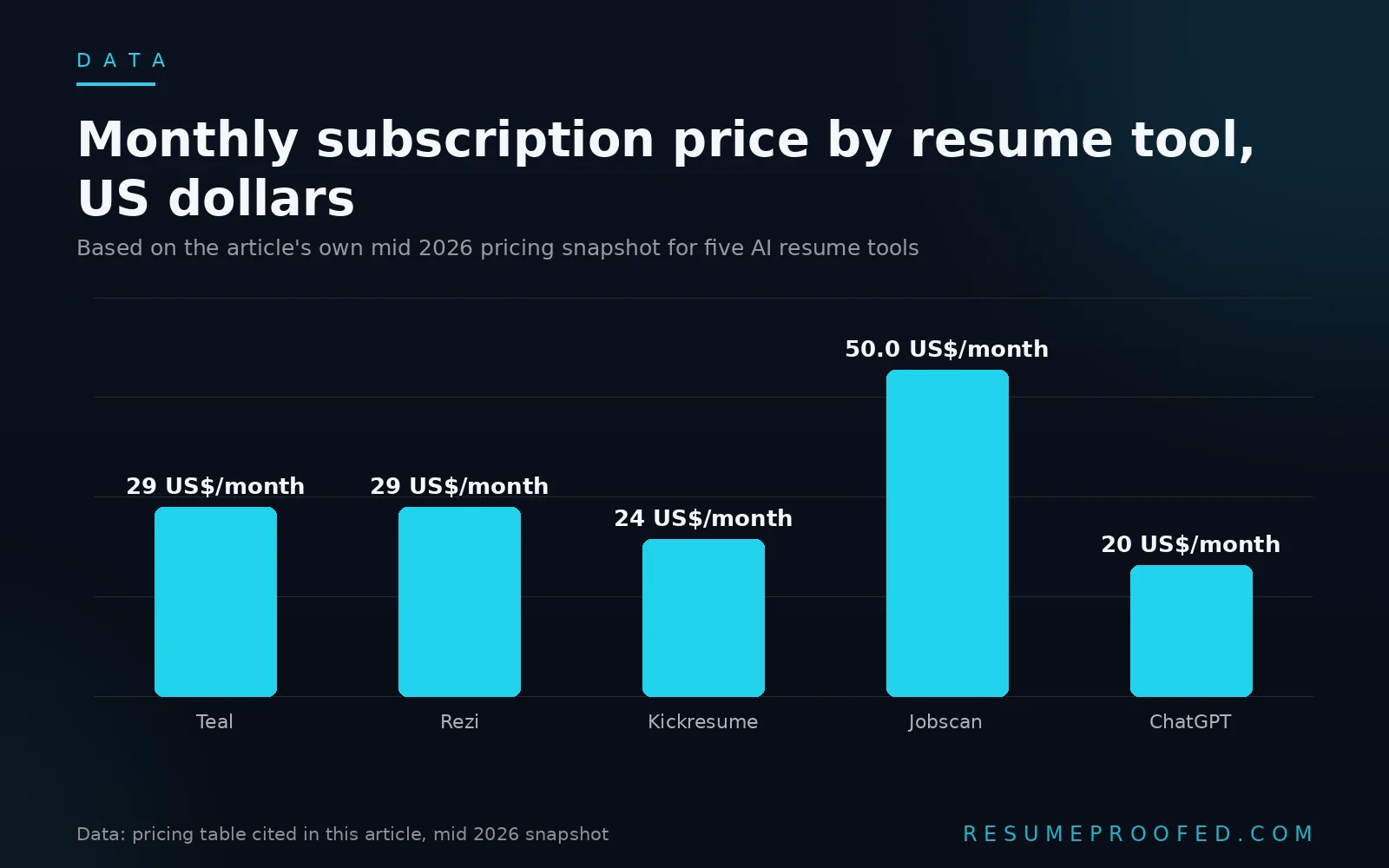
Prices move constantly and every vendor changes plans without notice, so treat the figures below as an approximate, mid-2026 snapshot rather than gospel, and check each vendor's own pricing page before you commit a card.
| Tool | Category | What it produces | Price (about, as of mid 2026) | Best for |
|---|---|---|---|---|
| Teal | Builder with AI assist | Job tracker plus AI-suggested bullets, generated from the job ad's language | Free tier; Teal+ about US$29/month, about US$79/quarter | Tracking applications with light AI help alongside |
| Rezi | Builder | ATS-focused templates with an AI writer and built-in score | Free tier limited; Pro about US$29/month, lifetime option around US$149 | Building a first resume from a blank page |
| Kickresume | Builder | Designed templates and an AI writer for a fast first draft | About US$24/month, cheaper on quarterly (about US$18/month) or annual (about US$8/month) billing | A professionally designed resume, fast |
| Jobscan | Scorer | Match rate, keyword gap report, formatting warnings, no rewriting | About US$49.95/month, about US$29.98/month billed quarterly | A diagnostic pass if you already know how to act on it |
| ChatGPT (DIY) | General AI, manually operated | Whatever you prompt it to write, with no memory of your evidence between sessions | Free tier available; Plus about US$20/month, Go about US$8/month | People willing to build and paste their own fact sheet every time |
| ResumeProofed | Tailoring tool | A resume and cover letter tailored per job from evidence you confirmed once | Free: 2 generations. Essential A$29/month (50/month). Pro A$59/month (150/month) | People who want the actual rewrite, not another score or template |
If you are weighing a resume tailoring tool vs resume builder decision and you are still not sure which side of that line a specific product sits on, the test from the definitions section above is the one to apply: does it invent phrasing from the job ad, or does it draw from something you confirmed you actually did? That single question sorts most of this table.
Six tools, reviewed honestly
Teal is the closest thing to a tailoring tool in the builder camp, mostly because of how good its job tracker is alongside the resume features. Teal+ adds AI-suggested bullets and deeper keyword matching, but the suggestions lean toward generating plausible phrasing straight from the job description rather than working from evidence you confirmed ahead of time. Treat every generated bullet as a draft to check against what you actually did, not a finished sentence.
Rezi is a resume builder first, with an AI writer and a built-in ATS-style score. It earns its reputation with format guardrails baked into the templates, useful if you are starting from nothing. Like Teal, its AI content is written to match the job ad's vocabulary rather than sourced from a fact set you have verified line by line, so the review step is still yours to do, every time.
Kickresume leans hardest into design, and its templates genuinely look good. Its AI writer drafts content quickly, which makes it a reasonable pick if a polished first impression matters more to you right now than keyword precision or evidence tracking. It is not built around per-application tailoring at all; you are meant to produce one strong resume and adjust it lightly, which puts it closer to a builder than anything else on this list.
Jobscan does not tailor anything, and it does not claim to, which is honestly more comfortable than a builder pretending its AI button is a tailoring feature. What it does well is diagnosis: a match percentage, a keyword gap list, formatting warnings for the things that commonly confuse a parser. If what you actually want is the rewrite, not the report, Jobscan was never built to give you that, and no plan tier changes that fact. Our full Jobscan alternatives roundup goes deeper on where it fits and where it falls short if a score is genuinely what you are after.
ChatGPT, used manually, is the honest free option and it deserves a fair hearing rather than a dismissal. If you paste your work history and a job ad into a good prompt, you can get a competent rewritten bullet for free, or for US$20 a month on Plus if you want a faster, more capable model. The catch is that it has no memory of your evidence between sessions unless you rebuild the context every time or keep your own separate fact document to paste in alongside the job ad, and it will happily generate a fluent, confident sentence about something you never actually did if your prompt is loose about the difference between "true" and "sounds plausible." As an AI resume tailoring tool, it is entirely capable, provided you supply the discipline a purpose-built product would otherwise supply for you. For a one-off application, this is a genuinely fine choice. For your fortieth application this month, the manual overhead adds up fast.
ResumeProofed is the product this blog belongs to, so read this review with that in mind and weigh it against the others above rather than taking our word for it. It takes the position argued through this whole article and builds it into the product directly: you set up a master profile once, an extraction step pulls structured facts out of your existing resume, and you confirm every single one before it can be used anywhere. From there, pasting in a job description generates a tailored resume and cover letter drawing only on evidence you have verified, across four ATS-safe templates, exported as a Word .docx file. Where a fact is genuinely missing, its evidence interview asks you a direct question rather than filling the gap with confident-sounding filler, which is the exact failure mode described above in the Teal and Rezi reviews. Its Proof Score measures how much of a tailored document is backed by confirmed evidence, and it is explicitly not, and never claims to be, an official ATS score, because no such score exists for any tool to claim. The honest limits, stated plainly: it is a young Australian product, the template range is four rather than dozens, and if you want a job tracker or LinkedIn profile grading built into the same tool, it does not do either of those today, so pairing it with Huntr or Teal for tracking is a reasonable combination while that gap remains. What it is built to do, and the reason this whole article exists, is the rewrite itself, done from evidence rather than guesswork, every time you apply.
Common questions
What is a resume tailoring tool?
A resume tailoring tool takes your existing work history as evidence and rewrites a resume, and usually a cover letter, per job application by reordering, reweighting and rephrasing that evidence to match a specific job ad. It is different from a resume builder, which helps you produce one document from a blank page, and different from a resume scorer, which grades a resume you already have without writing anything for you.
Is there a free resume tailoring tool?
ChatGPT's free tier can function as a manual resume tailoring tool if you paste your own fact sheet and the job ad into a careful prompt each time, though it has no memory between sessions and will confidently write sentences you have no evidence for unless you are strict about only asking for things you actually did. Among purpose-built products, ResumeProofed's free tier gives two full tailored generations, and Teal and Huntr both offer usable free tiers for lighter builder-style features.
What is the difference between a resume tailoring tool and a resume builder?
A builder helps you produce a resume from scratch, usually once, with templates and formatting help. A tailoring tool works from existing evidence about you and regenerates a rewritten resume for each individual job application, which means the output changes every time you paste in a new job ad rather than staying fixed after the first draft.
Can a resume tailoring tool guarantee I pass an ATS or get more interviews?
No, and be sceptical of any tool that claims otherwise. No mainstream applicant tracking system issues a public pass or fail score that a third party tool can see, and no honest product can promise interviews, because interview outcomes depend on the recruiter, the specific role and the market, not on software. Our ATS resume score myth piece covers what actually determines whether a resume gets found in the first place.
Do these tools use AI to write content that is not true?
Some do, and it is the single biggest risk in this category. A tool that generates language directly from the job ad's wording, without checking it against evidence you confirmed, will happily produce a fluent sentence about a skill you do not really have at the level implied. Ask any tool you are evaluating a direct question: does a generated bullet trace back to something you confirmed, or is it generated to sound like a match. The honest ones will have a clear answer.
Is Jobscan a resume tailoring tool?
No. Jobscan is a resume scorer: it reports a match percentage and a keyword gap between your resume and a job ad, but it does not rewrite anything for you. You still have to do the tailoring yourself after reading its report, which is the core distinction this whole article is built around.
Try ResumeProofed free: two tailored applications on the house, no card required.