Jobscan alternatives: what to use instead in 2026
Jobscan charges US$49.95 a month for a resume score. Here are the real alternatives, what each one does, and why a score alone never fixes anything.
- ATS
- Résumé writing
- Job search tools
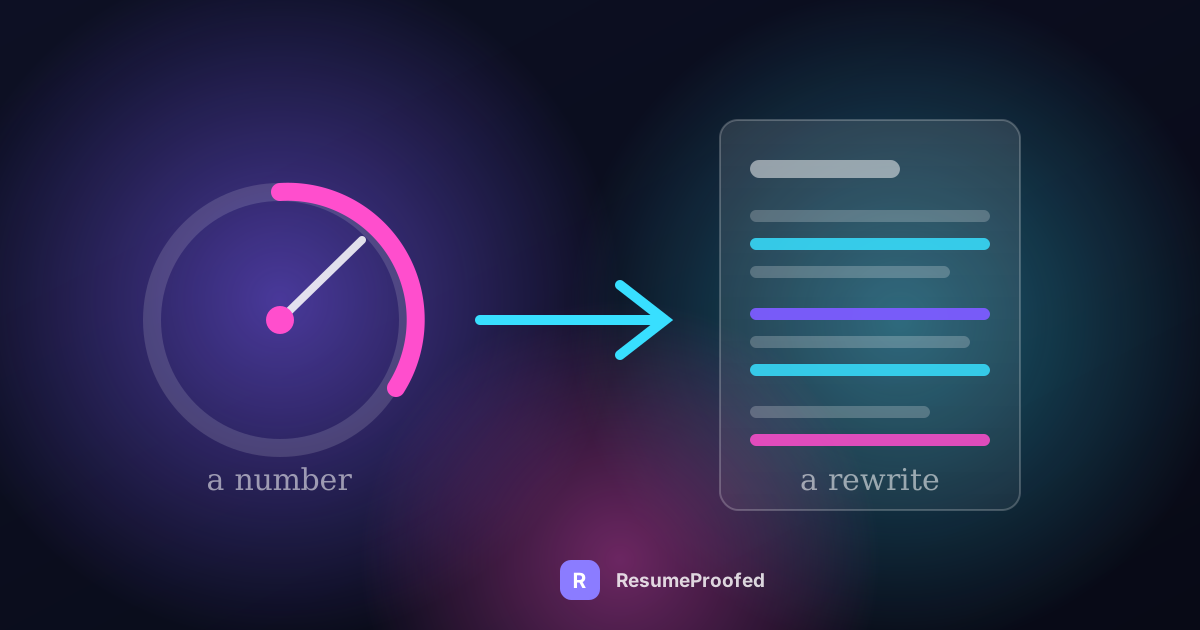
You have been paying US$49.95 a month for a number. Jobscan tells you your resume matches a job description at 68 percent, or 74, or 82, and then it is up to you to work out what to actually change and how to phrase it without lying. That gap between the score and the fix is where most job seekers get stuck, and it is the reason so many people go looking for a Jobscan alternative.

Here is the position most comparison posts will not take: the majority of Jobscan alternatives are score clones. They read your resume, read the job ad, count the keyword overlap, and hand you a percentage with a slightly different colour scheme. A score tells you what is wrong. It does not fix it, and it never did. The real split in this category is not between tools that score well and tools that score better. It is between tools that measure your resume and tools that rewrite it, and once you see that split, most of these comparisons get much easier to make.
What Jobscan actually does well
Credit where it is due, because Jobscan built the category and it is not a bad product.
Jobscan's core scan compares your resume text against a pasted job description and reports a match rate, a list of hard skills and soft skills found or missing, and formatting warnings for things that commonly confuse a parser (tables, columns, headers with contact details in them). For a first pass at a resume you have not touched in two years, that is genuinely useful. It will catch the job title you forgot to translate into standard language, the certification you mentioned once and should mention twice, and the section heading that reads "Where I've Made Magic" instead of "Experience." Our ATS resume score myth piece goes into why no applicant tracking system actually issues that percentage the way Jobscan implies, but the underlying keyword gap analysis it runs is still a reasonable diagnostic. It also covers LinkedIn optimisation and cover letter scanning, and its Power Edit feature will let you swap in suggested phrases directly.
What it does not do is write anything for you from scratch, connect the gaps it finds to your actual work history, or ask you a single question about what you have done. It hands you a list. You still do the writing, the deciding what is true, and the rephrasing, every single time you apply. At US$49.95 a month for that, a lot of people start counting how many applications they would need to send to make the subscription worth it.
The real problem: a score is a diagnosis, not a treatment
This is the part worth sitting with before you compare a single feature list.
Imagine you get your Jobscan result back and it says you are missing "stakeholder management," "SQL," and "cross functional." Now what? You cannot paste those words into your skills section and call it done, because a recruiter reading past the first ten seconds will notice a bullet point that says "Cross functional stakeholder management, SQL" attached to nothing. You need to remember a specific project where you actually did stakeholder management, phrase it as a bullet with a number in it, decide whether "SQL" belongs under a tool you touched twice or a skill you use weekly, and do this for every gap, for every application, for as long as you are job hunting.
A score tool optimises for telling you the truth about the gap. It has no opinion about how you close it, because closing it requires knowing your actual career, and a keyword matcher does not know anything about you beyond the text you pasted in. That is the ceiling on the entire category of score-only tools, and it is why the honest answer to "which Jobscan alternative is best" depends entirely on whether you want a better diagnosis or an actual rewrite.
What actually matters when you evaluate an alternative

Strip away the marketing pages and there are really five questions worth asking about any tool in this space.
- Does it score, or does it write? Scoring tells you what is missing. Writing produces the sentence that fills the gap. These are different products even when they share a UI.
- Where does the language in a rewritten bullet come from? If a tool generates content, ask whether it is drawing from facts you confirmed, or generating plausible sounding claims from the job ad itself. The second one is a fabrication risk dressed up as a feature.
- Does it survive a parser? A beautifully formatted resume that a real applicant tracking system reads as a wall of scrambled text has solved the wrong problem. Templates matter more than most tools admit.
- What does it actually cost per application, not per month? A US$49.95 monthly fee used for three applications costs more per application than a US$29 one used for fifteen. Do this maths before you subscribe to anything.
- Does it help you find the right words in the job ad itself, or just count them? Our piece on finding the real keywords in a job ad covers how recruiters actually search a database of applicants, which is the mechanism every one of these tools is trying to help you pass.
A worked example: one job description, six tools
Take a real scenario. You are applying for a Senior Data Analyst role. The job ad asks for five years of experience, SQL and Python, Tableau dashboard work, stakeholder communication with non-technical teams, and experience mentoring junior analysts. Your current resume is two years old, written for a different, more junior title, and it undersells the mentoring you have actually done because you never thought to write it down.
Run that resume and that job ad through a pure scanner and you get a report: 61 percent match, missing "Tableau," missing "mentoring," "Python" underused, formatting flagged for a two column layout. Accurate, and not remotely enough on its own. You now need to remember which of your three most recent roles actually used Tableau, write a bullet about mentoring that did not exist on the page five minutes ago, restructure the layout into a single column, and decide how much of your Python use to claim given you mostly used it for one script a quarter.
A rewriting tool with a verified profile behind it handles this differently. It already knows, because you told it once, that you built four Tableau dashboards for the finance team in your current role and that you have informally mentored two junior analysts for the past year, even though neither of those facts made it onto your old resume. When you paste in the Senior Data Analyst ad, it pulls those specific, true facts forward, phrases them against this job's language, and produces a bullet like "Built four Tableau dashboards adopted by the finance team for monthly reporting" instead of leaving you to reconstruct that from memory under deadline. The score tool told you Tableau was missing. The rewrite tool found the Tableau you already had and put it on the page.
That is the entire distinction this article is arguing for. It is not abstract, it shows up every time you apply.
The alternatives, compared
| Tool | What it does | Price (about, mid 2026) | Best for |
|---|---|---|---|
| Jobscan | Scores resume against job ad, keyword gap report, formatting checks | About US$49.95/month, or about US$29.98/month billed quarterly | A first diagnostic pass if you already know how to rewrite |
| Teal | Job tracker plus AI-assisted resume bullets and a free base tier | Free tier available; Teal+ about US$29/month, about US$79/quarter | People who want tracking and light AI help in one place |
| Rezi | ATS-focused resume builder with AI content suggestions and scoring | Free tier limited; Pro about US$29/month, lifetime option around US$149 | Building a resume from a blank page with format guardrails |
| Resume Worded | Scores resume and LinkedIn profile, line-by-line feedback | About US$49/month, cheaper on quarterly or annual plans | Line editing an existing resume and a LinkedIn profile together |
| Kickresume | Resume and cover letter builder with templates and an AI writer | About US$19 to 24/month, cheaper on quarterly or annual billing | Designed templates and a fast first draft |
| Huntr | Job application tracker with an attached resume builder | Free tier tracks up to 100 jobs; Pro about US$40/month | Managing a high volume of applications in one dashboard |
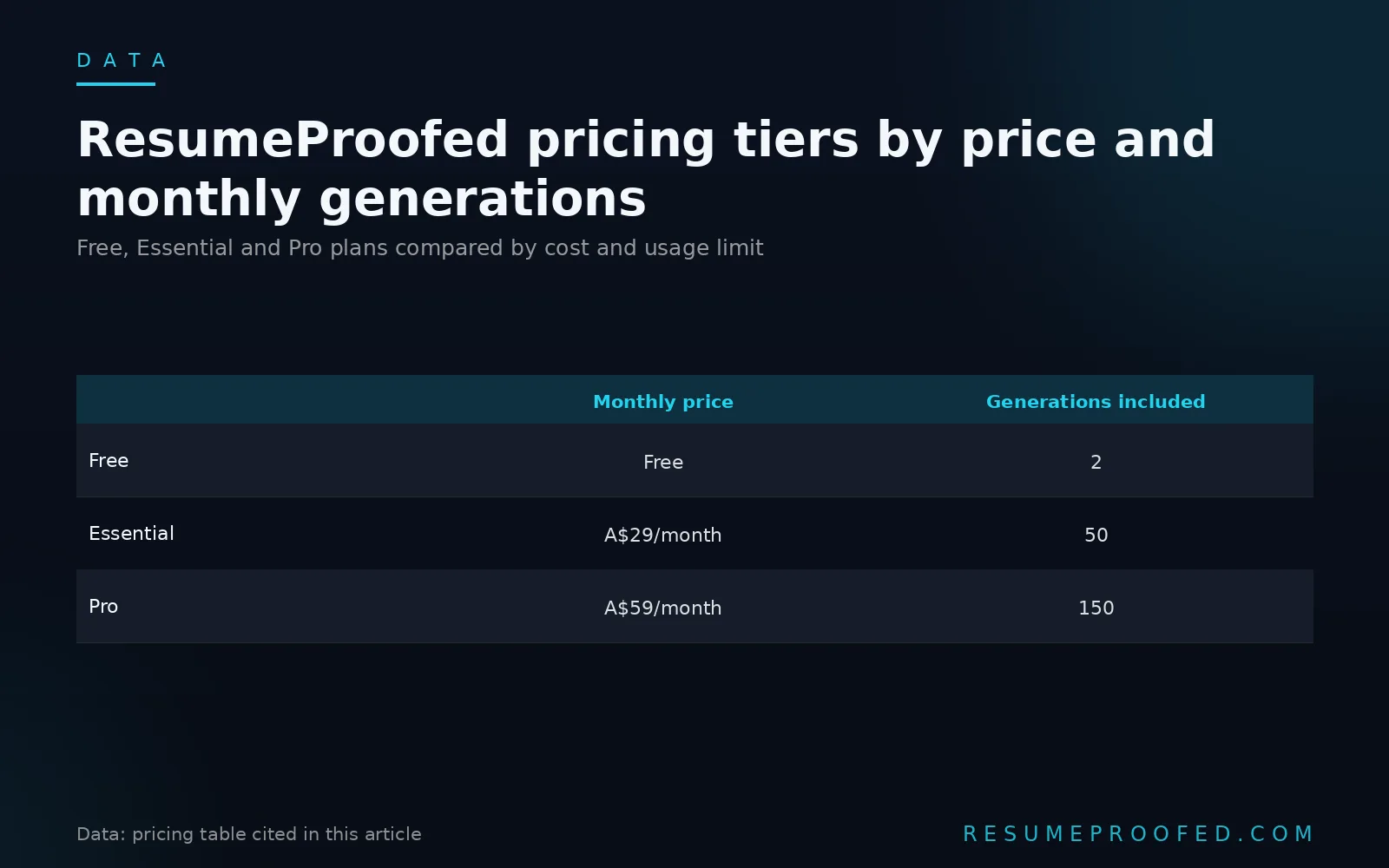
| ResumeProofed | Builds a verified fact profile once, then tailors a resume and cover letter per job from only confirmed evidence | Free: 2 generations. Essential A$29/month (50/month). Pro A$59/month (150/month) | People who want a tailored, honest rewrite each time, not another score |
Prices move and every vendor changes plans without much notice, so treat the figures above as a mid-2026 snapshot rather than gospel. Check each tool's own pricing page before you commit a card.
Six alternatives, reviewed honestly

Teal is closest to a Jobscan alternative that also wants to be your job tracker. Its free tier covers basic resume building and application tracking, and Teal+ adds AI-assisted bullet suggestions and deeper keyword matching. The AI writing leans toward generating plausible phrasing from the job description rather than working from a verified fact base, so it is worth checking every generated bullet against what you actually did before you send it.
Rezi is a resume builder first, with an AI writer and an ATS-style score built in. It is strong if you are starting from nothing and want format guardrails baked into the templates, and its scoring is transparent about what it is checking. Like most tools in this list, the AI content it suggests is written to match the job ad, not sourced from a fact set you confirmed line by line, so review is still on you.
Resume Worded is the most "grading" of the group. It gives detailed, almost line-editor style feedback on both your resume and your LinkedIn profile, which is useful if you already have a strong resume and want a second pair of eyes rather than a rewrite. It does not generate new content for you; it tells you what to change and you make the change yourself.
Kickresume leans hardest into design. Its templates look genuinely good, and its AI writer will draft content quickly. If your priority is a resume that looks professionally designed on a first pass, it is a reasonable choice. It is less focused on the keyword matching and ATS diagnosis that Jobscan built its name on, so pair it with a separate check if parsing is your main worry.
Huntr solves a different problem well: it is a Kanban-style tracker for the applications themselves, with a resume builder attached rather than the other way round. If your actual pain point is losing track of which version of your resume went to which company, Huntr is arguably a better fit than any pure scoring tool, because tracking, not scoring, is what it is built for.
ResumeProofed is the product this blog belongs to, so read this one with that in mind. It takes the position argued above literally: you build a master profile once, an AI extraction step pulls structured facts out of your existing resume, and you review and confirm every single one before anything is used, nothing is invented on your behalf. From there, pasting a job description generates a tailored resume and cover letter using only the evidence you have verified, across four ATS-safe templates, exported as a Word .docx file. Where it asks you a direct question rather than filling a gap with a guess is its evidence interview: if the job wants stakeholder management and your profile has nothing that proves it, it asks you, instead of writing a bullet that sounds right and might not be true. Its own Proof Score measures how well your tailored resume is backed by confirmed evidence, and it is explicitly not, and never claims to be, an official ATS score, because no such score exists to claim. The honest limits: it is a young Australian product, the template range is currently four rather than dozens, and if you want a job tracker or LinkedIn profile grading in the same tool, it does not do either of those today. What it is built to do is the rewrite, not just the score, and that is the one gap this whole article has been describing.
Common questions
What is the best free Jobscan alternative?
Teal and Huntr both offer usable free tiers, Teal for basic resume building and tracking, Huntr for tracking up to 100 applications with a resume builder attached. ResumeProofed's free tier gives two full tailored generations rather than unlimited light features, which is enough to test whether the rewrite approach suits you before paying for anything.
Is Jobscan worth the monthly price?
It depends on how many applications you send and whether you already know how to act on a keyword gap report. At roughly US$49.95 a month, Jobscan is worth it if you are running a high volume job search and want a fast diagnostic, and it is poor value if you only apply to a handful of roles or if you need the actual rewrite done for you, since Jobscan will not write that rewrite.
Do any of these tools guarantee an ATS pass or more interviews?
No, and be wary of any that claims to. No mainstream applicant tracking system issues a pass or fail score that a third party tool can see or guarantee against, and no honest tool can promise interviews, because interview outcomes depend on the recruiter, the role and the market, not on software. Our ATS score myth piece explains what actually determines whether a resume is found.
Can AI resume tools detect or beat AI detection software used by recruiters?
No credible tool can reliably do either, and none of the alternatives compared here claim to. Most hiring teams are not running AI detection on resumes in the first place; the actual filter is a recruiter's keyword search and a fast human read, which is a different problem entirely from evading a detector.
What is the difference between a resume scorer and a resume tailoring tool?
A scorer reads your resume against a job ad and reports what matches and what is missing, leaving you to rewrite it yourself. A tailoring tool generates the rewritten bullets and sections directly, ideally from evidence you have confirmed rather than invented language, which is the distinction this whole comparison rests on.
Is Teal or Rezi better than Jobscan?
Neither is a straight replacement, because they solve slightly different problems: Teal adds job tracking, Rezi adds guided resume building from scratch, and Jobscan focuses narrowly on the match score and gap report. Choose based on which step of the process you are actually stuck on, not on which tool has the higher star rating.
Try ResumeProofed free: two tailored applications on the house, no card required.