How many jobs should you apply for each week?
The real answer isn't a single number. Here's the math on tailored applications per week, real conversion data, and a weekly plan you can copy.
- Job search
- Job applications
- Career strategy
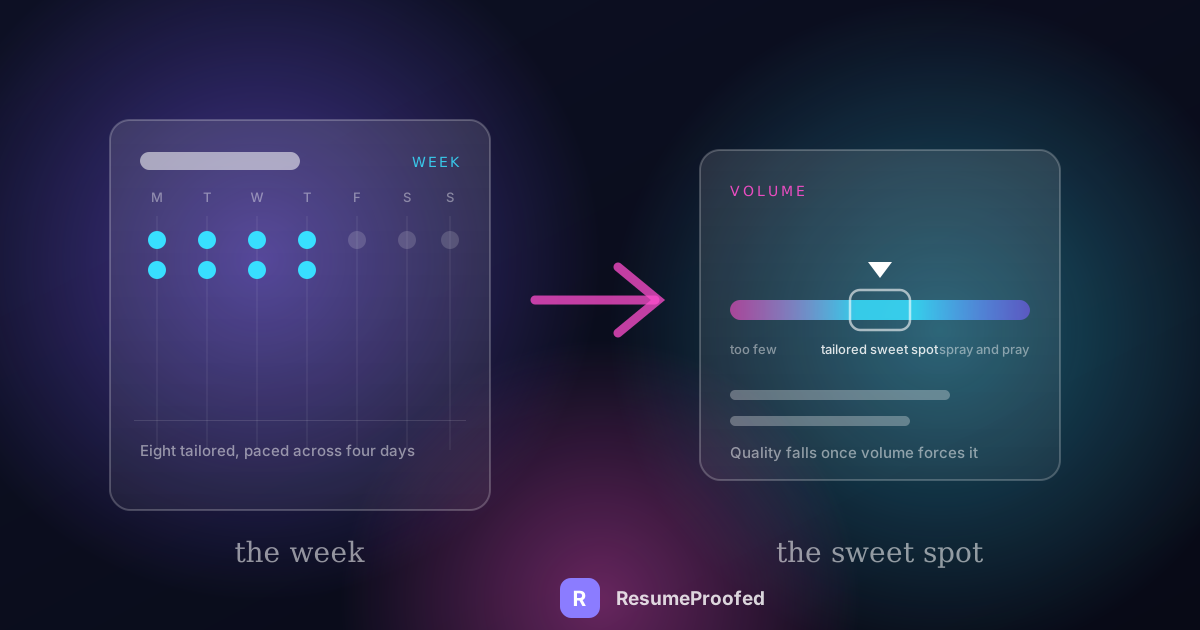
Short answer: if you're searching while employed, aim for five to fifteen properly tailored applications a week. If you're searching full time, fifteen to twenty five. That range comes out of arithmetic you can check yourself, not a number borrowed from a listicle, and the arithmetic is in the next section.
The longer answer is more useful, and it's this: the count of applications you send each week is close to the least important number in your search. What matters is how many of them are tailored, and there is a real, measurable point past which sending more applications makes your results worse rather than better. Most advice on this topic skips both of those facts and just gives you a round number to hit. This one shows the working.
The maths behind the number

Start from time, not from a target. A properly tailored application, one where you've actually read the job ad, adjusted the top third of your resume to speak to it, and checked the result still tells the truth, realistically takes somewhere between twenty and forty minutes once you have a solid master resume to work from. Less than that and you're not really tailoring, you're just swapping a company name at the top of a generic document.
Now budget your week honestly. Someone searching while holding down a full time job might have five to eight hours a week they can genuinely give to applications, spread across evenings and one weekend session. At twenty to forty minutes each, that's eight to fifteen tailored applications. Someone searching full time might reasonably give fifteen to twenty hours a week to the whole process, applications plus research plus networking, of which maybe half goes to writing and sending, which lands you at fifteen to thirty tailored applications.
That's the entire basis for the range at the top of this article. It isn't a magic constant pulled from a study, it's what falls out of a realistic time budget once you refuse to let "tailored" mean less than fifteen minutes of actual attention per application. If your available hours differ from the ones above, redo the arithmetic with your own numbers, the method matters more than the specific result.
What the conversion data actually says
The reason the maths above insists on tailoring rather than raw count is that recent hiring data shows the average application converting worse than it used to, and applying at higher volume hasn't closed the gap.
Gem's 2026 Recruiting Benchmarks report, built from more than 165 million applications and 1.2 million actual hires tracked between mid 2021 and mid 2025, puts the global median applicant to interview conversion rate at 3.6 to 4.7 percent, with applicant to hire conversion sitting near 0.5 percent across roles. The same report found referred candidates convert at roughly eleven times the rate of a cold inbound application, and that directly sourced candidates produced about eleven percent of all hires from just 2.6 percent of total applications received, a four times yield over the general applicant pool. See the Gem 2026 Recruiting Benchmarks report.
Ashby's 2026 Talent Trends data tells a similar story from a different angle. Drawn from more than 100 million applications across over 200,000 roles on its platform, it found applications per hire have roughly tripled since 2021 and now sit above 300 on average, while a candidate today is about fifty percent less likely to land an interview than a candidate applying to a comparable role five years ago. Full detail is in Ashby's Talent Trends Report.
Greenhouse's 2026 Hiring Benchmarks, compiled from more than 6,000 companies and 640 million applications between 2022 and 2025, shows applications per job posting climbing from 116 to 244 over that period, a rise of 111 percent, while median time to fill a role rose from roughly 44 days to roughly 60 days across the same window. See the Greenhouse Hiring Benchmarks report.
These three don't agree on an exact interview conversion percentage, and it's worth saying plainly why rather than picking the flattering one. They're pulled from different employer bases, different mixes of company size and industry, and each platform likely defines "interview stage" a little differently in its own pipeline data. Treat the specific percentages as directional, not exact. What all three agree on, without exception, is the direction: raw application volume across the market has risen sharply since 2021, and an individual applicant's odds per application have fallen. Sending more of the same kind of application into that environment doesn't fight the trend, it adds to it.
Applications aren't the unit that matters

Here's the argument this data actually supports: a tailored application and an untailored one are not the same unit, and treating them as interchangeable is where "just apply to more jobs" advice goes wrong.
The referral and direct-sourcing numbers above are the clearest evidence of this inside the same funnel. Referred candidates aren't eleven times better qualified than cold applicants, on average they're not different people at all, they're the same pool of candidates arriving through a channel that skips the anonymous keyword search most cold applications get filtered through first. Directly sourced candidates converting at four times the general rate is the same mechanism from the recruiter's side: targeting beats broadcasting, consistently, at every stage measured.
That's also where the ceiling in the maths above comes from. If you have ten hours a week and you spend twenty minutes tailoring each application, you can send thirty. Push past that by cutting corners, ten minutes each instead of twenty, and you can technically send sixty, but at that point you've stopped tailoring in any way that changes the outcome, you're back to swapping a company name. The extra thirty applications don't add thirty chances, they add thirty near-zero-value submissions that also cost you the time and attention a genuinely tailored application needs. Past a certain point, more volume is not neutral, it actively displaces the quality that was doing the actual work. Why you're not getting interviews covers the diagnostic side of this in more depth if a low response rate is the problem you're actually trying to solve.
When spray and pray is actually rational

None of the above means high volume is always wrong. There are markets where sending more, less individually tailored applications is a genuinely sound strategy, not a shortcut you're settling for.
Entry-level, high-turnover roles are the clearest case: retail, hospitality, warehouse and logistics, aged care and other community services roles. SEEK's own employment reporting has repeatedly shown application activity concentrated in exactly these categories, and the reason tailoring returns less here is structural, not about effort. Employers hiring for a dozen similar roles a month, with light screening and fast backfill needs, are not differentiating candidates on the strength of a customised top third of a resume, they're differentiating on availability, right to work, and basic fit. A slightly generic application that lands on time beats a beautifully tailored one that arrives a week late because you spent an hour perfecting it.
Contract and temp staffing markets work similarly. Agencies often want a broad pipeline of candidates on file across several similar roles at once, and the qualifying bar per application is lower because a recruiter, not an algorithm, is doing the first-pass matching by hand across their existing pool. In both cases, the honest move is to flip the ratio from this article's default: spend less time per application and more applications per week, because the marginal value of tailoring in these specific markets is genuinely lower, not because tailoring stopped mattering everywhere.
When it's self-defeating
The same strategy applied to a mid-level, senior, or specialist role tends to backfire, and it's worth being specific about why rather than just asserting it. These roles are differentiated: two titles that look similar on a job board can want very different things underneath, deep technical depth versus stakeholder management, individual contribution versus team leadership. A resume tuned for neither reads as generically competent, which converts worse than a resume that reads as a strong fit for something slightly different. Volume can't fix that, because the problem isn't exposure, it's fit, and untargeted volume doesn't create fit, it just spends more of your limited time not creating it.
There's a second cost that's easy to miss: reputational, not just statistical. Recruiters at busy companies, and staffing agencies working several roles for the same client, do notice repeat cold submissions from the same untailored resume across multiple similar postings in a short window. It doesn't read as effort, it reads as a mass submission, and it can quietly work against you at exactly the employers you'd most want to convert. What a master resume actually is is worth reading if the reason you're tempted to skip tailoring is that starting from scratch each time feels too slow, because a good master resume is what makes the twenty-minute tailoring pass in the maths above realistic instead of aspirational.
The burnout and rejection volume, honestly
There's a version of "just apply to more jobs" that isn't a strategy at all, it's a coping mechanism, and it deserves an honest paragraph rather than being folded quietly into a productivity tip.
Resume Genius's 2025 Mental Health and Employability report, surveying 1,000 active US job seekers, found that 72 percent said the job search had harmed their mental health. Given the conversion numbers above, that's not surprising: a process where the large majority of effort produces silence is going to wear on anyone, and it's reasonable, not a personal failing, if it does. Read the Resume Genius Mental Health and Employability report for the fuller picture.
The uncomfortable part is that pushing volume higher in response to that anxiety, sending more because doing something feels better than sitting with the silence, usually doesn't help the number that matters. Given conversion rates sitting in the low single digits regardless of volume, doubling your weekly count roughly doubles your weekly rejection exposure without a proportional rise in interviews, especially once quality per application starts dropping as covered above. A defensible weekly cap, the kind this article is arguing for, isn't just a productivity choice, it's also a reasonable way to keep the process survivable over the weeks or months it can genuinely take. In Australia, the Bureau of Statistics put the national unemployment rate at 4.2 percent as of July 2025, with a meaningful share of that group counted as long-term unemployed, people for whom this compounding effect isn't hypothetical.
Track what you send
None of the numbers above are useful to you personally unless you know your own conversion rate, and that requires tracking, not memory. A simple weekly log, a spreadsheet is enough, doesn't need more than five columns: the role and company, the date you applied, whether the application was genuinely tailored or a faster, lighter-touch send, and what happened next. After four to six weeks you'll have enough data to tell whether your personal conversion rate is near the 3.6 to 4.7 percent range the benchmarks above describe, well under it, which usually points to a targeting or format problem worth diagnosing, or well over it, in which case whatever you're doing is working and the only lever left is volume within your available hours. Teal vs Jobscan covers a free tracker option if a spreadsheet isn't going to survive contact with a busy week.
A simple week you can copy
This is one reasonable way to structure a week at the employed-search end of the range, roughly eight tailored applications, adjust the daily counts up if you're searching full time.
Monday: spend thirty to forty minutes sourcing new listings and shortlisting five to eight that are genuine fits, not just plausible ones. Update your tracker with anything still open from last week.
Tuesday to Thursday: two tailored applications a day, each getting a proper twenty to forty minute pass against the specific ad. Working from a locked master resume makes this realistic on a weeknight; ResumeProofed exists specifically to make that pass faster by generating a tailored draft from a confirmed set of facts rather than a blank page, though a spreadsheet and your own editing does the same job more slowly.
Friday: follow up on anything you applied to ten to fourteen days ago and haven't heard from, log the week's numbers in your tracker, and take stock of your running conversion rate rather than only your running application count.
Weekend, optional: if you're in a high-volume entry-level or contract market, this is where extra lighter-touch applications belong, outside the tailored budget above, not instead of it.
Repeat for four to six weeks before judging the pace itself. A single quiet week, even at the right pace, tells you very little, given how much of this process is genuinely governed by timing and market conditions outside your control.
Common questions
How many job applications should I send per week?
Five to fifteen properly tailored applications a week if you're searching while employed, fifteen to twenty five if you're searching full time. That range comes from budgeting twenty to forty minutes per genuinely tailored application against realistic weekly hours, not from a fixed rule, so adjust it to your own available time.
Is applying to more jobs always better?
No. Past the point where extra volume forces you to cut tailoring time below roughly fifteen minutes per application, additional applications add close to no expected value while displacing the time that a genuinely tailored application needs. In high-turnover entry-level and contract markets this trade-off shifts and higher volume with lighter tailoring is often the more rational approach.
What actually counts as a tailored application?
At minimum, reading the specific job ad and adjusting the top third of your resume, the part a recruiter reads first, so it speaks directly to what that ad is asking for, backed by evidence rather than restated responsibilities. It does not require rewriting your history from scratch for every role, which is what a locked master resume is for.
How many applications does it typically take to get one interview?
Recent benchmark data disagrees on the exact figure. Gem's 2026 report puts the global median applicant to interview rate at 3.6 to 4.7 percent, while Ashby's data shows candidates about fifty percent less likely to land an interview than five years ago. Treat any single percentage as directional rather than a fixed rule for your own search, and use your own tracked conversion rate once you have four to six weeks of data.
Is it rational to mass apply for entry-level jobs?
Often, yes. In high-turnover categories like retail, hospitality, warehouse and logistics, and aged care and community services, employers are typically screening on availability and basic fit rather than a finely tailored resume, so a higher volume of lighter-touch applications tends to outperform spending an hour tailoring each one.
How do I know if I'm applying too much or too little?
Track your applications for four to six weeks, tagging each as tailored or not, and compare your resulting conversion rate to the roughly 3.6 to 4.7 percent benchmark range cited above. A rate well below that alongside high volume points to a targeting or format problem, not a volume problem. A rate at or above it means your current approach is working and the only lever left is how many hours you can give it.
Try ResumeProofed free: two tailored applications on the house, no card required.