Job offers are being pulled more often in 2026: warning signs to watch
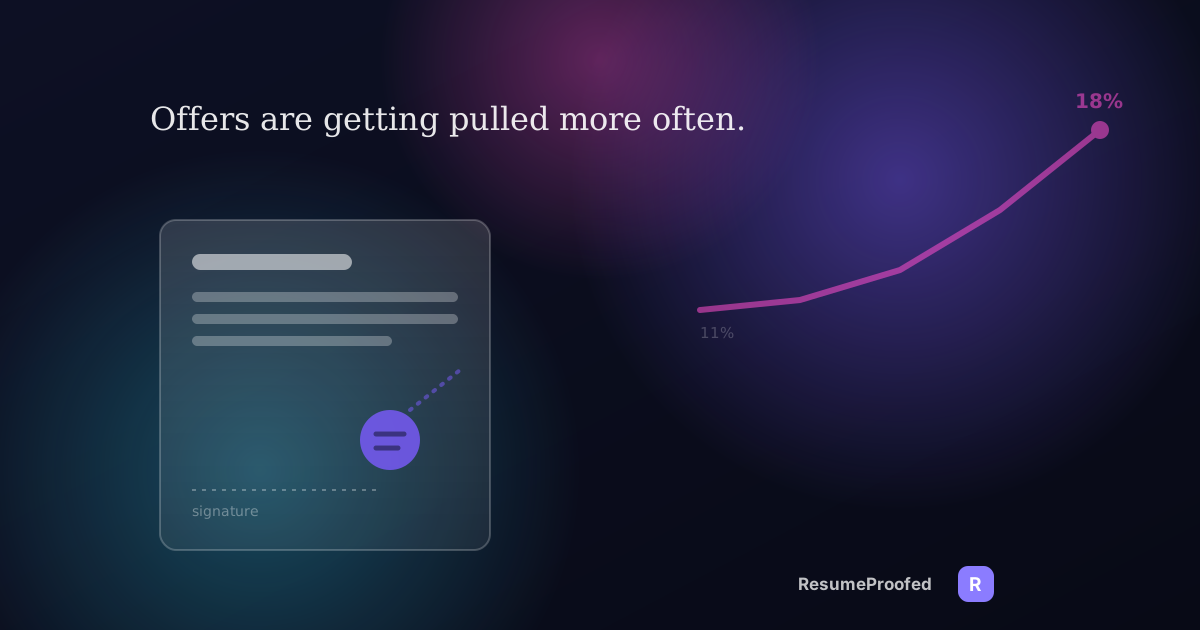
18% of job seekers had an offer withdrawn in Q1 2026, up sharply from the 2025 rate. Here's what's driving it and how to protect yourself if it happens.
- Job search
- Career strategy
- Job applications
You got the offer, you told your current employer, maybe you turned down another interview because this one was done. Then the email arrives saying the role has been paused, or the offer is being withdrawn, or budget has changed. It happens after the hardest part of the search is supposedly over, which is exactly why it's so disorienting, and current data says it's happening to more people, more often, than it was even a year ago.
The position worth stating first: a rescinded offer is a genuinely new and growing risk in this specific job market, not a rare fluke you can safely ignore, and there are real, checkable warning signs before you sign a lease or resign your current job based on an unsigned offer. This isn't a reason to distrust every offer you receive. It's a reason to know the current base rate and the practical steps that reduce your exposure if the offer you're holding turns out to be one of the ones that doesn't hold.
The numbers: offers are taking longer to arrive, and more are being pulled
Huntr Research's Q1 2026 Job Search Trends Report, built from 139,927 tracked applications submitted by 25,635 active job seekers between January and March 2026, found the median time from search start to first offer climbed to 108 days in Q1 2026, up from 83 days in Q4 2025, a 30 percent jump in a single quarter and the longest median the report has recorded. A separate survey run alongside that data, fielded between 13 April and 3 May 2026 among 593 respondents, found that 18 percent of the 554 who answered the question had an employer withdraw a job offer after extending it during the first quarter of 2026, up sharply from the 11 percent rate recorded across the whole of 2025.
Read those two figures together and the shape of the current market becomes clearer: searches are taking meaningfully longer to produce an offer at all, and a materially larger share of the offers that do arrive are being pulled before they turn into an actual start date. That combination is worse than either figure on its own, because a longer search that also carries a higher chance of the eventual offer falling through changes how you should plan around an offer once you have one, not just how you should feel about the wait beforehand.
The broader strain this sits inside
This isn't an isolated data point. Monster's Job Search Strain survey, fielded 17 March 2026 among 1,003 US job seekers via the Pollfish platform, found that 25 percent of job seekers have now been searching for over a year, 39 percent feel more pressure to get hired than in previous searches, and 46 percent say they're applying more broadly than before, with 64 percent applying outside their usual industry or career track. Two independently fielded 2026 surveys pointing at the same lengthening, higher-stakes search, from two different organisations using two different methodologies, is a stronger signal than either alone, and it's worth reading as a genuine shift in market conditions rather than a run of bad luck concentrated in any one person's search.
Why offers are getting pulled more often right now
A rescinded offer usually isn't personal, and understanding the mechanics helps you read the warning signs rather than just reacting to them after the fact. The most common drivers are budget reapproval falling through after a hiring manager verbally extends an offer but before finance formally signs off, a hiring freeze or reorganisation landing between the offer date and the start date, and, increasingly, a role being paused because the same AI scaled application volume covered elsewhere on this blog means companies are running slower, more layered approval processes even after they've decided who they want. None of these are things you did wrong, and none of them are things you could have detected from the interview alone. They're mostly organisational, not personal, decisions happening after you're out of the room.
Warning signs to watch for before you rely on an offer
A long gap between the verbal offer and the written one. A verbal yes is not a formal offer, and the longer that gap stretches, days turning into more than a week or two, the more likely something is moving slowly or being reconsidered internally on the employer's side. It's reasonable to ask directly when to expect the written offer rather than waiting silently.
Vague or shifting language about the start date. "We'll confirm the exact start date closer to the time" said once is normal. The same line repeated, or a start date that moves more than once before you've even begun, is worth a direct, polite question about whether anything about the role or timeline has changed.
A hiring freeze or restructure in the news about the company. If you see public reporting about layoffs, a freeze, or a leadership change at the company between your offer and your start date, that's a legitimate reason to check in proactively rather than waiting to be told, even if the news doesn't mention your specific team.
Reluctance to put the offer in writing at all. A legitimate offer should include, in writing, the role, start date, salary and reporting line. Persistent vagueness on any of these, especially after you've asked directly, is a stronger signal than any single delay on its own.
A worked example
Say you receive a verbal offer for a program manager role on a Thursday, with a written offer promised "early next week." Ten days pass with no written offer despite one follow up email. Rather than assuming the worst or going silent yourself, you send a brief, professional message: "I'm still very keen to join the team. Could you let me know when I might expect the formal offer letter, since I'll need to give appropriate notice to my current employer once I have it in hand?" This does two useful things: it keeps the process moving without sounding anxious, and it protects you practically, because it means you haven't yet resigned your current role based on a verbal promise alone. If the written offer arrives promptly after that, the delay was likely administrative. If it stalls further or the answer becomes evasive, that's a genuine signal to hold off on resigning or making other commitments until the paperwork is actually in hand.
How to protect yourself financially and practically
Don't resign your current job until you have a signed, written offer, not a verbal one and not an email summarising terms without a formal letter attached. Given the current 18 percent Q1 2026 withdrawal rate, treating a verbal offer as equivalent to a signed one is a meaningfully bigger gamble this year than it would have been in 2025.
Build a longer financial runway into your planning than you might have a year ago. With a median 108 day search to first offer, and a real chance that offer doesn't hold, planning around a shorter timeline risks a genuine cash flow problem if either the search or the offer itself takes longer than expected.
Keep other conversations open for longer than usual, not shorter. The instinct once you have a promising offer is to pause other applications immediately. Given the current withdrawal rate, it's more defensible to keep at least one or two other active conversations moving until your offer is fully signed, rather than closing every door the moment a verbal yes arrives. Our piece on why you're not getting interviews covers the diagnostic steps worth running if you do need to restart a search quickly after a rescinded offer, since the causes of a stalled search are largely the same regardless of why you're back in it.
If an offer is actually rescinded
Ask directly, in writing, for the specific reason, since some organisations are legally required to provide one and it also tells you whether the decision was about the role broadly (useful to know if you're weighing whether to reapply later) or something specific to you (rarer, but worth understanding if so). If you've already given notice at a current job based on a verbal offer that then fell through, some employers will reconsider a rescinded decision if you push back promptly and professionally, though this works less often than people hope. Treat the search as restarting immediately rather than waiting to see if the situation resolves, since the data above shows a resolution in your favour is the less likely outcome once an offer has actually been withdrawn rather than merely delayed.
Common questions
How common is it for a job offer to be rescinded?
More common than in recent years. Huntr Research found 18 percent of job seekers had an offer withdrawn after it was extended in the first quarter of 2026, compared with 11 percent across the whole of 2025, a sharp jump in a single quarter.
Why do companies rescind job offers after extending them?
Common reasons include budget reapproval falling through after a verbal offer, a hiring freeze or restructure occurring between the offer and start dates, and slower internal approval processes even after a hiring decision has been made. Most rescinded offers reflect organisational shifts rather than anything specific to the candidate.
Should I quit my current job as soon as I get a job offer?
Not until you have a signed, written offer letter with the role, salary, start date and reporting line confirmed. A verbal offer or an informal email summary is not the same thing, and with the rescission rate up sharply in Q1 2026 versus 2025, treating the two as equivalent carries more risk right now than it did previously.
How long does it typically take to get a job offer in 2026?
Huntr Research's Q1 2026 data found a median of 108 days from the start of a search to a first offer, up 30 percent from 83 days in the previous quarter and the longest median the report has recorded, based on tracked data from over 25,000 active job seekers.
What should I do if my job offer gets rescinded?
Ask in writing for the specific reason, since it clarifies whether the decision was about the role broadly or something else, and restart your search immediately rather than waiting to see if the offer is reinstated. Treat any other conversations you kept warm during the process as your fastest path back into an active search.
Is the job market actually getting harder in 2026?
Multiple independently fielded 2026 surveys point the same direction. Huntr's data shows search timelines lengthening and offer withdrawals rising, while Monster's Job Search Strain survey found a quarter of job seekers have now been searching for over a year and most report applying more broadly than before, consistent signals of a slower, higher-pressure market rather than an isolated result from a single source.
Where ResumeProofed fits, and where it doesn't
ResumeProofed can't prevent a company from withdrawing an offer, and no honest tool can promise that, since the causes documented above are mostly organisational decisions made well after your resume did its job. What it can do is help you keep a second and third application genuinely ready to go, tailored rather than generic, so if an offer does fall through, restarting your search doesn't also mean starting your materials from scratch.
Try ResumeProofed free: two tailored applications on the house, no card required.