How long does a job search actually take? What the data says
Government labour data puts real numbers on job search length, and the gap between the median and the average explains why it feels endless for some.
- Job search
- Career strategy
- Job applications
Eight weeks in with nothing but rejections and silence, and the question stops being "what am I doing wrong" and becomes "is this actually normal." It's a reasonable thing to lose track of, because almost everything you'll read on this gives you a single confident number, six weeks, three months, six months, without ever explaining why those numbers don't agree with each other. They don't agree because they're measuring different things, and once you see the actual government data behind them, the gap makes a lot more sense than any single average does on its own.

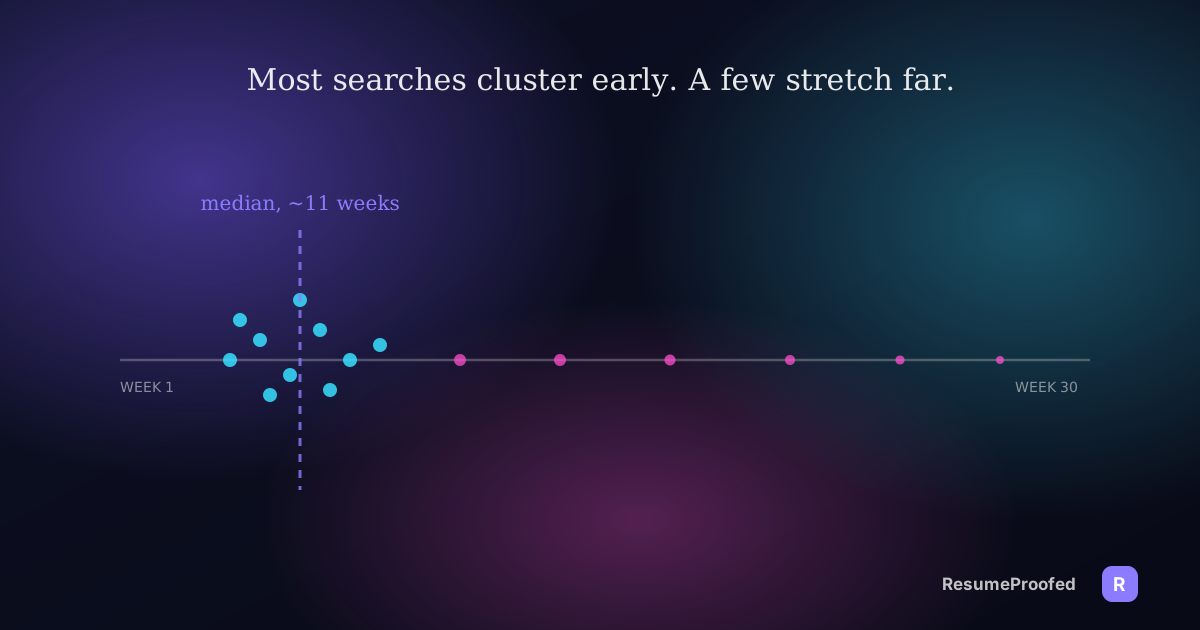
Here's the position worth stating first: there is no one true answer to how long a job search takes, but there is real data on the shape of the distribution, and the shape matters more than the average. Most job seekers land something faster than the number that gets quoted most often. A smaller group gets stuck much longer than that number, and it's that second group dragging the average upward that makes "the average job search" sound worse than what most people actually experience.
What the government's own numbers say

The US Bureau of Labor Statistics tracks duration of unemployment every month as part of the Current Population Survey, and the Federal Reserve Bank of St. Louis republishes that series through its FRED database. As of early 2026, the median duration of unemployment, meaning half of unemployed people had been searching for less time and half for longer, sat at roughly 11 weeks, per the FRED Median Weeks Unemployed series, sourced from BLS data and checked in August 2026. That's the number that should anchor most people's expectations far better than the round "three to six months" figure repeated across most job search content, because it reflects the actual midpoint of everyone currently searching, not a marketing-friendly guess.
The BLS's July 2026 Employment Situation report adds the other half of the picture: the unemployment rate stood at 4.1 percent, and the number of long-term unemployed, people searching for 27 weeks or more, was 1.8 million, accounting for 25.5 percent of everyone unemployed that month. One in four searches, roughly, stretches well past six months. That's the group responsible for the gap between the roughly 11-week median above and the much higher average duration you'll see quoted elsewhere, sometimes in the 20-plus week range, because a mean is dragged upward hard by a smaller number of very long searches in a way a median never is.
Why median and average tell two different stories
This distinction isn't academic pedantry, it's the actual reason the same government data can support both "the average job search is about two and a half months" and "the average job search takes closer to five or six months," depending on which measure a given article picked.
A median tells you the experience of the person exactly in the middle of the distribution. An average, or mean, adds up every single search length and divides by the number of people, which means twenty people who found a job in four weeks and one person who's been searching for sixty weeks produce a mean that looks far worse than what nineteen out of those twenty people actually experienced. Job search duration is exactly this kind of lopsided distribution: most searches resolve in a matter of weeks, and a smaller tail stretches on much longer, pulling the average upward without changing what's typical.
The practical takeaway: if you're a handful of weeks into a search and it feels slow compared to some number you read online, check which measure that number was. Against the median, roughly 11 weeks as of the most recent data, a lot of searches that feel discouragingly long are still tracking close to typical.
What actually predicts getting stuck in the long tail
The 25.5 percent long-term unemployment figure above is the number worth paying attention to, not as a source of dread, but because it points at something genuinely useful: getting past roughly the six-month mark is where a search shifts from "typical, if frustrating" into a materially different, harder-to-exit category. This isn't just a feeling. A field experiment by economists Kory Kroft, Fabian Lange and Matthew Notowidigdo, published in the Quarterly Journal of Economics, sent close to 12,000 fictitious resumes with randomly assigned unemployment spell lengths, from one to 36 months, to around 3,000 real job postings in sales, customer service, administrative and clerical roles across 100 US cities. See the NBER working paper for the full study. Callback rates dropped as the assigned unemployment length grew, and most of that drop happened within the first eight months, a pattern the researchers call duration dependence: employers appear to use spell length itself as a signal, independent of anything else on the resume. Whether or not that's a fair way to judge a candidate, it's a real enough pattern in the data to argue for actively changing your approach well before you'd hit that six-month mark, rather than repeating the same routine for another two months and hoping the outcome shifts on its own.
This is where the volume and quality questions this blog covers elsewhere actually connect to the timeline question. How many jobs should you apply for each week? covers the volume side of this directly, and why you're not getting interviews is the diagnostic to run before you're several months in, not after, since the fixes it describes, tailoring, targeting the right level, cleaning up formatting, are far more useful applied early than as a last resort deep into a long-term search.
A worked example: a checkpoint routine instead of a single deadline

Rather than treating "how long should this take" as one number to hit or miss, run a structured check at fixed points and change something concrete at each one if the numbers below it aren't moving.
Week 4: Track your application-to-response rate, not just whether you have a job yet. If you're sending genuinely tailored applications and getting almost no responses at all, the problem is likely the resume or the targeting, not the timeline, and it's worth fixing now while it's cheap to fix.
Week 8, close to the roughly 11-week median: If you're getting interviews but no offers, the problem has moved downstream, into interview performance or role fit, not the resume. If you're still getting almost no interviews at this point, treat it as a real signal to change your targeting, not a reason to simply send more of the same applications faster.
Week 12 to 16: You're now past the median. That's not a crisis on its own, plenty of searches run longer than the midpoint, but it is the point to honestly widen your search: adjacent titles, adjacent industries, or a hard look at whether your target level is realistic against what's actually landing interviews.
Week 24, approaching the long-term threshold: This is worth a genuine strategy reset rather than a continuation of the same routine, since the data above shows this is roughly where searches start behaving differently. Consider contract or contract-to-hire roles as a way back into continuous employment, lean harder into your network rather than cold applications alone, and treat a short, honest explanation of the gap as something to prepare for rather than avoid, similar to the approach in how to explain a career gap on your resume.
Common questions
How long does the average job search take?
It depends which measure you mean. The median duration of unemployment in the US sat at roughly 11 weeks as of early 2026 government data, meaning half of searches resolve faster than that. The average, or mean, is pulled meaningfully higher by a smaller group of long-term searches, which is why different sources quote very different "average" numbers.
Is a job search that's taking three months normal?
Broadly yes. Three months sits past the roughly 11-week median but well short of the 27-week point that defines long-term unemployment in government data. It's a reasonable point to review your approach, but it isn't, on its own, evidence that something is unusually wrong.
What counts as a long job search?
The US government's own statistics define long-term unemployment as 27 weeks or more, roughly six months, without work while actively searching. As of mid-2026, this group made up around a quarter of all unemployed people, which is a meaningful share but still a minority.
Does taking longer to find a job hurt your chances?
A field experiment published in the Quarterly Journal of Economics found callback rates fell as assigned unemployment spell length grew, with most of the decline happening in the first eight months, a pattern called duration dependence. It's a real enough effect to justify actively adjusting your approach well before a search runs very long, rather than a reason to panic at any specific week count.
Why do some sources say the average job search takes six months and others say two months?
Almost always because one is quoting a median and the other a mean, or because one is measuring unemployment duration broadly and the other something narrower like time from first application to offer for people who found work quickly. Always check which measure a given number is describing before comparing it to your own experience.
What should I do if my job search is taking longer than the median?
Run a structured check on what's actually stalling: response rate to applications, interview-to-offer conversion, or the breadth of roles you're targeting. Passing the median isn't a failure signal by itself, but it is a reasonable point to change something concrete rather than repeating the same routine unchanged.
Where ResumeProofed fits, and where it doesn't
ResumeProofed can't shorten a job search on its own, and no honest tool can promise that. What it changes is the response-rate side of the checkpoint routine above: tailoring each application to the specific job ad's language from a confirmed history of what you've actually done, so that if your search is stalling, you can rule out a generic, unmatched resume as the cause faster and focus your energy on whatever's actually holding things up.
Try ResumeProofed free: two tailored applications on the house, no card required.