How to explain a career gap on your resume (with examples)
Gaps are common now, and hiding them backfires. How to name a career gap on your resume in one honest line, with real example lines to adapt.
- Résumé writing
- Job search
- Career advice
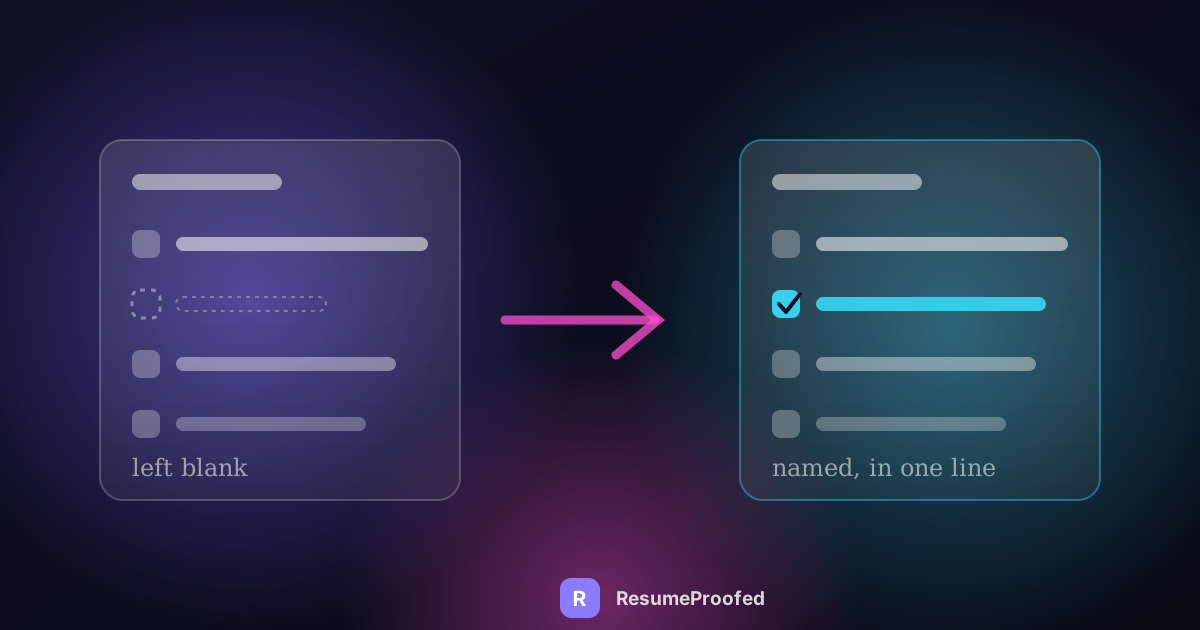
Somewhere on your resume there is a stretch of months, maybe a year or two, with nothing listed against it. You know exactly what happened during that time. The person reading your resume does not, and in the space between what you know and what they can see, they will fill in a story. Left with no information, most people do not default to a generous guess.

Here is the position worth taking early: the gap itself is rarely the problem. The problem is silence, an unexplained blank stretch that hands the reader's imagination the pen, and imagination tends to write worse fiction than the truth. Most of the advice circulating online treats the gap as something to engineer around: switch to a functional resume so the timeline blurs, list only years so a short gap rounds away, describe the time in the vaguest language available and hope nobody asks a follow up question. All of that is a way of avoiding one sentence, and avoidance is usually more visible, and more damaging, than the sentence would have been.
How common gaps actually are, and what the data says about them

Before deciding how to handle a gap, it helps to know how normal one is, because the honest answer is: very. An analysis of roughly 27 million resumes by career site LiveCareer, reported by Forbes in 2025, found that from 2020 to 2025 more than half of workers reported at least a one month gap, and 58 percent had a gap of six months or longer. The share of job seekers with no gap at all had dropped below half by 2025, down nine points from 2020. A separate February 2025 survey of 1,000 US workers by MyPerfectResume found 47 percent had experienced a career break, and while the company reports most employers say they are more understanding of gaps than they used to be, it also found roughly three in ten hiring managers still treat an unexplained gap unfavourably. Both things are true at once: gaps are common, and a meaningful minority of the people reading your resume still hold them against you by default.
Attitudes are shifting, but not all the way to indifferent. A 2024 Harvard Business Review analysis by Boris Groysberg and Eric Lin points to pandemic era unemployment, generational attitude change, and more openness about career breaks on social media as reasons the old stigma has softened. Their research is also direct about the limit of that shift: gaps still measurably reduce the chance of a callback, and the effect grows with the length of the gap. LinkedIn's own 2022 global survey, covering close to 23,000 workers and over 7,000 hiring managers, landed in a similar place: about one in five hiring managers said they would reject a candidate outright over a career break, while 51 percent said they would be more likely to call a candidate back if they understood the context of the gap, and roughly half described career break candidates as an untapped pool of talent worth considering. Read those numbers together and the honest conclusion is not "recruiters don't mind." It is closer to: a fifth of readers are unmoved by any explanation, roughly half will actively respond better once you give them one, and giving them one is the only lever you actually control.
Should you use a functional resume to hide it?
Usually, no. A functional or skills-based resume groups your experience under skill headings instead of a chronological run of roles, and it is the single most common piece of gap advice online, and also the one that tends to backfire hardest, for two separate reasons.
The first is mechanical. Applicant tracking systems are built to recognise a small set of standard section headings, in a predictable reverse-chronological order, with dates and employers sitting next to the roles they belong to. A functional resume disrupts exactly that structure: skills get grouped under headings a parser was never built to expect, dates get pushed to the margins or dropped entirely, and the software either misfiles your history or simply cannot reconstruct a timeline from it at all. We have covered the mechanics of what breaks a parser in more depth in why an ATS may not be reading your resume correctly, and a scrambled or missing timeline is one of the more common causes.
The second reason is human, and it is the one that matters more here. A recruiter who has read thousands of resumes recognises a functional format on sight, and the near universal read is not "efficient" or "well organised." It is "this person is hiding something," which is precisely the impression you were trying to avoid. You have taken an ordinary, explainable gap and wrapped it in a format that itself functions as a red flag, before the recruiter has even worked out what the gap is. A plain, reverse-chronological resume with the gap named in one line does more for you than a format designed to obscure it ever will.
Year-only dating: when it helps and when it looks evasive
Listing only years instead of months and years ("2019 to 2022" rather than "March 2019 to July 2022") is a legitimate, common convention, and it is worth separating two very different uses of it. Using year-only dates consistently across an entire resume, especially for roles from a decade or more ago where the exact month is irrelevant to anyone, is standard practice and raises no questions. Switching to year-only dates specifically around the one gap on an otherwise fully dated resume is a different move entirely: it draws attention to exactly the spot you wanted to smooth over, because a reader doing basic maths will still notice a role ending in 2023 and the next beginning in 2024 could mean anything from a one month gap to an eleven month one, and an inconsistency in your own formatting is itself a small tell. If you use year-only dates, use them everywhere, not selectively around the part you would rather not discuss.
Disclosure rules and norms differ by country and by industry, and this article is not the place for legal advice about what you are obliged to disclose to an employer. What follows is about presentation, not obligation: state what you are comfortable stating, in your own words, and keep it consistent across the document.
Where the explanation goes
The explanation belongs in one place: a single line, treated exactly like a job entry, sitting chronologically where the gap would otherwise be a blank space. Not a paragraph. Not a separate "Career Break" section with its own heading and three sentences of justification. One line, doing the same job as a job title and dates would, because that is functionally what it is.
Family caregiving, 2024 to 2025
That is the whole entry. No elaboration underneath it, no bullet points explaining what caregiving involved. If the gap is your most recent experience and therefore close to the top of the page, the same line can sit in your summary instead: "Returning to full-time work after a period of family caregiving, ready to bring [skill] back into a [role type] position." If the gap predates your most recent role and sits further down the page, the one-line timeline entry is the cleaner option, because it keeps the reader moving through your history in order rather than sending them back up to a summary they have already read.
A cover letter, where you are using one, can carry one additional sentence if the role specifically calls for continuity of experience the resume line does not fully address. The interview is where a longer, comfortable answer belongs, not the page. If you are rewriting your resume from a single master document for each job you apply to, the gap line does not need to change between applications the way the rest of the page does. It is a fact, not a pitch, and it reads the same to every reader.
How to phrase it: examples for common situations
Keep each line to a fact plus a timeframe. No apology, no elaborate justification, no adjectives doing emotional work. Adapt any of these directly.
Caregiving. "Primary carer for a parent following a stroke diagnosis, 2024 to 2025." A caregiving gap is one of the more sympathetically received reasons across the survey data above, and it needs nothing beyond the fact.
Redundancy or layoff. "Position made redundant in a company-wide restructure, November 2024." Redundancy is a decision about a role, not a verdict on the person who held it, and naming it as a structural change rather than a personal failure keeps the framing accurate.
Illness or medical leave. "Medical leave for treatment and recovery, 2023 to 2024." You do not need to name a diagnosis or a condition on a public document. "Medical leave" is a complete, professional answer on its own, and the specifics, if you choose to share them at all, belong in a conversation you control, not a page a stranger skims in ninety seconds.
Study. "Completed a Graduate Diploma in Data Analytics, full-time, 2024." A study gap is close to a non-issue in most fields: it reads as an investment, and it usually earns its own line in your education section as well as a mention in the timeline.
Travel. "Extended travel through South America and Southeast Asia, six months, 2023." Keep it brief and factual rather than reflective. This is one of the few gap types where a slightly longer cover letter sentence can help, but only if the role genuinely benefits from the adaptability or cross-cultural experience travel can build, not as a default addition.
Being let go. This is the hardest case, and the honest answer is that the resume line does less work here than the interview does. "Departed [Company], 2024" is enough on the page. Resist the urge to explain further in writing, whether that is minimising it, contextualising it, or pre-empting a question nobody has asked yet. A brief, neutral line on the resume, followed by a short, calm, non-disparaging account in the room when someone actually asks, does far more for you than a paragraph of pre-justification a stranger has to read before deciding whether to take you seriously.
What not to over-explain

The instinct once you have decided to be direct is often to keep going, and over-explaining causes its own damage. A single sentence reads as someone stating a fact. Three sentences read as someone who feels they need to earn forgiveness for existing during that period, and that tone transfers to the reader whether you intend it to or not.
Specific things to leave off the page: a medical diagnosis, unless you choose to disclose it and it is directly relevant; an apology of any kind ("Unfortunately, due to unforeseen circumstances..."); a defensive justification of why the gap was actually productive, stacked in vague language ("used the time for personal growth and reflection"), which reads as evasive as no explanation at all because it says nothing concrete; and, generally, any gap under roughly three to four months. A short gap between roles is unremarkable and does not need a line of its own. The data above is about gaps of six months or longer being the ones that actually change how a resume reads. Explaining a two month gap draws attention to something nobody was going to notice.
Common questions
Do I need to explain every employment gap on my resume?
No. Gaps of a few months between roles are common and do not typically need a line of their own. The gaps worth naming directly are the longer ones, roughly six months or more, where the blank space is large enough that a reader will otherwise wonder rather than assume nothing unusual happened.
Will a functional resume hide my gap from an ATS or a recruiter?
Not reliably, and it usually creates a worse impression than the gap alone. Functional formats frequently confuse how applicant tracking systems parse dates and job order, and recruiters recognise the format on sight as a common way of obscuring a timeline, which tends to draw more scrutiny, not less.
Should I use year-only dates to hide a short gap?
Only if you use year-only formatting consistently across your whole resume. Applying it selectively around the one period you would rather not discuss is noticeable and reads as an inconsistency, which invites more attention to that spot rather than less.
How do I explain being fired versus being laid off on a resume?
A layoff or redundancy can be stated plainly on the page, since it describes a decision about the role rather than the person. Being let go for other reasons is better handled with a brief, neutral line on the resume, such as a departure date with no further detail, and a short, honest account saved for the interview conversation rather than written out on the page.
Do employers really care about resume gaps in 2026?
Some do and some do not, and the honest picture sits between the two extremes often claimed online. Survey data from LinkedIn and MyPerfectResume both suggest roughly a fifth to a third of hiring managers still respond less favourably to an unexplained gap, while a majority say context changes their view, which is why naming the gap briefly tends to help more than it hurts.
Should I mention a mental health or medical gap on my resume?
You are not obliged to specify a diagnosis or condition, and most people do not. "Medical leave" is a complete and professional description on its own. Whether to share more detail, and with whom, is a personal decision, and disclosure norms and legal protections differ by country, so this is worth thinking through case by case rather than following a blanket rule.
Where ResumeProofed fits
ResumeProofed will not tell you how much of a gap to disclose. That is a personal decision, and one this article deliberately treats as presentation rather than a rulebook to follow. What it does is take a master resume you build once, including whatever gap line you decide to use, and tailor it against a specific job ad, returning a Proof Score that measures how well the tailored version is backed by evidence you actually confirmed, not language borrowed from the job posting. The gap line stays whatever you decide it should say, unchanged from one application to the next, because it is a fact, not something a job ad should be able to talk you out of.
Try ResumeProofed free: two tailored applications on the house, no card required.