Resume writing help for Australian veterans
Your ADF service record doesn't read as a civilian resume yet. Here's how to translate ranks, acronyms and duties into language recruiters recognise.
- Résumé writing
- Career advice
- Australia
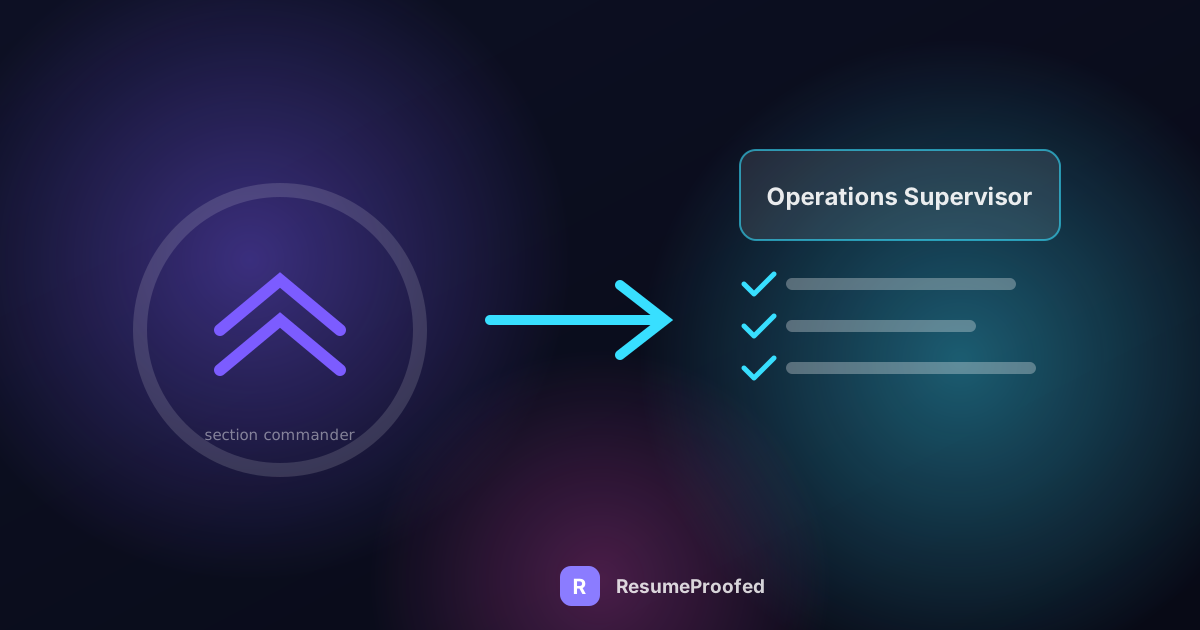
Your service record is full of real, demonstrable achievement, leading people under pressure, managing logistics at scale, making decisions with incomplete information, and almost none of it currently reads as a civilian resume can use. A civilian hiring manager does not know what a Section Commander does day to day, has never heard of OPSEC, and will not go looking up an acronym to find out. That gap is not a reflection of what you achieved in service. It is a translation problem, and it is a solvable one.
The position worth stating early: the goal is not to remove your military background or make it sound less specific. It is to make the same real achievements legible to someone who has never worn a uniform, using civilian job titles, plain-language descriptions of what a role actually involved, and the same quantified, outcome-focused format that works on any resume. Real support exists for this specific transition in Australia, and the translation itself follows a learnable pattern.
Real support exists, and it is worth using
This is not a gap you need to close alone. Soldier On Australia runs a Career and Education Support Program pairing veterans with one-on-one career officers for a tailored career and education plan, a Discover My Career tool built on the Harrison Career Navigation System for self-directed career exploration, a Jobs and Opportunities Board connecting veterans directly with veteran-supportive employers, and dedicated resume templates and interview-skills resources. Two mentoring formats sit alongside that: a structured 18-week Full Mentoring Program, and a newer Micro-Mentoring option offering a single 45-minute session with a career professional, useful if you want focused feedback on a resume draft without committing to a longer program.
The advice below is not a replacement for that kind of tailored, one-on-one support. It is the groundwork you can do yourself before or alongside it, so the resume you bring to a mentoring session or a career officer is already most of the way there.
The translation problem, broken into three parts
Ranks and role titles. A civilian recruiter searching an applicant tracking system does not type "Section Commander" or "Platoon Commander" into a search box, because those are not terms used outside Defence. Successful Resume Australia's guide to translating military experience gives concrete examples of this exact translation: "Platoon Commander" becomes "Team Leader," "Section Commander" becomes "Operations Supervisor." The underlying scope and responsibility do not shrink in the translation, the label just becomes searchable by someone outside Defence.
Acronyms and jargon. SOPs, OPSEC, CO, and the rest of the Defence acronym set carry real, specific meaning inside the ADF and carry no meaning at all to a civilian reader. The same source translates these directly: "SOPs" becomes "Standard Operating Procedures," "OPSEC" becomes "Security Management," "CO" becomes "Senior Manager." Every acronym on your service record needs the same treatment before it goes on a civilian resume, spelled out in the plain-language civilian equivalent, not the Defence shorthand.
Duty statements versus outcomes. This is the same problem every resume has, made sharper by how differently military service records are written. A weak, duty-focused line like "Managed personnel" says almost nothing a civilian recruiter can evaluate. A quantified, outcome-focused rewrite, "Led and mentored a team of 30 personnel while maintaining operational readiness, safety compliance and high performance across complex environments," gives a recruiter a real number and a real, comprehensible outcome. Our guide to quantifying resume achievements covers the same formula in more depth: action, context, measurable result, and it applies directly to service history once the military-specific language has been translated into civilian terms.
Transferable skills worth naming directly
Certain skills built through ADF service map cleanly onto roles civilian employers actively search for, and naming them explicitly, rather than assuming a hiring manager will infer them from "served in the ADF," is worth doing on every application. The clearest, most commonly cited translations: leadership, team management, problem-solving, decision-making under pressure, planning, project coordination, risk management, logistics, training and instruction, communication, adaptability, and safety compliance.
Each of these should appear on your resume attached to a specific example, not as a bare list. "Risk management" on its own is an adjective. "Assessed and mitigated operational risk across a 40-person deployment, resulting in zero safety incidents over a 6-month posting" is evidence a recruiter can act on, and it uses the same quantify-the-outcome formula covered in the section above.
A worked example: rewriting a service record entry
Take a realistic case: eight years of ADF service, most recently as a Section Commander managing a team of 15 through training cycles and a regional deployment, now applying for an Operations Supervisor role at a logistics company.
The raw service-record version, the one most veterans start with:
"Section Commander, [Unit], 2018 to 2026. Responsible for personnel management, logistics coordination and operational readiness in accordance with SOPs. Maintained OPSEC throughout deployment activities. Reported to CO."
A civilian recruiter reading this has no reliable way to evaluate scope, seniority, or specific achievement, because half the sentence is Defence-specific shorthand.
The translated, civilian-resume version:
"Operations Supervisor, Australian Defence Force, 2018 to 2026. Led and coordinated a team of 15 through training cycles and a 6-month regional deployment, maintaining full compliance with standard operating procedures and zero safety incidents across the posting. Managed logistics planning and security protocols for deployment activities, reporting directly to senior command. Selected for an accelerated promotion pathway based on demonstrated leadership and operational performance."
Notice what changed. "Section Commander" became "Operations Supervisor," a searchable civilian title with equivalent seniority. "SOPs" and "OPSEC" became plain-language descriptions of what those terms actually govern. "Responsible for" became specific, quantified outcomes: a team size, a deployment length, a safety record. Nothing about the actual scope of the role was inflated. It was translated.
A short routine for translating your own service record
- Pull your full service record or performance reviews and list every role, rank, and responsibility exactly as written. Do this first, in full military language, before translating anything, so nothing gets lost in an early edit.
- Translate every rank and role title into its closest civilian equivalent, using a resource like Successful Resume Australia's translation guide or Soldier On's career support for terms specific to your corps or role that a general guide will not cover.
- Spell out every acronym in full, plain-language civilian terms, and then decide whether the acronym itself needs to appear at all. In most cases, the civilian recruiter needs the plain-language meaning, not the original abbreviation.
- Rewrite every duty statement as a quantified outcome, using team sizes, deployment lengths, safety records, budget or equipment values managed, and training outcomes delivered, following the same formula covered in our guide to quantifying achievements.
- Have a career officer or mentor review the translated version, through Soldier On's Career and Education Support Program, a Micro-Mentoring session, or an equivalent veteran-specific service, since a second, experienced set of eyes catches translation gaps a first draft usually misses.
Common questions
How do I translate my military rank into a civilian job title?
Match the actual scope and responsibility of the rank to the closest civilian equivalent, not a literal translation of the title. A Platoon Commander's team-leadership responsibility typically maps to "Team Leader," while a Section Commander's broader operational oversight often maps closer to "Operations Supervisor." Veteran career services can help pin down the closest equivalent for roles specific to your corps.
Where can Australian veterans get free resume help?
Soldier On Australia offers a Career and Education Support Program with one-on-one career officers, resume templates, and both an 18-week Full Mentoring Program and shorter Micro-Mentoring sessions, all aimed specifically at veterans transitioning to civilian employment.
Should I remove military acronyms from my resume entirely?
Generally, yes, replace them with their plain-language civilian meaning. A civilian recruiter is very unlikely to look up an unfamiliar acronym, so an untranslated term is effectively invisible to them, even if the underlying skill or responsibility is exactly what the role needs.
How do I quantify achievements from military service when there's no sales number or revenue figure?
Team sizes led, deployment or posting lengths, safety and compliance records, equipment or budget values managed, and training outcomes delivered are all legitimate, quantifiable figures. The same formula that works for quantifying any resume achievement, action plus context plus measurable result, applies directly to military service once the terminology is translated.
Will hiring managers understand a gap between leaving the ADF and starting a civilian job?
Transition periods after leaving the ADF are common and generally understood, especially when named plainly rather than left blank. Our general guide to explaining a career gap covers how to name any gap in one honest line rather than leaving it unexplained.
Do veteran-friendly employers actually exist in Australia, or is that just marketing language?
Genuinely, yes. Soldier On's Jobs and Opportunities Board connects veterans directly with employers who have specifically opted in as veteran-supportive, and several major Australian employers run structured hiring pathways for ex-ADF candidates, beyond general goodwill statements in a careers page footer.
Where ResumeProofed fits, and where it doesn't
ResumeProofed cannot translate ADF-specific rank structures or corps terminology for you, that groundwork, and the specialised support available through services like Soldier On, comes first. What it can do once your service history is translated into plain, civilian language is help you confirm those achievements as verified facts in a profile, then generate a resume and cover letter tailored to a specific civilian job ad's actual wording each time you apply, rather than reusing one general translation of your service record for every application.
Try ResumeProofed free: two tailored applications on the house, no card required.