Resume for stay-at-home parents returning to work
Caring for children is the single leading reason Australian women outside the workforce give for not being available for a job. Here's the resume fix.
- Résumé writing
- Career advice
- Australia
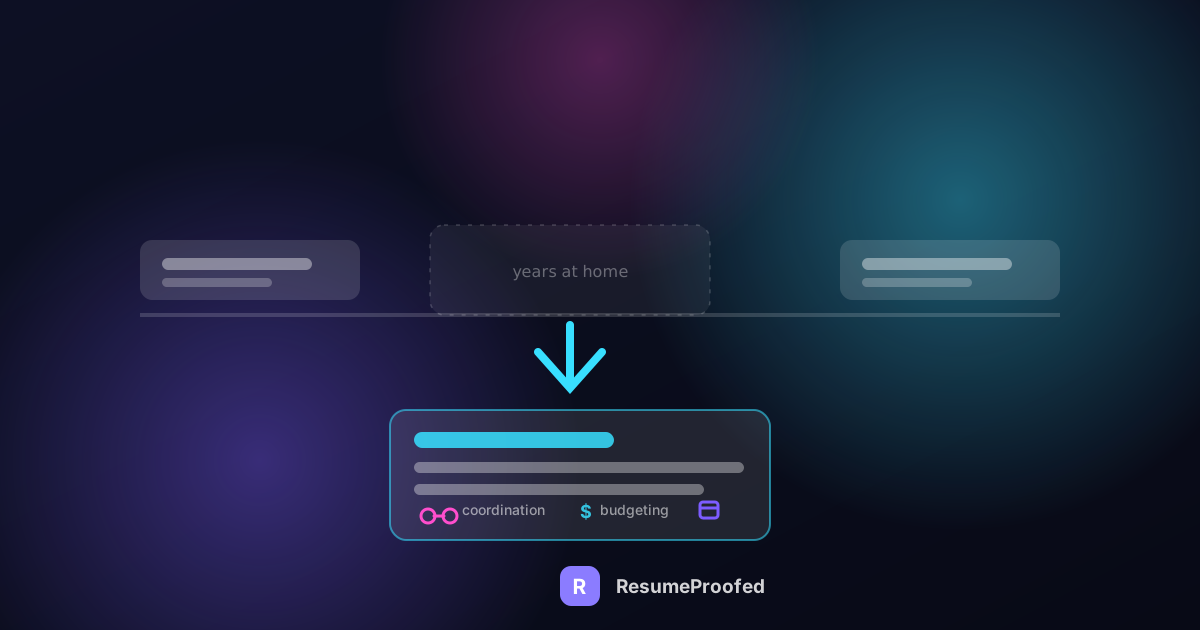
You have been out of paid work for a stretch of years, caring for children, and now you are staring at a resume template that assumes a tidy, unbroken run of job titles. Every piece of generic career-gap advice you find online is written for someone who took eight months off between two corporate roles, not someone reframing several years of unpaid, unrelenting, genuinely skilled work into language a hiring manager will recognise. This is the version written for that specific situation.
The position worth stating early: this is not a small or unusual cohort you need to apologise your way past. Caring for children is the single most common reason Australian women who want a job are not available to start one within four weeks, cited by 43 percent of that group, according to the Australian Bureau of Statistics' own Barriers and Incentives to Labour Force Participation data. Among people aged 25 to 39 who say they do not currently want a job at all, caring for children is also the leading reason, cited by 37 percent. That is not a fringe circumstance a resume format needs to hide. It is the majority explanation for a very large, very normal group of people, and the resume advice below treats it that way.
Why this deserves its own advice, not a generic gap fix
Our general guide to explaining a career gap covers the mechanics that apply to any gap: use a plain reverse-chronological format, keep date formatting consistent, and name the gap in one honest line rather than trying to hide it with a functional layout an applicant tracking system cannot parse. All of that still applies here. What it does not cover is the part specific to caregiving: what to actually put in the employment history for those years, how to translate the work itself into language a hiring manager recognises, and how to write a summary line that leads with the return rather than the absence.
Encouragingly, the return itself is well underway at a national level, not a rare, individual swim against the tide. Women's workforce participation in Australia rose from 61.2 percent to 63 percent between 2019 and 2024, according to reporting from Swinburne Open Education. More of this cohort is actively re-entering paid work than the stale "she opted out" framing assumes, which is worth remembering the next time a generic template makes the gap feel like a disqualifying exception rather than an extremely common transition.
If a structured paid program is what you are after rather than a self-directed application, our guide to returnship programs in Australia covers named, paid re-entry programs at Deloitte, EY, Accenture and Macquarie, several of which are built specifically for candidates returning after caregiving leave. This piece is for the more common path: applying directly, on your own resume, without a formal returnship pipeline.
What to actually put in the employment gap
Three approaches work, and which one fits depends on what you actually did during the time away.
List it as a line item, honestly labelled. If you did not do any paid or structured volunteer work during the break, list the years plainly as a line in your work history: "Family caregiver, 2022 to 2025." This is not weaker than an invented job title. It is a clear, confident line that matches the ABS data above: this is a common, recognisable reason for a gap, not something that needs euphemism.
List any structured activity that happened during the break. Volunteer committee roles, school P&C or canteen coordination, community fundraising, freelance or part-time work taken alongside caregiving, all belong in the employment history as real entries with real responsibilities, not folded quietly into a single "caregiver" line. If you coordinated a school fundraiser that raised a specific amount, or managed a roster of twelve volunteers for a community event, that is genuine, quantifiable experience and belongs in a bullet point, not a footnote.
Address it directly in the summary, once, and move on. A single sentence in your resume summary naming the gap and the return removes the need to explain it again anywhere else on the page. "Returning to full-time work in 2026 after a period of family caregiving, bringing 6 years of [prior field] experience and recently refreshed skills in [specific area]" does the job in one line and lets the rest of the resume focus entirely on what you can do now.
Translating caregiving work into resume language
The instinct to describe years of caregiving as "just" raising children undersells work that, described accurately, maps onto genuinely transferable skills employers already screen for. The translation only works if it stays specific and avoids inflating the role into something it was not.
| What the work actually involved | How it translates on a resume |
|---|---|
| Managing a household budget, school fees, and multiple family schedules | Budget management, resource allocation, scheduling and logistics coordination |
| Coordinating school events, sports commitments, or a P&C committee | Event coordination, stakeholder communication, committee administration |
| Researching schools, healthcare providers, or specialist services and making decisions under time pressure | Research and evaluation, vendor or provider assessment, decision-making under constraint |
| Managing conflicting priorities across multiple children's needs simultaneously | Multitasking, prioritisation, crisis management |
| Volunteering in a structured or leadership capacity | Direct, quantifiable experience, listed as its own entry, not folded into "caregiving" generally |
The rule that keeps this honest: translate what you actually did into the closest accurate professional term, do not invent scope or seniority you did not have. "Coordinated a rotating volunteer roster of 12 people for a term-long school program" is a specific, defensible line. "Led a team" is not, if the reality was an informal group of parent volunteers with no reporting structure. The Australian Bureau of Statistics figures cited above exist precisely because this is common, structured, real work for a huge number of people, which means you do not need to inflate it to make it count. You need to describe it accurately.
A worked example
Take a real, common case: a marketing coordinator with four years of pre-parenting experience, three years out of paid work caring for two children, now applying for a Marketing Coordinator role at a mid-size company.
The weak version, the one most people default to:
"Marketing Coordinator, ABC Company, 2019 to 2022. [Then a blank gap.] Seeking to return to the workforce after taking time for family."
This tells a hiring manager nothing about what happened in the gap and nothing about what has changed since 2022.
The rewritten version:
Summary: "Marketing Coordinator with 4 years of campaign and content experience, returning to the workforce in 2026 after a period of family caregiving. Recently completed a refresher course in Google Analytics 4 and continued freelance social media management for two small local businesses throughout the break."
Employment history:
- Marketing Coordinator, ABC Company, 2019 to 2022: [original bullets with real numbers, unchanged]
- Family caregiver and freelance social media manager, 2022 to 2025: "Managed social media content and posting schedules for two small local businesses on a freelance basis while caring for two children full-time. Grew combined follower count by 40 percent across both accounts over two years through consistent posting and basic analytics review."
- Marketing Coordinator, ABC Company, 2019 to 2022 [as above]
Notice what the rewrite does. It names the caregiving plainly, once, in the summary. It surfaces the freelance work as a real, dated, quantified entry rather than hiding it inside a vague "gap" label. And it gives the hiring manager a specific, recent reason to believe the marketing skills are current, not three years stale.
A short routine for writing your own
- List everything that happened during the break, paid, unpaid, structured, informal. Volunteer roles, freelance work, courses, committee positions, anything with a start date, an end date, and a describable set of responsibilities.
- Decide, item by item, what belongs as its own resume entry versus what belongs folded into a single summary sentence. Anything with real scope and a result, list separately. Pure day-to-day caregiving with nothing structured attached, name once in the summary.
- Write the summary sentence first, naming the return plainly, then quantify your strongest pre-break or during-break achievement. This is the same discipline covered in our guide to writing a resume summary: lead with the specific, not the adjective.
- Quantify every entry you can, using our formula for quantifying achievements even for caregiving-adjacent work: a volunteer roster size, a fundraising total, a follower count, a budget managed. A number makes the entry read as real experience rather than a placeholder.
- Update any lapsed skills before you apply, not after. If your field moved on while you were out, one recent short course or certification listed in the summary does more to reassure a hiring manager than any amount of careful gap-phrasing.
Common questions
How do I write a resume objective for a stay-at-home mom returning to work?
Lead with your prior job title and years of experience, name the return plainly in one sentence, and follow immediately with your strongest recent or pre-break achievement, ideally with a number attached. Avoid apologetic language like "seeking to re-enter the workforce" with nothing else backing it up, since it reads as a gap explanation rather than a value statement.
Should I list "stay-at-home parent" as a job title on my resume?
You can, and "family caregiver" or "stay-at-home parent" is an honest, recognisable line item, especially now that it is such a common entry: 43 percent of Australian women who want a job cite caring for children as the reason they are not yet available to start one. If you also did structured volunteer or freelance work during that time, list those as separate, dated entries rather than folding everything into the one caregiving line.
How do I explain a multi-year gap for raising children in an interview?
State it plainly and briefly, then pivot immediately to what you did to stay current or what you are bringing to the role now: a course completed, freelance work maintained, or transferable skills built through structured volunteering. A confident, one-sentence explanation followed by evidence of readiness reads far better than a long, apologetic justification.
What skills should I highlight if I have no paid experience to list from my time as a parent?
Budget management, scheduling and logistics coordination, multitasking under time pressure, and any structured volunteer, committee, or community coordination work, described with real scope and, where possible, a number. These are genuine transferable skills, not padding, as long as they are described accurately rather than inflated.
Are there programs specifically for parents returning to work in Australia?
Yes. Several large Australian employers, including Deloitte, EY, Accenture and Macquarie, run paid returnship programs aimed at candidates re-entering the workforce after an extended break, several specifically welcoming candidates returning from parental caregiving. Our guide to Australian returnship programs covers how to find and apply to one.
Will an employer discriminate against me for having a multi-year career gap for children?
Some bias against unexplained gaps does exist, but a well-labelled gap with a clear, confident explanation performs far better than a hidden or vague one. Given how common this specific gap reason is, being direct about it, backed by evidence you have stayed current, is a stronger position than trying to disguise the timeline.
Where ResumeProofed fits, and where it doesn't
ResumeProofed cannot decide for you whether a caregiving stretch belongs on its own resume line or folded into a summary sentence, that judgement call depends on what actually happened during your specific break. What it can do is help you confirm and quantify the parts that do belong on the page, freelance work, volunteer coordination, courses completed, as verified facts in your profile, then generate a resume and cover letter tailored to a specific job ad's language once those facts are confirmed. It will not invent scope or seniority for caregiving work you did not have, which means the resume it produces is only ever as strong, and as honest, as what you tell it actually happened.
Try ResumeProofed free: two tailored applications on the house, no card required.