How to spot a ghost job posting before you waste a tailored application
About 1 in 7 US job postings sit unfilled for 30+ days. Here is the data on ghost jobs and a checklist for spotting one before you apply.
- Job search
- Career strategy
- Job applications

You spend forty minutes tailoring a resume and cover letter to a specific listing, hit submit, and hear nothing back, not even a rejection. It's easy to blame the resume. Sometimes the real explanation is simpler and more frustrating: the job might never have been a real, fillable role in the first place. "Ghost jobs," postings that stay live with no genuine intent to hire anyone soon, are common enough now that a wasted application to one isn't bad luck, it's closer to the odds.

The position worth stating first: ghost jobs are a real, measurable, and growing share of what you'll see on any job board, not an urban legend job seekers invented to explain rejection. The data below puts real numbers on how common they are, why companies post them, and gives you a concrete checklist to run before you spend real tailoring effort on a listing that was never going to result in an interview.
What the data actually shows
Clarify Capital analysed more than 175,000 US job listings, according to a Clarify Capital study, reported by Forbes in April 2026, and found that about one in seven job postings stayed active for more than 30 days without resulting in a hire. That rate isn't evenly spread. It climbs to 51 percent in wholesale, and to 21 percent specifically among senior-level roles, meaning a listing for a more senior position carries meaningfully higher ghost-job risk than an entry-level one.
A separate report from MyPerfectResume, published in November 2025 and covered by HR Dive, found nearly a third of US job postings don't result in an actual hire. That report also pulled US Bureau of Labor Statistics figures directly: in June 2025, the most recent month reflected in that report, employers posted 7.4 million openings but completed only 5.2 million hires, a gap of 2.2 million unfilled positions in that single month alone. Before the pandemic, from 2010 to 2019, the gap between postings and hires tracked closely, typically under 10 percent. That gap widened sharply in 2021, to around 38 percent, and has stayed elevated since, running at roughly 28 to 32 percent most months rather than returning to its pre-pandemic norm. This isn't a short blip. It's a multi-year shift in how job boards behave, and it means "the listing is still up" tells you far less than it used to about whether a role is actually being filled.
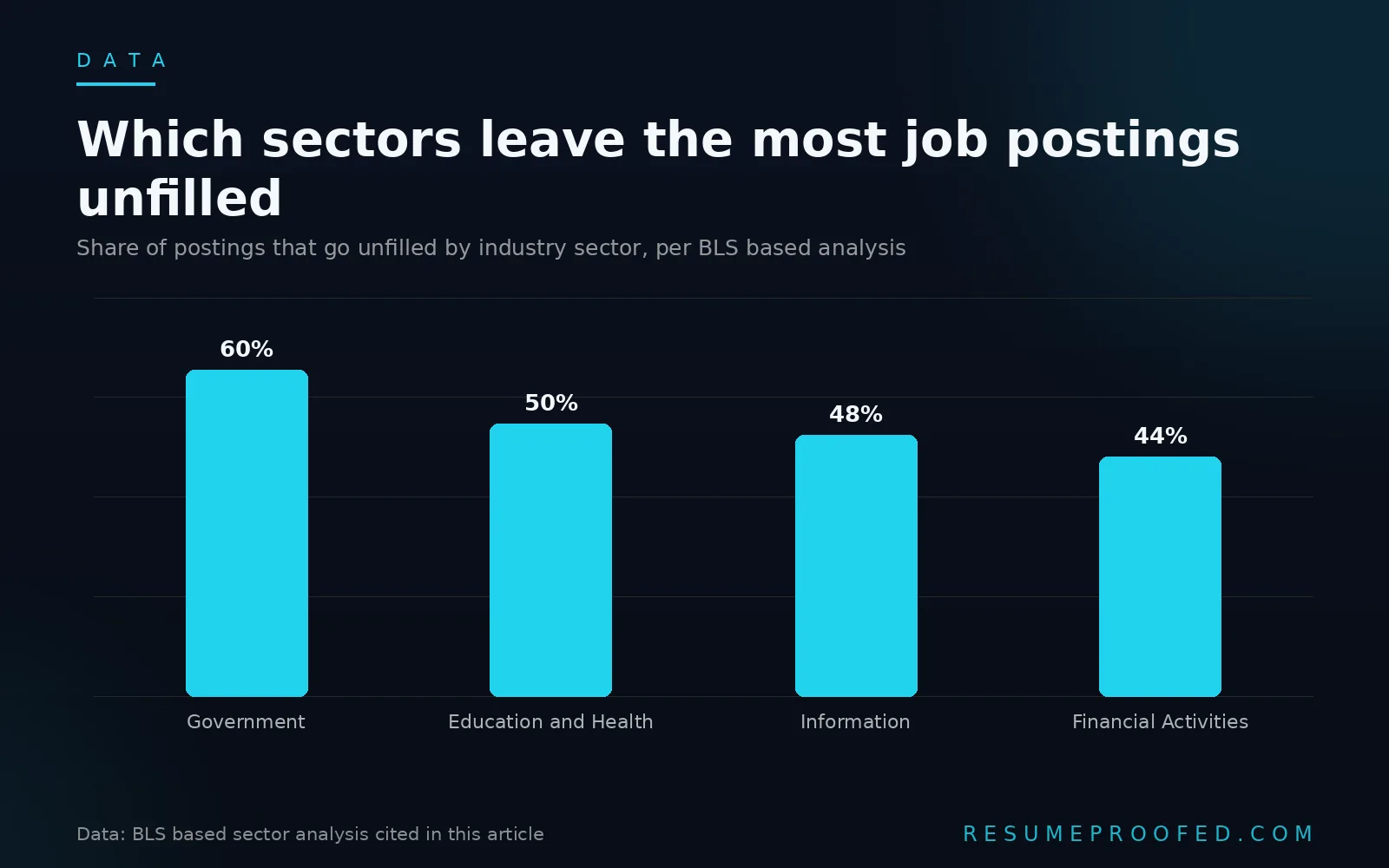
The unfilled-posting rate also varies sharply by sector, per the same BLS-based analysis: government postings go unfilled around 60 percent of the time, education and health around 50 percent, information (the BLS supersector covering publishing, broadcasting and telecom) around 48 percent, and financial activities around 44 percent. If you're applying in one of these sectors, a stale-looking listing is closer to normal than exceptional, which makes the detection habits below more useful, not less.
Why companies post jobs they don't intend to fill soon
Ghost jobs aren't always deliberate deception, and it's worth being fair to the mechanism before treating every stale listing as bad faith. A few genuine reasons a posting stays up with no active hiring behind it:
- Pipeline building. Some companies keep a role open indefinitely to build a pool of candidates for when a position eventually opens, rather than scrambling to source candidates cold when it does.
- Internal approval delays. A hiring manager gets budget approval pulled or paused after the listing already went live, and nobody remembers to take it down.
- High turnover roles. Certain positions, especially in retail, hospitality, and call centre work, are reposted continuously because the role churns constantly, not because any single posting represents a specific open seat.
- Signalling growth. A company under investor or board scrutiny sometimes keeps listings up as a visible signal that it's hiring and growing, independent of whether any specific role is close to being filled.
- Genuine administrative lag. Some postings are simply never taken down after the role is filled, because nobody owns that cleanup task.
None of that changes the practical problem for you as an applicant: whatever the reason, your time tailoring a resume to that specific listing was spent on a role that isn't moving.
A checklist for spotting a ghost job before you apply

Run through these before you commit real tailoring time to a listing, not after you've already submitted:
- Check the posted date, and treat 30+ days as a caution flag, not a hard stop. LinkedIn, Indeed and SEEK all show when a listing first went live. A posting open for a month or more with no update is exactly the pattern Clarify Capital's data flags as the ghost-job threshold, though a genuinely slow-moving hire can still be real past that point.
- Cross-check the role against the company's own careers page. If a listing appears on a job board but not on the employer's own site, or the job board version has been up noticeably longer than any equivalent on the company's page, that's a real signal the board listing may be stale or evergreen rather than actively worked.
- Search the exact job title plus the company name. If the same title has been reposted by the same company every few weeks for months, it's more likely a continuously churning or pipeline-building listing than a single specific vacancy.
- Look at the seniority level and industry. Per the data above, senior roles and wholesale, government, education, health and IT postings all carry meaningfully higher ghost-job rates. That doesn't mean skip them, it means budget less tailoring time up front and watch for a response before investing more.
- Check whether the listing describes a specific team or reports to a named role, versus generic department language. Specificity, a named manager, a named team, a specific project, correlates with a role someone is actively trying to fill, since generic postings are cheaper to keep evergreen.
- Note how the company responds to your application, if it responds at all. A total silence with no automated acknowledgment, no rejection, nothing, over several weeks, on a listing that also failed the checks above, is a reasonable signal to deprioritise following up further and put your energy into other applications.
None of this is a guaranteed test. Plenty of real roles take a month or more to fill and stay listed the whole time. The goal isn't to avoid every listing that shows any of these signs, it's to avoid spending your most careful, individually tailored effort on the listings showing several of them at once, and instead save that depth of tailoring for postings that look genuinely active.
A worked example

Say you find two listings for "Senior Marketing Manager" roles that both interest you.
Listing A: Posted 6 days ago on the company's own careers page and cross-posted to LinkedIn the same day. Names the team ("reports to the Director of Brand"), lists a specific project focus, and the company has no other identical postings currently live.
Listing B: Posted 47 days ago, appears only on a third-party job board, not on the company's own careers page. Generic department language ("join our growing marketing team"). A search shows the same company has posted near-identical "Senior Marketing Manager" listings twice in the past six months.
Listing A is worth your full tailoring effort: a fresh, specific, single-source posting. Listing B fits several of the ghost-job signals above at once, stale, generic, board-only, repeatedly reposted, so it's a reasonable candidate for a faster, lighter application rather than your most careful, deeply tailored version. This is the same logic behind why you're not getting interviews: if your tailoring effort isn't converting to responses, the listing itself, not just the resume, is worth auditing.
If you're applying at real volume and want to track which listings are actually responding versus going silent, a job application tracker makes this pattern visible over time instead of anecdotal: you'll start to see which sources, industries, and posting ages correlate with silence in your own search, not just in aggregate national data.
How ghost jobs distort your sense of how the search is going
One of the quieter effects of ghost jobs is what they do to your read on your own progress. If a third of the postings you're applying to were never going to result in a hire regardless of how well you tailored your application, then your real response rate, measured only against genuinely active listings, is meaningfully better than your raw numbers suggest. That distinction matters for morale as much as for strategy: it's the difference between "nothing I write is working" and "a chunk of what I'm applying to was structurally unlikely to respond no matter what I sent."
This connects directly to the timeline question covered in how long does a job search actually take. If you're tracking weeks elapsed against silence received, and a meaningful share of that silence came from listings that were stale, evergreen, or pipeline-building rather than actively hiring, your search may be tracking closer to typical than the raw silence makes it feel. It doesn't shorten the search, but it changes what you should conclude from a stretch of non-responses: audit the listings themselves before concluding the resume is the problem.
Where this shows up differently by platform
The signals above translate slightly differently depending on where you're job hunting. On LinkedIn, the "posted X weeks ago" timestamp is visible directly on the listing and on the applicant count, which gives you a rough read on both age and competition at a glance, though a high applicant count says nothing about whether any of those applicants have heard back. On Indeed, older listings sometimes get automatically refreshed or resurfaced without a genuinely new posting date, so cross-checking against the employer's own careers page matters more there than the platform's own timestamp. On SEEK, the most relevant board for Australian job seekers and covered in more depth in our guide to tailoring a resume for SEEK job ads, listings typically expire and are removed automatically after a set window, so a SEEK posting that's still live is a slightly stronger freshness signal on its own than an Indeed or LinkedIn listing, though it's still worth checking against the same generic-language and repeated-posting patterns described above.
Common questions
What is a ghost job?
A ghost job is a job posting that stays active on a job board or careers page without the employer actively working to fill it soon, whether because of pipeline building, budget delays, high turnover reposting, or simple administrative lag. It looks identical to a real, currently-hiring listing from the outside.
How common are ghost jobs in 2026?
A February 2026 study of more than 175,000 US job listings found roughly 1 in 7 stayed active for 30 or more days without a hire, rising to 51 percent in wholesale and 21 percent among senior-level roles specifically. A separate report found nearly a third of US postings overall don't result in an actual hire.
How can I tell if a job posting is fake or stale?
Check the posted date against a 30-day threshold, confirm the role also appears on the company's own careers page, search whether the same title has been reposted repeatedly by the same employer, and look for specific team or project details versus generic department language. No single check is conclusive, but several together are a real signal.
Should I still apply to a listing that looks like a ghost job?
You can, but it's reasonable to budget less tailoring time to it than to a fresher, more specific listing. A generic, lightly-adjusted application costs you less if the role turns out not to be real, and you can always go deeper if you get a response.
Why do companies post jobs they don't fill?
Reasons range from genuinely benign, building a candidate pipeline for future openings, continuous reposting of high-turnover roles, budget approval delays, to simple neglect in taking down old listings. It's rarely as simple as deliberate deception in every case, even though the effect on an applicant is the same either way.
Does a long-open listing mean the role has been filled internally?
Not necessarily, and there's no reliable way to confirm this from outside the company. A long-open listing might be filled and simply not taken down, still genuinely open and slow-moving, or an ongoing pipeline posting. Treat it as a caution flag for how much effort to invest, not a certainty either way.
Where ResumeProofed fits, and where it doesn't
ResumeProofed can't tell you whether a specific listing is a ghost job, and no tool honestly can from outside the hiring company. What it changes is the cost of finding out: because it tailors a resume to a specific job ad's language from a confirmed history of what you've actually done in a couple of minutes rather than a full evening, you can afford to apply to a promising-but-uncertain listing without the sunk-cost pressure that makes a long silence sting more than it needs to.
Try ResumeProofed free: two tailored applications on the house, no card required.