How to tailor your resume for SEEK job ads
SEEK is two separate documents wearing one login: a profile recruiters search, and a resume you attach per job. Confusing them is the real problem here.
- Australian job market
- Résumé writing
- Tailoring
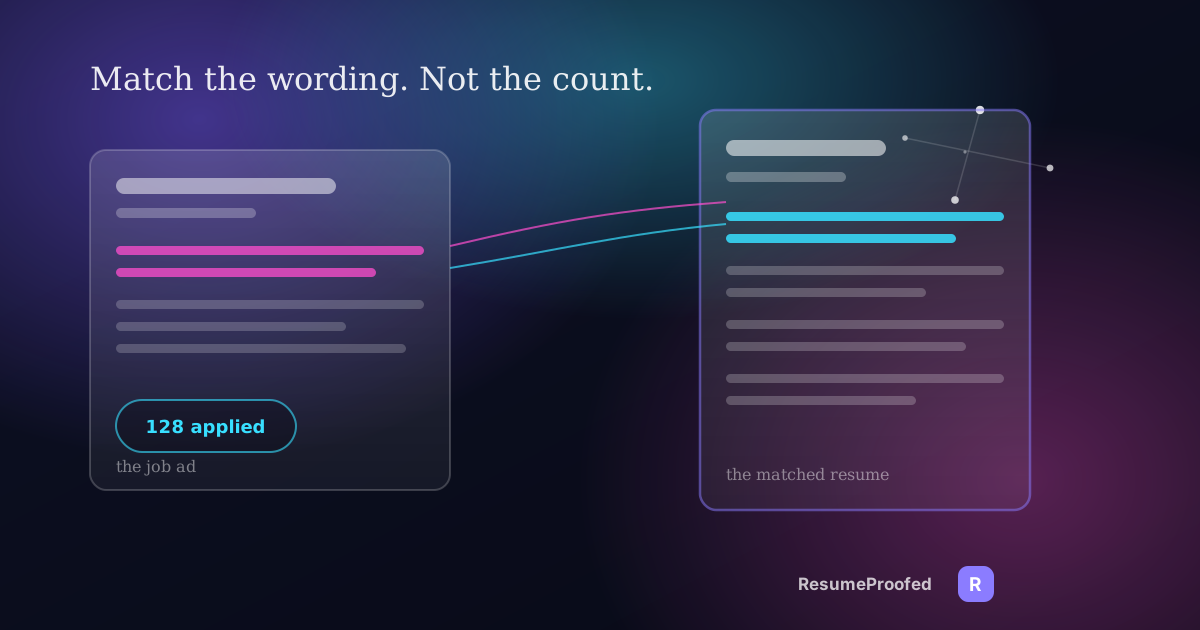
You've applied to a dozen roles on SEEK, the "applicants" count keeps climbing past a hundred before you've even finished reading the ad, and you're starting to wonder whether tailoring anything matters when you're apparently one of two hundred identical looking applications. It's a reasonable thing to wonder, and SEEK's own published data actually answers it, more encouragingly than the applicant counter makes it feel.

The position worth stating first: SEEK is not one document, it's two, a profile the platform's own search surfaces to recruiters directly, and a resume you attach to each individual application, and most job seekers treat them as the same thing. They aren't scored the same way, read by the same process, or updated on the same schedule, and conflating them is the single biggest reason a SEEK application underperforms relative to the effort put into it. This sits alongside, but separate from, the general question of what an Australian resume should look like: that's about format, this is about how SEEK specifically surfaces and reads what you send it.
Two documents, one login

Your SEEK profile is a standing, searchable record: a summary, work history, education, skills and salary expectations, sitting on SEEK's servers whether or not you're actively applying to anything. Recruiters with a SEEK Talent Search subscription search that profile database directly, by keyword, independent of any specific job ad, which means a complete profile can surface you for roles you never applied to at all. A fully completed profile simply gives Talent Search more to match on than a partial one, which is the entire reason to keep it current even while you're not actively job hunting.
The resume you attach to an individual application is a different object entirely: a static file, tailored or not, that a human or an applicant tracking system reads once, for that one job, and then largely forgets. SEEK's own advice to job seekers on this is blunt about how little of it actually gets read on a first pass: recruiters spend a few seconds scanning, and one to three minutes if something in that scan holds their attention, according to SEEK's resume tips for getting an interview. Treating your profile and your per job resume as the same document, copy pasted between the two, wastes the specific advantage each one offers: the profile's job is to be found broadly, the resume's job is to convert one specific reader, fast.
What the applicant counter actually means, and what it doesn't
SEEK's own Employment Dashboard for February 2026 shows job ad volumes falling for a third consecutive month, down 0.5 percent from January and 2.6 percent from February 2025, while applications per job ad have been declining slowly since a peak in June, per the SEEK Employment Dashboard, February 2026. That's the market wide direction: fewer ads overall, and per ad competition edging down from where it was, not climbing toward some new record.
The picture varies sharply by state within that national trend. Western Australia was the only region with growth in both job ad volume, up 0.2 percent monthly and 1.4 percent annually, while New South Wales, Victoria and Queensland all recorded monthly declines in ad volume over the same period. Applications per ad moved in the opposite direction in some of those same states, rising slightly in New South Wales, the Northern Territory and Victoria. Read together, this means a triple digit applicant count on one specific ad tells you almost nothing about the market overall; it tells you about that role, that state, and that industry's specific supply and demand, which is exactly why obsessing over the number next to one ad is close to useless, and tailoring your actual application to that specific ad is not.
Your profile summary is not your resume summary
Because the profile and the resume answer different questions, their summary sections should read differently too, even though people often paste the exact same three sentences into both.
A profile summary is written for a recruiter who has never seen a specific job ad from you, searching broadly by keyword or skill. It should describe your overall professional identity in terms broad enough to surface for several related roles, for example: "Operations manager with nine years across retail and logistics, specialising in team leadership, rostering and vendor negotiation." That sentence is doing its job if it surfaces you for a reasonable range of adjacent roles a recruiter might be searching for.
A resume summary attached to one specific application should narrow that same true information to the ad in front of you. If the ad specifically calls out inventory management and supplier negotiation, the resume version tightens to: "Operations manager with nine years leading retail teams, including full inventory control and direct supplier negotiation across a $2 million annual spend." Same person, same true facts, different emphasis for a different reader. Keeping these two versions distinct, rather than reusing one for both purposes, is a small amount of extra effort that directly addresses the keyword matching problem covered next.
What gets scanned first, and how to make it match
SEEK's own advice names the mechanism directly: if a recruiter, or the applicant tracking system reading before them, is scanning for keywords, you need to be using the same language the ad uses, not a synonym you think sounds equally good. This is the same underlying discipline covered in how to find the right resume keywords in a job ad, applied specifically to how SEEK's own scanning behavior works: an ad asking for "stakeholder management" and a resume that says "worked with clients and internal teams" are describing the same capability to a human reader, but they don't match as cleanly to a keyword scan, and they don't grab the few seconds of attention a human scanner is giving each resume either.
A worked example
Job ad line: "Proven ability to manage competing priorities and deliver on tight deadlines in a fast paced retail environment."
Weak resume bullet, unmodified from a generic resume: "Responsible for daily store operations and staff scheduling."
This describes a job, not a capability the ad is actually asking about, and it doesn't use a single word the ad used.
Strong resume bullet, tailored to this specific ad: "Managed competing priorities across a 40 person roster and daily stock deadlines in a fast paced retail environment, reducing rostering conflicts by coordinating three concurrent priorities during peak trading periods." This mirrors the ad's own phrasing, "competing priorities," "fast paced retail environment," "deadlines," directly, while still describing something real and specific rather than repeating the ad's words with no evidence behind them. SEEK's own guidance uses a similar principle in its own worked example, citing a candidate who quantified a result as increasing revenue by $20,000 a year rather than describing the role generically. The pattern is the same either way: name the ad's own language, then back it with a specific, real number.
A repeatable routine for applying through SEEK

- Before you touch your resume, read the ad twice and underline its three most repeated or most specific requirements. These are almost always the terms a keyword scan and a human scanner are both looking for first.
- Check your resume for those exact terms, not synonyms, and add them where they are genuinely true, in the same wording the ad used, in your summary and at least one bullet.
- Keep your SEEK profile separately up to date on a slower cycle, roughly monthly rather than per application, since it needs to represent you broadly to searching recruiters, not to one specific ad.
- Save each tailored resume version with a label you'll recognize later, since applying to several similar roles in a week without tracking which version went where is how you lose track of what you actually said to whom. Do you need a job application tracker? covers a simple system for exactly this.
- Don't let a high applicant count talk you out of applying if the ad is a genuine fit. As the state level data above shows, that number reflects the specific ad and region far more than it reflects your odds once a tailored, keyword matched application is actually in front of a reader.
Common questions
Does my SEEK profile matter if I still upload a resume to every application?
Yes, they serve different purposes. Your profile can surface you to recruiters searching independently of any application, through SEEK's Talent Search tool, while your uploaded resume is what gets read for that one specific role. A complete profile gives recruiter searches more to surface on its own, separate from anything you actively apply to.
How many people usually apply for a job on SEEK?
It varies enormously by state, industry and role, and SEEK's own dashboard data shows applications per ad have actually been declining slowly since a peak in June nationally, even though some states and industries move in the opposite direction. A high number next to one ad reflects that specific ad's conditions, not a fixed market rate.
Should my SEEK profile and my resume say the same thing?
They can overlap, but they don't need to match word for word. Your profile should represent your overall experience for broad searchability, while your resume should be tailored to the specific ad's language and requirements each time you apply.
Do recruiters actually read every application on SEEK?
Not closely, at least not on a first pass. SEEK's own advice to job seekers states recruiters typically spend only a few seconds scanning a resume initially, extending to one to three minutes if something in that first scan holds their attention, which is why matching the ad's own keywords in the first few lines matters.
Why do some SEEK job ads get far more applicants than others?
Largely state, industry and role level supply and demand, which SEEK's own dashboard data shows varies significantly, for example Western Australia recording ad volume growth while other states declined over the same period. It isn't evidence that tailoring stopped mattering, since the underlying reading process for each individual application doesn't change based on how many other people also applied.
Should I skip applying to a SEEK ad that already shows 100 or more applicants?
Not automatically. That count reflects the ad's specific conditions, not your personal odds, and a well tailored application matched to the ad's own language is judged on its own content by the person or system reading it, not ranked purely against a running total.
Where ResumeProofed fits, and where it doesn't
ResumeProofed tailors a resume to a specific job ad's actual wording from a confirmed history of what you've done, which is the keyword matching discipline this article describes, done from evidence rather than guesswork. It doesn't manage your SEEK profile, and it doesn't change how many other people apply to the same ad. What it changes is whether your one attached resume, out of however many, actually mirrors the language the ad and the reader behind it are looking for.
Try ResumeProofed free: two tailored applications on the house, no card required.