Resume vs CV in Australia: what employers actually expect
US advice says one page, UK advice says CV. Neither fits Australia. Here is the length, format and detail SEEK-era Australian employers actually expect.
- Résumé writing
- Australian job market
- CV
Type "resume vs CV Australia" into Google and the first page of results is mostly recycled American advice wearing an Australian flag. It will tell you to cut everything to one page, strip out anything that isn't a punchy bullet, and never let the word "CV" near your document. Follow that advice here and you hand a recruiter at a Melbourne logistics firm, a state health department or a Perth mining company something built for a hiring process this country doesn't run.
Here's the position worth stating plainly, because most posts on this topic dance around it: in Australia, resume and CV are the same document. The convention Australian employers actually expect is neither the clipped American one page resume nor the comprehensive UK or academic CV. It's its own thing, closer to a hybrid, and getting it wrong doesn't usually get you rejected outright. It just reads as someone who copied a template from a US site and never opened SEEK.
Resume vs CV in Australia: they're the same document
SEEK's own career advice is blunt about this: resume and CV are used interchangeably across the vast majority of Australian job ads, and for private sector roles you can treat the two words as synonyms. Nobody reading a retail, hospitality, trades, corporate or tech job ad in Australia is quietly judging you for calling your document a CV instead of a resume, or the reverse.
The exceptions are narrower than the confusion suggests. Academic, research, medical and some government roles use "CV" to mean something specific: a comprehensive, chronological record of your entire professional and academic history, publications included. Everywhere else, when an ad asks for "your CV" or "your resume", it wants the same thing: a tailored, readable document that shows you can do this particular job. Check the industry before you assume otherwise, but do not lose sleep over which word goes in the file name.
How long should an Australian resume actually be

This is where the imported American advice does the most damage. The rigid one page rule that dominates US resume culture doesn't apply here, and Australian recruiters generally aren't counting pages the way the advice implies.
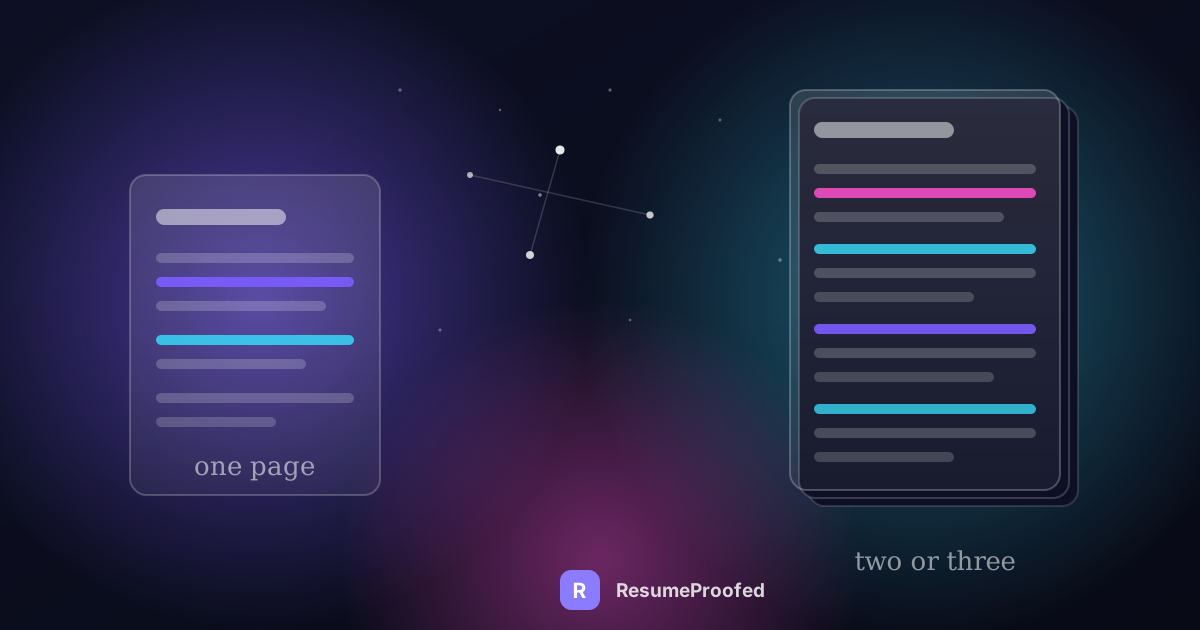
The rough convention: one page if you're a student or graduate with limited experience, two pages for most working professionals, and up to three pages once you're deep into a specialised or senior career with a genuine amount of relevant history to show. A senior candidate who submits a single page in Australia doesn't read as efficient, they read as though they've left things out.
That doesn't mean length for its own sake. A padded three page document with weak content loses to a tight two pager every time.
The extra page budget compared to the US isn't permission to include everything you've ever done. It's room to show the specific evidence a recruiter is scanning for, the tools, the scope, the outcomes, at a level of detail an American one pager physically cannot fit.
What to leave off: photo, date of birth, marital status
Where the US and UK conventions vary, Australia is fairly consistent, and stricter than either. Leave off your photo, your date of birth, your marital status, your nationality and any identification numbers. Include your name, phone number, a professional email address, your general location (suburb and state is plenty, a full street address is not necessary) and a LinkedIn URL if you keep one current.
The reason sits in anti-discrimination law. Federal legislation including the Age Discrimination Act, the Racial Discrimination Act, the Sex Discrimination Act and the Disability Discrimination Act, plus equivalent state and territory laws, make it risky for an employer to base a hiring decision on information like age, marital status or appearance. That risk makes many employers and recruitment systems cautious about even receiving that information, which is why photos are actively discouraged rather than merely optional. This isn't legal advice: for the specifics of what an employer can and can't lawfully ask during recruitment, the Australian Human Rights Commission and the Fair Work Ombudsman both publish plain language guides worth reading directly.
Once you're actually hired, an employer will need your date of birth for tax and superannuation purposes. That's a normal, separate step. It has no reason to be on the document that gets you shortlisted.
References: on the page or available on request
SEEK's guidance here is more specific than most people expect: don't bother writing "references available on request". It's implied, every recruiter already knows they can ask, and the sentence spends a line saying nothing.
Unless the job ad specifically asks you to list referees, leave them off entirely. That space is worth more spent on evidence of your work than on contact details nobody's asked for yet. Instead, prepare a short, separate reference sheet, two or three people who've agreed in advance to take the call, ready to send the moment someone asks. If a listing does ask for referees up front, list two to three names with role, organisation and a phone number or email, and confirm with each of them beforehand.
Government applications are a different exercise entirely
If you're applying to a federal, state or local government role in Australia, put the general advice above to one side. Government recruitment usually runs on selection criteria: a published list of capabilities the panel needs you to address directly, often using the STAR method (situation, task, action, result) to structure each response with a concrete example.
These applications commonly run longer than a standard resume, sometimes two to six pages depending on seniority and the department's application guide, and the criteria responses are frequently a separate document from the resume itself. A generalist supply chain resume is one document. A response to "demonstrated experience managing stakeholder relationships in a complex regulatory environment" is a different piece of writing entirely, closer to a structured short essay with named evidence. If you're new to government applications, read the actual application guide for the role before you start, because format and page limits vary between agencies.
Academic CVs are the genuine exception
This is where "CV" in Australia does mean what it means in the UK and in most of the academic world: a long, comprehensive, ever growing document. Publications, grants, conference presentations, supervision history, teaching load, peer review activity, all catalogued in full and updated continuously rather than trimmed for each application. It's normal for an academic CV to run to ten pages or more for an established researcher, and cutting it down defeats the point of the document.
If you're outside academia, medicine or research, this convention does not apply to you, no matter how the word "CV" gets used casually in your industry.
Cover letters are still expected
A brief, genuinely tailored cover letter remains the norm for most Australian applications, and skipping one for a role where it's requested can mean the application gets set aside without much consideration. Keep it to a single page, sent as an attachment rather than pasted into the body of an email, in the same plain professional font as your resume. The emphasis Australian employers want to see is what you'd contribute to the role and the organisation, backed by a specific example or two, not a general account of what you're hoping to get out of the job.
A worked example: the same person, two documents

Meet Priya, a supply chain analyst with six years of experience, three of them at her current employer. Here's how her document changes moving from a US style resume to an Australian one, section by section.
Header. US version: name, phone, email, city and state, a small headshot in the corner. Australian version: same contact details, no headshot, suburb and state instead of a full address, LinkedIn added. The photo isn't a formatting choice here, it's the single most common tell that a document was built for the wrong market.
Summary. US version: two tight lines, built for a six second skim. Australian version: three to four lines, still concise, but with room to name the specific systems and scope (NetSuite, six distribution centres, S&OP) rather than compressing everything into adjectives.
Experience. This is where the extra pages go. The US version lists her current role in four bullets, each a single quantified achievement, nothing else. The Australian version keeps those same four and adds two or three more that show breadth of responsibility, the parts of the job that don't reduce to a metric but that a hiring manager still wants to see: who she worked with, what she owned day to day. Her previous two roles, condensed to one line each on the US version, get three or four bullets each in the Australian one, because there's genuinely room for them.
Education and skills. Largely unchanged between versions, though the Australian one drops any mention of GPA, which barely features in Australian hiring outside graduate programs, and keeps the skills section short and honest rather than a long undifferentiated list.
Referees. Absent from both, per the guidance above, unless a specific ad asks for them.
The document isn't just the US one page resume with information added back in. It's restructured around a different assumption: that the reader has more than a few seconds and expects a level of professional detail that Australian resumes budget space for and American ones don't.
If you're job hunting across both markets at once, or tailoring the same career story for a mix of Australian employers, keeping one long, unedited master resume with every achievement in it makes this far less painful. You build once, then trim to the right length and detail for whichever version you need, rather than starting from a blank page every time the target market changes.
Applying from overseas: work rights on the page
If you're applying to Australian roles as a visa holder or recent arrival, add one clear line near your contact details stating your work rights, not your immigration history in detail. Something like "Australian permanent resident, full work rights" or "Subclass 482 visa holder, full work rights" is enough. Recruiters want to know quickly whether sponsorship or restricted hours are relevant, and a vague or absent statement tends to generate more questions than a direct one line answer would have.
This line should not try to explain visa conditions, sponsorship pathways or working hour limits in detail, because that's genuinely a legal and administrative question, not a resume writing one. For anything specific to your situation, the Department of Home Affairs and the Fair Work Ombudsman are the accurate sources. Beyond that one line, the rest of the document follows the same Australian conventions as everyone else's. Being new to the country doesn't mean a different resume format, it means one additional sentence.
Australian recruiters searching SEEK's own applicant database still search by keyword the same way recruiters anywhere else do. The extra page budget compared to a US resume isn't an invitation to pad. It's room for the specific tools, standards and outcomes that keyword search and human judgement both reward, written out properly instead of compressed into one cramped page.
Common questions
What's the difference between a resume and a CV in Australia?
In practice, none, for the large majority of private sector job ads, where the two words are used interchangeably. The genuine difference only shows up in academic, medical and research contexts, where "CV" means a comprehensive, ever growing document of publications and credentials rather than a tailored, trimmed application.
How long should an Australian resume be?
Generally one page for students and graduates, two pages for most working professionals, and up to three pages for senior or highly specialised candidates with a substantial relevant history. Content and relevance still matter more than hitting a specific page count, but a one page resume from an experienced applicant usually reads as though detail has been left out.
Do you put a photo on an Australian resume?
No. Photos are actively discouraged on Australian resumes, largely because of anti-discrimination law that makes employers cautious about receiving information that could introduce bias into a hiring decision. The same applies to date of birth, marital status and nationality, none of which belong on the document.
Should you list references on your resume, or write "available on request"?
Neither, in most cases. SEEK's own advice is to skip the phrase entirely since it states the obvious, and to leave referees off the resume altogether unless the specific job ad asks for them. Keep a short reference sheet ready separately, with people who've already agreed to take the call.
Do overseas applicants need to mention their visa status on an Australian resume?
A single clear line stating your work rights, such as "full work rights" or your visa subclass with work rights noted, is usually enough near your contact details. Save the detailed conditions for a conversation, or check them directly with the Department of Home Affairs, rather than trying to explain them fully on the page.
Is a cover letter expected for Australian job applications?
Yes, for most roles, and a tailored one rather than a generic one. Keep it to a single page, attach it rather than pasting it into an email body, and focus it on what you would contribute to the specific role rather than what you're hoping to get from it.
How ResumeProofed handles this
ResumeProofed is built around the Australian convention described above, not the American one page rule that most resume tools default to because they were built for the US market first. When you tailor an application, the length, structure and level of detail it produces are calibrated for how Australian employers and SEEK era recruiters actually read applications, not for a generic global template.
That means it won't compress six years of relevant experience into four bullet points because a US style tool assumes you have one page to work with, and it won't add a photo field, a date of birth prompt or a marital status line, because none of those belong on an Australian resume. Pricing runs in AUD, and the free tier covers two full tailored applications before anything is charged, so you can see how it handles your own history before deciding whether it's worth paying for.
It doesn't promise an interview, and nothing here should be read as claiming to. What it does is remove the guesswork of which country's conventions you're accidentally following, which is a more common and more fixable problem than most job seekers realise.
Try ResumeProofed free: two tailored applications on the house, no card required.