What is a master resume? The one document that makes tailoring fast
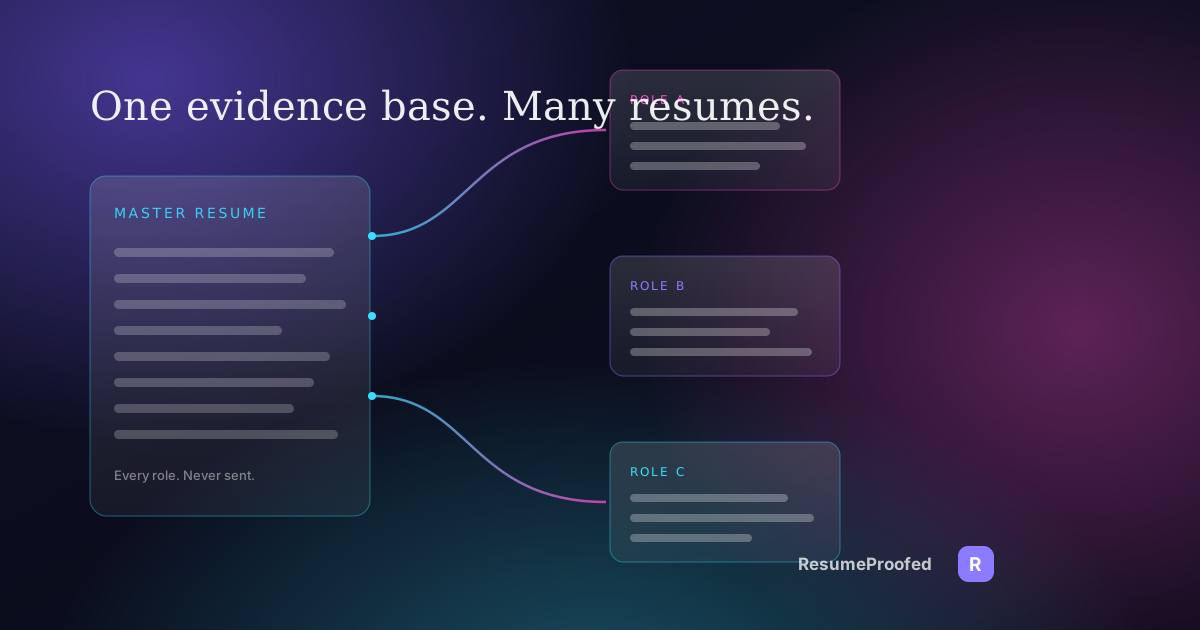
A master resume is not a longer resume. It is an evidence file you never send, and confusing the two is why tailoring one takes an hour, not ten minutes.
- Master resume
- Résumé writing
- Career management
Every time a new role catches your eye, you open your resume, stare at a document built for the last job, and start deleting and rewriting under deadline pressure. Forty minutes later you send something that fits reasonably well and captures maybe half of what you have actually done.

That forty minutes is not a tailoring problem. It is a missing document problem.
What a master resume actually is
A master resume is not a longer resume. That single confusion is responsible for most of the wasted time people spend on job applications, so it is worth being precise about it.
A tailored resume is a one or two page pitch, built for one reader, one role, one moment. It is deliberately incomplete: it leaves out anything that does not help this specific application, because a hiring manager will give it roughly thirty seconds and a recruiter will scan it for specific terms before reading a word of prose.
A master resume is the opposite kind of document. It is not a pitch at all. It is a private, comprehensive record of every role you have held, every quantified result you can defend, every licence and certification with its real status, every tool you have used and at what depth, and every project worth remembering, whether or not it ever appeared on a resume before. It can run to six or eight pages without embarrassment, because nobody except you will ever read it end to end. Its job is to be complete and true, so a tailored resume can be assembled from it in minutes rather than reconstructed from memory each time.
Think of it as the difference between a warehouse and a shopfront. The shopfront, your tailored resume, displays a small, chosen selection for one customer. The warehouse, your master resume, holds everything you have, indexed well enough to find the right item fast. Nobody browses a warehouse, but everybody needs one behind the shopfront.
Once you see the distinction, the failure of "one resume for everything" becomes obvious. A single resume tries to be both documents at once, and it does neither well. Kept short, it discards facts a future role will need. Kept long to preserve those facts, it becomes the unfocused document that loses a reader's attention. A master resume fixes this by taking the completeness job away from the document you send, so the document you send can stay short on purpose.
Why the one-resume-for-everything approach quietly fails
When a company opens a role, a recruiter is frequently facing a stack of a few hundred applications, not thirty. Their first pass is rarely a careful read of each one. It is a search: they open the applicant database and type a term, a tool name, a certification, a scope word like "multi site" or "P&L". Only the results that surface get the careful read.
If every application you have ever sent is a variant of the same static resume, you are searchable only for the handful of terms that happened to be in that document at the time you last edited it, usually in a hurry, for a role that is not this one. A genuine strength you have, say, six years running vendor negotiations, might sit buried under a summary line written for a different kind of job, and it will never surface for a search on "vendor management" because the phrase simply is not on the page. We wrote a full breakdown of how recruiters search resumes by keyword if you want the mechanics, but the short version is this: what is not written down cannot be found, and a single all-purpose resume can only ever contain a fraction of what is true about you.
A master resume fixes this at the source. Because it holds every fact you can defend, you are never trying to recall in the moment whether you have any experience with a particular system or standard. You search your own document instead of your memory, and the tailored resume you send ends up covering more of what a recruiter is actually searching for, honestly, because the facts were captured once when they were fresh rather than reconstructed under a deadline months later.
There is a second, quieter cost to the single resume habit: facts decay faster than you expect. The exact percentage from a project two years ago, the precise headcount on a team you led, the correct name of a system you used briefly then moved on from, these are sharp for a few weeks and blurry within a year. A master resume captures them while they are sharp.
What belongs in a master resume

Completeness is the entire point, so build wide rather than narrow. A master resume should contain, at minimum:
Every role, not just the recent or relevant ones. Include the job you think is irrelevant now. A skill or story from ten years ago occasionally becomes the exact evidence a future application needs, and you cannot tailor with a fact you deleted.
Every quantified achievement you can defend, attached to the role that produced it. Not "improved efficiency" but the real before and after number, even an estimated one, clearly marked as an estimate if it is not exact.
Every licence, ticket, and certification, with its real status. Issue date, expiry if it has one, issuing body. Half remembered certifications are worse than none, because you will either omit something true or risk overstating something lapsed.
Every tool, system, and method you have used, tagged with how recently and how deeply. "Used daily for three years" and "touched briefly on one project" are both worth recording, and worth being honest about which is which.
Projects outside your formal roles. Volunteer work, committee membership, a side project, a community initiative you ran. These often hold your best leadership stories precisely because nobody assigned them to you.
The story behind each significant bullet. A short note, in your own words, on what the situation actually was, what you specifically did, and what happened as a result. This is the part almost everyone skips, and it is what saves you at interview. A bullet point proves a claim happened; the story is what you say when someone asks you to walk them through it, and reconstructing that from a five word bullet six months later is far harder than writing three sentences now, while you still remember.
A master resume you can copy
Here is a section by section structure, with sample entries for a fictional operations manager named Priya Chandran, so you can see what a genuinely useful master resume looks like rather than an abstract description.
1. Header. Name, phone, email, city, LinkedIn or portfolio link. No formatting effort spent here, this document is never sent.
2. Roles, reverse chronological, one block per job.
Operations Manager, Coastal Freight Solutions, Mar 2021 to present Context: regional freight and warehousing operator, 3 depots, 140 staff. Responsibilities: owned depot scheduling, safety compliance, and vendor contracts across all 3 sites; managed a team of 6 supervisors. Achievements:
- Cut average dispatch delay from 46 minutes to 19 minutes across 3 depots by rebuilding the scheduling process, over 8 months.
- Reduced lost time injuries from 11 to 2 in one financial year after redesigning the site induction and daily checklist process.
- Renegotiated 4 vendor contracts, saving approximately $210,000 annually, without a service level reduction. Tools: NetSuite (daily, 3 years), Deputy rostering (daily, 3 years), SAP (monthly reporting only, 1 year). Story notes: the dispatch delay project started because a single depot manager flagged recurring afternoon backlogs. Built a shared whiteboard system first as a manual test before the digital rollout, so I had proof the approach worked before asking for budget.
Warehouse Supervisor, Coastal Freight Solutions, Jul 2018 to Feb 2021 Context: single site, 45 staff, high seasonal volume swings. Achievements:
- Improved inventory accuracy from 91% to 98.5% over 6 months by introducing weekly cycle counts.
- Onboarded and trained 30 seasonal staff across 2 peak periods with zero safety incidents. Tools: Excel (advanced, daily), early NetSuite exposure (weekly, final year).
3. Licences and certifications. Forklift licence (LF), issued 2017, current. White card, issued 2016, current. Certificate IV in Warehousing Operations, completed 2019.
4. Education and training. Any formal study, short courses, and internal training programmes worth naming, with dates.
5. Projects outside the core role. Volunteer logistics coordinator, community flood relief effort, 2022: organised transport for donated goods across 6 collection points in 4 days.
6. Skills inventory. A flat, honest list grouped by category, tagged with recency: systems (NetSuite, Deputy, SAP, Excel), compliance (WHS auditing, incident investigation), people (rostering for teams up to 12, seasonal hiring).
7. Master list of accomplishments. This is the section most people never build, and it is the highest value one. Pull every quantified achievement out of its role and into one flat pool, tagged by theme rather than by job: cost savings, safety, process speed, people leadership, revenue, compliance. When a job ad wants "cost reduction" evidence, you search this list by theme instead of rereading every role from scratch.
The maintenance routine
A master resume that is accurate today and stale in six months has lost most of its value, so treat updating it as a habit, not a project.
Set a recurring 15 minute slot at the end of each quarter, or trigger it off a milestone: finishing a project, a performance review, changing teams, gaining a certification. In that window:
- Add any new responsibility or role change since the last update.
- Log any new quantified result while the number is still fresh in your head, not six months from now when you have half forgotten it.
- Check licences and certifications for anything approaching an expiry date.
- Remove or downgrade tools you have not touched in a long time, and mark ones you have picked up.
Fifteen minutes a quarter is roughly one hour a year. Compare that to the alternative, which is trying to reconstruct three years of achievements from memory the night before an application is due, and the trade is not close.
From master resume to a tailored one-pager
This is the payoff. Once the master resume exists, tailoring a resume to a specific job description stops being a rewriting exercise and becomes a selection exercise, which is a much faster job.
- Read the job ad and note its three or four genuine priorities, ignoring the wallpaper phrases.
- Search your master resume's achievement list for entries matching those priorities, across every role.
- Pull the strongest 5 to 8 achievements into a new one page draft, ordered by the ad's priorities.
- Trim each bullet's wording to the ad's own vocabulary where it is honestly accurate, without changing the fact.
- Cut anything that does not serve this application, however impressive. It belongs in the master resume, not necessarily here.
- Proofread against the master resume itself, not memory, to confirm every number and date matches the source.
Because every fact already exists, verified and numbered, this process runs in ten to fifteen minutes rather than the forty or sixty it takes drafting sentences from scratch under deadline pressure.
Build yours today: a 60 to 90 minute first pass

The first build is the only slow part, and it is worth doing properly once rather than patching a thin version repeatedly. Block 90 minutes with no interruptions and work through this order.
- List every job, reverse chronologically (10 minutes). Company, title, dates, one line of context, skeleton only.
- Write every responsibility as a plain fact under each role (15 minutes). What you actually owned, not the job description you were hired against.
- Attach a real number to every outcome you can (20 minutes). The slowest, most valuable step. No exact figure, write your best honest estimate and mark it as one.
- Add licences, tickets, and certifications with their real dates (5 minutes).
- Add projects and volunteer work with their outcomes (10 minutes).
- Build the skills inventory, grouped and tagged by recency (10 minutes).
- Write one to three sentences of story notes for your 5 strongest achievements (15 minutes). Situation, what you did, what happened.
- Save it as a single dated file, with the date at the top so future updates are obvious.
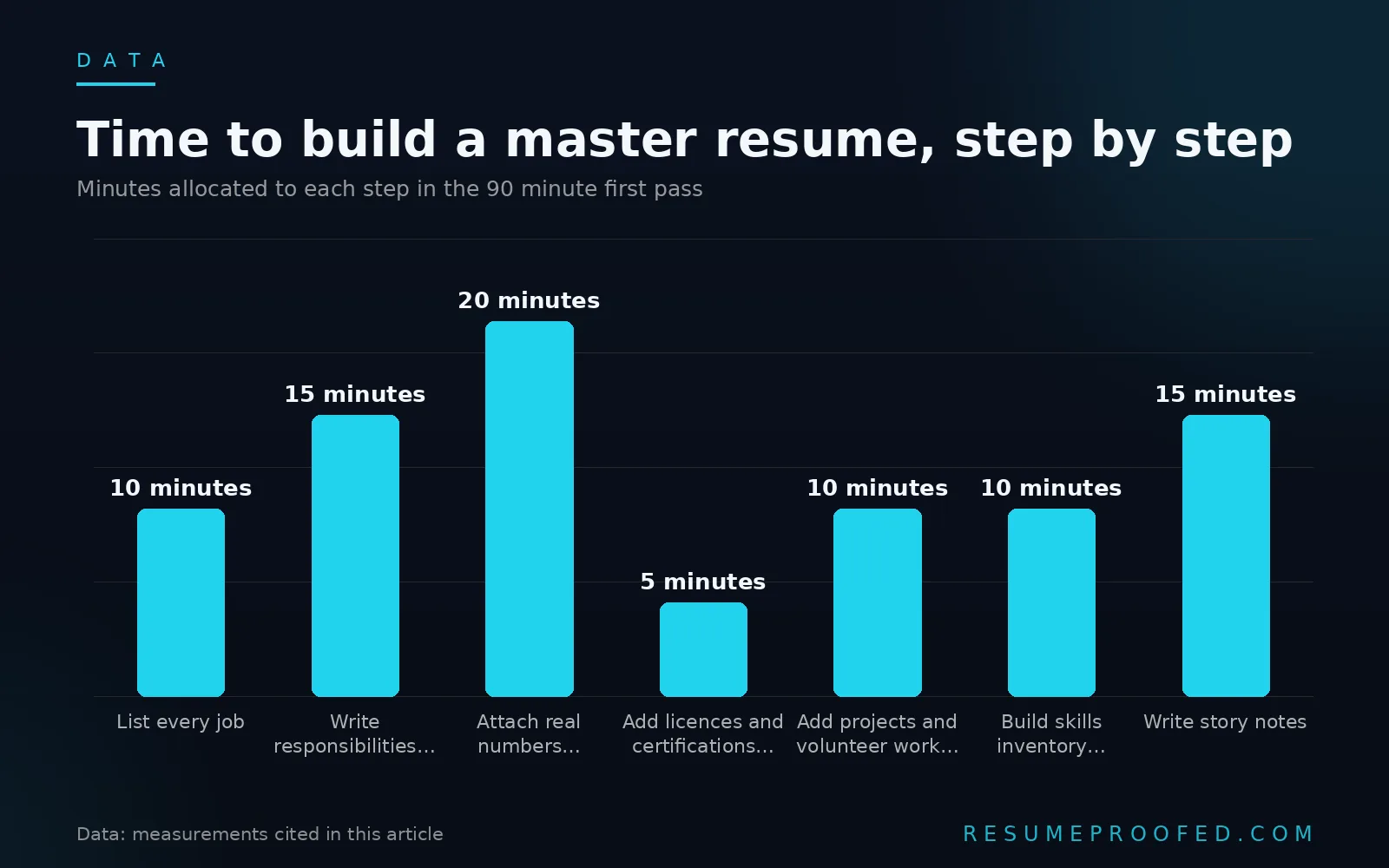
Ninety minutes once, against ten minute tailoring for every application after that, is the whole argument for building this before you need it rather than during your next deadline.
How ResumeProofed handles this
ResumeProofed's Master Profile is this exact concept, built into the product rather than left as a habit you maintain in a spreadsheet.
You paste your existing resume once, and the AI extracts it into structured, individual facts: roles, dates, achievements, tools, certifications. You review every extracted fact yourself before anything is saved, because the value of a master profile collapses the moment it holds a fact you cannot stand behind. Once confirmed, it is locked and versioned, so it stays a stable source rather than something that quietly drifts.
From there, every job description you paste in produces a tailored resume and cover letter, drawn only from that verified evidence, in one of 4 ATS-safe templates, with Word export. The free tier includes 2 generations, no card required, so you can test the whole loop before deciding whether it is worth paying for. Paid plans start from A$29 a month.
It will not invent an achievement you never had, and it will not claim an official ATS score exists, because no such universal score does. What it removes is the forty minutes of rebuilding a resume from memory each time, because that work happened once, properly, when you built the profile.
Common questions
What is a master resume?
A master resume is a private, comprehensive record of your full work history: every role, every quantified achievement, every licence and tool, kept in one place and never sent to an employer. It is the source material a tailored resume is built from, not a resume itself.
How is a master resume different from a tailored resume?
A master resume is complete and can run to several pages, because only you will read it. A tailored resume is a short, selective document built from that source for one specific job, one page or two at most, with everything irrelevant left out.
What should go in a master resume?
Every role with real dates, every quantified achievement attached to the role that produced it, every licence and certification with its real status, every tool tagged by depth and recency, projects outside your formal roles, and a short story note behind each significant achievement for interview preparation.
How do I make a master resume?
Block 90 minutes, list every role you have held, write out every responsibility and achievement under each one with real numbers, add your licences and skills inventory, then write brief story notes for your strongest achievements. Update it in a 15 minute pass after every quarter or milestone.
How often should I update my master resume?
Roughly every quarter, or immediately after a milestone such as finishing a major project, a performance review, or gaining a certification. Updating close to the event matters because specific numbers fade from memory within months.
Can a master resume be too long?
No, within reason, because length is not a problem for a document nobody else reads. A master resume that is thin and short is the real failure mode, since it means facts you might need for a future application were never captured at all.
Try ResumeProofed free: two tailored applications on the house, no card required.