Teal vs Jobscan: which should you pay for?
Teal tracks your search and drafts bullets from a free base tier. Jobscan scores what you already wrote for $49.95 a month. Here is how to actually choose.
- Job search
- Resume tools
- ATS
You have narrowed a long list of job search tools down to two names that keep coming up: Teal and Jobscan. Both want real money for the full version, and most comparison posts either recommend one on affiliate commission or bury the differences under a features table nobody reads. You need a plain answer to which one earns a subscription for how you actually search.

Here is the position worth stating early: Teal and Jobscan are not really competing for the same job. Teal is a job search workflow tool, tracker first, with a resume feature and a keyword matcher built in. Jobscan is a resume scoring tool, diagnosis first, with a tracker bolted on as a paid extra almost nobody signs up for on its own. Which deserves your money depends entirely on your actual bottleneck: staying organised across dozens of applications, or knowing precisely which words a specific resume is missing.
What each tool actually is
Teal: a job search workflow with a resume tool attached
Teal was founded in 2019 by Dave Fano and David Goldberg in New York, and it has grown to over 650,000 members on one core idea: most job seekers fail not because their resume is bad but because their search is disorganised, so Teal built the tracker first and the resume tools around it. The free plan, called Free Forever, is generous for a category that usually paywalls everything past a first look: unlimited job tracking with a kanban board, a Chrome extension that saves listings as you browse, a basic resume builder with ten templates, and a one-time allotment of AI credits (ten resume bullets, two professional summaries, two cover letters) to try the writing tools before you commit.
The keyword side is called Match Score: paste a job description against your resume and it returns a percentage along with matched, missing, and suggested keywords split into hard and soft skills, updating in real time as you edit. On the free plan that breakdown is capped to your top five missing keywords, with the full list behind Teal+. Teal also runs a separate, free LinkedIn Profile Review tool, no paid plan required for that part.
Teal+ costs about US$29 a month as of mid 2026, with a weekly option quoted anywhere from $9 to $13 depending on the source, a quarterly plan around $79, and an annual plan around $179, roughly $15 a month if you commit for the year. Prices here move without much notice, so confirm the current numbers on Teal's pricing page before you subscribe. Teal+ unlocks unlimited AI credits, the full Match Score breakdown, every template, and resume analytics.
Jobscan: a resume scoring tool with everything else attached
Jobscan was founded by James Hu in 2014, after eight months of unemployment spent reverse engineering why his own applications were going nowhere. It is a private, Seattle based company, and resume optimisation is its entire business rather than one feature among many. We have reviewed it in full elsewhere, but the shape that matters here is simple: the match rate scanner is the product, and the job tracker, cover letter scanner, and LinkedIn optimiser are adjacent tools built around it, most locked behind the paid plan.
The free tier gives five resume scans a month with a full keyword gap report each time, plus formatting checks for the things that genuinely confuse a parser: tables, text boxes, headers holding your contact details. That is a complete diagnostic, just a rationed one. The paid plan is $49.95 a month with no commitment, or $89.95 billed every three months, about $29.98 a month, roughly a 40 percent discount for committing to the quarter. An annual plan runs close to $300 for the year. Paying unlocks unlimited scans, the cover letter tools, LinkedIn optimisation, and the job tracker, a kanban board with its own browser extension, not available on the free plan.
Neither tool's match percentage is an official verdict from anywhere. No mainstream applicant tracking system issues a score a third party tool can see, and both Teal's Match Score and Jobscan's match rate are each company's own invented metric, useful as a proxy for keyword coverage and nothing more.
Head-to-head on what actually matters
Tailoring help
Jobscan gives you a list and stops there; every rewrite is manual, every single time you apply. Teal goes further: its AI credits will draft a bullet, a summary, or a cover letter section, phrased against the job description's language. That is faster, and it comes with a catch. The draft is generated from what the job ad says it wants, not from a fact you confirmed actually happened, so a bullet claiming a skill you do not have will read just as confidently as one that is true. You still have to check every AI-generated line against your history before you send it, which narrows the time saved.
Keyword analysis

Jobscan's is the more mature single-scan report. Even on the free plan, each of your five scans gives the complete breakdown: matched terms, missing hard and soft skills, and formatting warnings, all at once. Teal's free tier shows only your top five missing keywords per scan, with the full list gated behind Teal+, so a free Teal user gets a narrower diagnostic than a free Jobscan user, with far more scans available to run it on since tracking and building are unlimited either way.
Application tracking
This is where the two tools stop being comparable. Teal's tracker is free, unlimited, and central to the product from day one. Jobscan's tracker is a paid-only feature bundled into the same $49.95 subscription, competently built but not differentiated on its own. If tracking is your pain point, Teal solves it for free.
Teal's LinkedIn Profile Review is free, no subscription required. Jobscan's LinkedIn optimiser is genuinely useful and fairly rare (most resume tools ignore LinkedIn entirely), but it sits behind the same paid plan as everything else.
Price per application
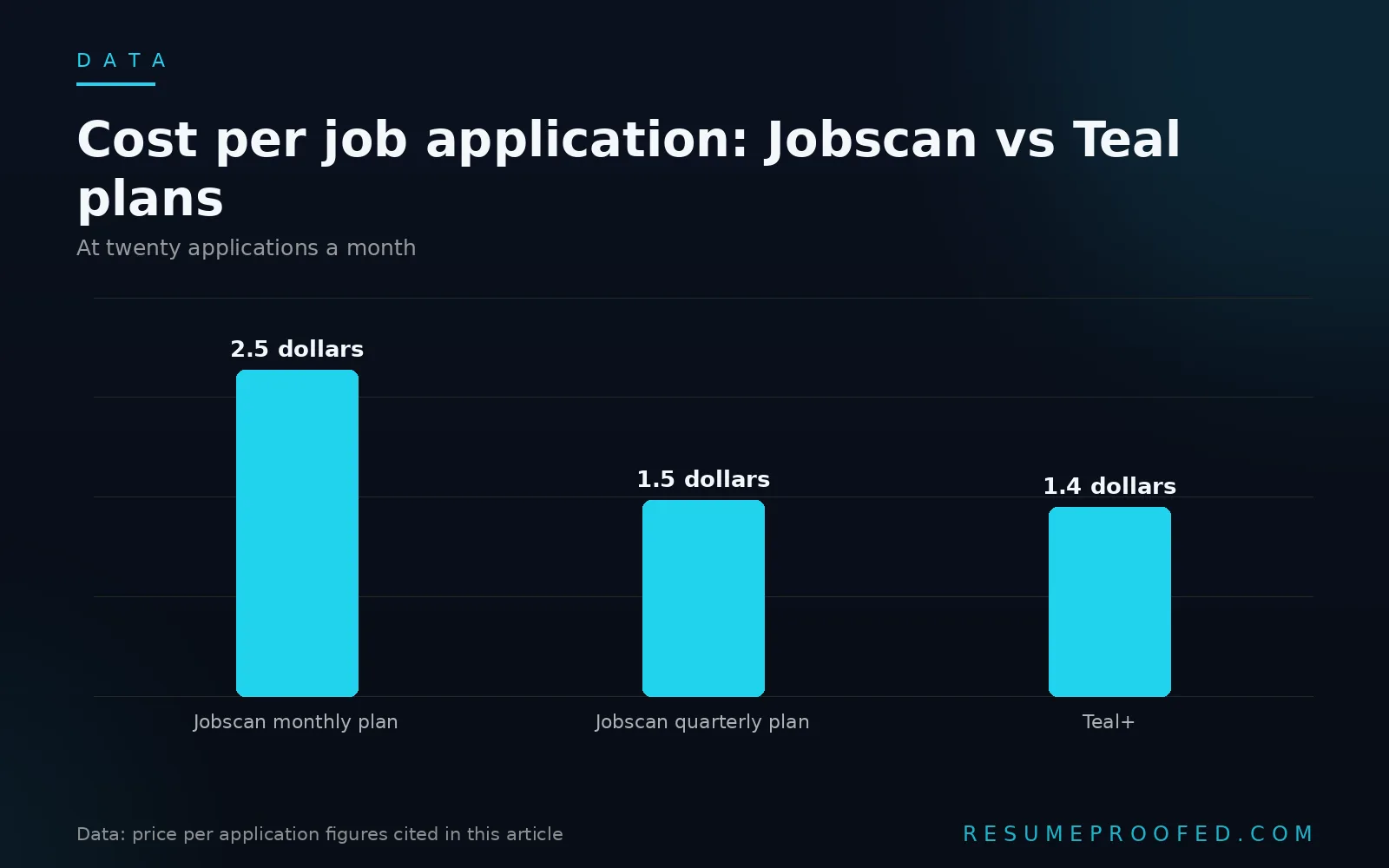
Run the maths rather than the sticker price. At twenty applications a month, Jobscan's monthly plan works out to roughly $2.50 per application, or about $1.50 on the quarterly plan. Teal+ at roughly $29 a month works out to about $1.45 per application at the same volume, and that includes a tracker you would have had for free anyway. At low volume, five applications a month or fewer, both free tiers cover the need without a subscription to either.
Output quality
Neither tool hands you a finished, ready-to-send resume. Jobscan hands you a list only. Teal hands you a draft, faster but carrying a fact-checking burden the tool cannot see, because it has no way to know what you actually did versus what the job ad merely wishes you had done. That is the gap the rest of this article keeps circling back to.
Teal vs Jobscan, compared
| Dimension | Teal | Jobscan |
|---|---|---|
| What it is | Job search workflow, tracker first | Resume scoring tool, diagnosis first |
| Founded | 2019, New York | 2014, Seattle |
| Free tier | Unlimited tracking, 10 templates, top 5 keyword matches, one-time AI credits, free LinkedIn review | 5 full resume scans a month, complete keyword and formatting report each time |
| Paid price (about, mid 2026) | Teal+ around US$29/month, roughly $79/quarter, roughly $179/year | $49.95/month, or $89.95 billed quarterly (about $29.98/month) |
| Keyword analysis | Real-time Match Score, full breakdown on Teal+ only | Match rate with hard and soft skill gaps, complete on every scan including free |
| Content generation | Yes, AI drafts bullets, summaries, and cover letters from the job ad | No, diagnostic only, all writing is manual |
| Job tracker | Free and unlimited, core to the product | Paid only, bundled with Premium |
| LinkedIn tool | Free profile review, no subscription needed | Paid optimiser, gated behind Premium |
| Best for | People whose search is unmanaged and want tracking plus light AI help | People who write well themselves and want a fast, accurate gap list |
Prices in this category shift often and neither company is shy about changing plans, so treat the figures above as a mid-2026 snapshot and check each tool's own pricing page before you commit a card. For the fuller detail on Jobscan specifically, including its refund policy and a minute-by-minute walkthrough, see our Jobscan review.
A worked example: the same application, two tools

Take a realistic scenario. You are applying for a Customer Success Manager role, your resume is eighteen months old, written for a slightly more junior title, and it undersells the renewal and upsell work you have actually been doing.
Running it through Jobscan. Paste the resume and job ad in, and within seconds you get a match rate, typically 55 to 65 percent for a resume this out of date, plus a ranked list of missing terms: things like "renewal forecasting," "churn reduction," "customer health scoring," and a formatting flag if your layout uses two columns. Nothing is written for you. You spend the next fifteen to twenty minutes deciding which terms you can honestly support, finding the bullet where each belongs, and rewriting the sentence so it reads like an accomplishment rather than a keyword dropped at the end. Re-scan, the percentage moves, and if it is still under Jobscan's own suggested 75 percent guideline you repeat the loop. Call it twenty-five minutes, almost all of it writing.
Running it through Teal. Paste the same job ad into Match Score and you get a similar keyword gap, though on the free plan you only see the top five missing terms. With a Teal+ credit, you can ask the AI to draft a bullet using one of them, and it hands you something like "Reduced customer churn through proactive health scoring and renewal forecasting" in seconds. That is faster than writing it yourself, and it is also unverified: did you actually reduce churn, or did the tool infer that from the job ad? You still need to check the sentence against what really happened, which eats back some of the time saved. Because you found the listing through Teal's Chrome extension, it is already logged in your tracker, which Jobscan will not do unless you are separately paying for its own tracker.
Net time is close either way, roughly fifteen to twenty five minutes depending on how much editing the AI draft needs.
The real difference is not speed, it is what each tool leaves you holding: Jobscan leaves you with a rewrite you wrote and verified yourself, and Teal leaves you with a faster draft that still needs the same verification pass, applied to someone else's sentence instead of a blank page.
Who should actually pick which
Pick Teal if your search spans dozens of listings and you have lost track of what you sent where, if a free LinkedIn check matters to you, and if you are comfortable treating AI-drafted bullets as a starting point you will fact-check. At roughly $29 a month, Teal+ is the cheaper paid plan and it throws in tracking you would otherwise manage in a spreadsheet.
Pick Jobscan if you already track applications some other way, you write confidently and mainly want a complete list of what is missing before you edit, and you apply in high enough volume that the diagnostic pays for itself. The quarterly plan at roughly $30 a month is the more defensible buy; the full $49.95 monthly price is hard to justify beyond a single test month.
Pick neither, for now, if you only apply to a handful of roles a month. Jobscan's five free scans and Teal's free tracker plus one-time AI credits will carry a modest search without a subscription to either.
The gap neither tool fills
Here is the honest limitation that applies to both products equally, and it is where our own product sits, so weigh what follows accordingly.
Jobscan never writes anything. Teal writes, but from the job description's language, not from a fact base you have confirmed is true. Neither starts from your actual, verified career history and builds a tailored document from it; one skips the writing step entirely, the other writes without checking. That gap, a rewrite sourced from evidence you have personally confirmed rather than language borrowed from the job ad, is the third thing this category is missing, and it is the specific problem ResumeProofed was built to solve. For the fuller landscape of tools trying to close that gap, our Jobscan alternatives roundup covers six of them, Teal included.
Where ResumeProofed fits, honestly
We should say plainly that ResumeProofed is a competitor to both tools described here, and we built it, so weigh what follows accordingly.
Our position, stated directly: if what you need is tracking, pick Teal, its free tracker is genuinely one of the best in the category and we do not build one at all. If what you need is scoring, a fast, accurate keyword and formatting diagnostic you will act on yourself, pick Jobscan, it is the more mature product for that job. If what you need is a done-for-you tailored rewrite built from facts you have personally verified, that is the gap neither closes, and it is where we sit.
ResumeProofed works from a master profile you build once: an evidence interview pulls out your actual accomplishments, you confirm each one, and pasting a job description then generates a tailored resume and cover letter using only that confirmed evidence, nothing invented from the job ad's wishlist the way an AI-drafted bullet can be. It comes with four ATS-safe templates and exports to Word, and the free tier gives two full generations with no card required, paid plans starting around A$29 a month.
The honest limits matter just as much as the pitch. We do not have a job tracker, so if losing track of applications is your actual problem, Teal solves that and we do not. We have no LinkedIn tools at all, ground both Teal and Jobscan cover. We offer four templates, not the ten Teal gives you. If you want a percentage to chase and enjoy the editing yourself, Jobscan remains a solid, honest tool for that. Our own Proof Score measures how well a tailored resume is backed by evidence you confirmed, and like every score in this article, it is not, and never claims to be, an official ATS verdict, because no such thing exists for any tool to claim.
Common questions
Is Teal better than Jobscan?
Neither is straightforwardly better, because they solve different problems: Teal is stronger for tracking a search and light AI drafting help, Jobscan is stronger for a fast, complete keyword and formatting diagnostic. Choose based on which step of your search is actually stuck, not on star ratings.
How much does Teal cost?
Teal's free plan is usable on its own, with unlimited tracking and a one-time batch of AI credits. Teal+ costs about US$29 a month as of mid 2026, with weekly, quarterly, and annual options that get cheaper per month the longer you commit; confirm the current figures on Teal's pricing page first.
How much does Jobscan cost?
The monthly plan is $49.95 with no commitment. The quarterly plan is $89.95 billed every three months, about $29.98 a month. An annual plan runs close to $300 for the year, and a free tier gives five resume scans a month.
Does Teal have a free plan that is actually usable?
Yes. Teal's Free Forever plan includes unlimited job tracking, the Chrome extension, ten resume templates, a top five keyword match preview, a one-time allotment of AI credits, and a free LinkedIn profile review, more than most competitors give away without a card on file.
Can Teal or Jobscan guarantee more interviews or a passing ATS score?
No, and be wary of any tool that claims to. No mainstream applicant tracking system issues a pass or fail score a third party tool can see, and interview outcomes depend on the recruiter, the role, and the market, not on software.
Which has the better job tracker, Teal or Jobscan?
Teal's, clearly. It is free, unlimited, and central to the product from day one, while Jobscan's tracker is a paid-only feature bundled into the same $49.95 subscription as its scoring tools.
Try ResumeProofed free: two tailored applications on the house, no card required.