Resume Worded review: is the free resume score worth acting on?
Resume Worded ranks first for resume score and draws over 600K monthly visits. What its free score checks, what Pro costs, and where it falls short.
- Job search
- Resume tools
- ATS
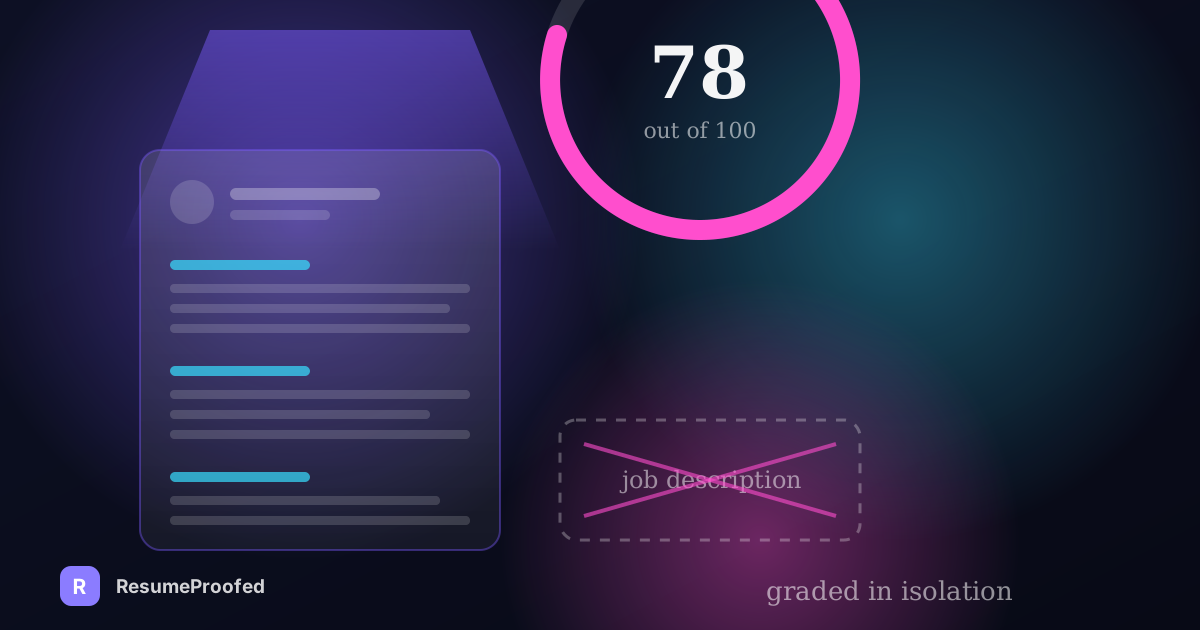
Type "resume score" into Google and Resume Worded is the first result you land on. According to Semrush's traffic overview, checked in August 2026, the site ranks in position one for that exact phrase, which carries roughly 14,800 monthly searches, and pulls in around 608,540 organic visits a month overall. Almost all of that ranking power sits on one page: Score My Resume, a free tool that grades your resume out of 100 in under a minute, no account required to see the number.

The honest question, once you have that number in front of you, is what it actually means. Is a 78 a real diagnosis or a hook designed to sell you the fix? Here is the position worth stating early: the free score is a legitimate, well built writing and formatting check. It is also, by design, blind to the one thing that decides whether a resume gets a callback: whether it matches the specific job you are applying for. That gap between what the score measures and what a reader actually needs to know is the whole story of this review.
What Resume Worded actually is
Resume Worded was founded in 2018 by Rohan Mahtani and has grown into a bootstrapped, self funded company based in Mountain View, with no outside investment on record according to its Crunchbase profile. The product line has expanded well past the free score tool over the years: a resume optimiser, a LinkedIn profile checker, a cover letter tool, and a library of keyword and skills pages for specific job titles, all built to rank for the long tail of career search terms. The free score tool is the front door. It is the page almost everyone arrives through, and it is the page this review is really about.
What Score My Resume actually checks
You upload a resume as a PDF or Word file, under 2MB, and the tool scans it without asking for a job description first. Within seconds it returns a score out of 100, described on the Score My Resume page as the output of more than thirty automated checks, with the exact number varying by career level, grouped into four areas: impact and quantification, brevity and style, growth and leadership signals, and ATS formatting compatibility. A companion page, the score guide, describes a slightly leaner twenty plus checks across three groupings instead of four, impact, brevity, and style. The two pages do not fully agree on the count, which is a small but telling sign that the number itself is a marketing shorthand rather than a fixed formula.
The score bands are consistent across both pages, though. Ninety and above is described as exceptional, with nothing left that a hiring manager would typically flag. Eighty five to eighty nine is strong, with minor refinement left. Eighty to eighty four is solid but needs targeted bullet point work. Below eighty means substantial room to grow. Resume Worded's own guidance states a good score sits at 85 or above, ideally 90 plus.
What actually gets checked, in practice, is writing craft rather than job fit. Impact scoring flags weak action verbs like "assisted" or "helped" and rewards bullets that lead with a measurable result. Brevity and style scoring catches filler words, buzzwords, passive voice, and resumes that run too long. Growth and leadership scoring looks for evidence of ownership, teamwork, and analytical thinking scattered through your role descriptions. ATS formatting checks whether a parser can actually read the file: consistent date formats, sensible section headings, and no contact information buried somewhere a parser will not look. All of that runs against your resume alone. There is no field to paste in a job ad on this particular tool, and the score does not change based on what role you are targeting.
On the free tier you get the score itself, the ranked list of top issues behind it, and the ability to re-upload and re-score after you make changes. The paid tier adds line-by-line feedback tied to individual bullets, AI rewriting suggestions, and a feature called AutoFix that rewrites flagged lines for you automatically.
What Pro actually costs
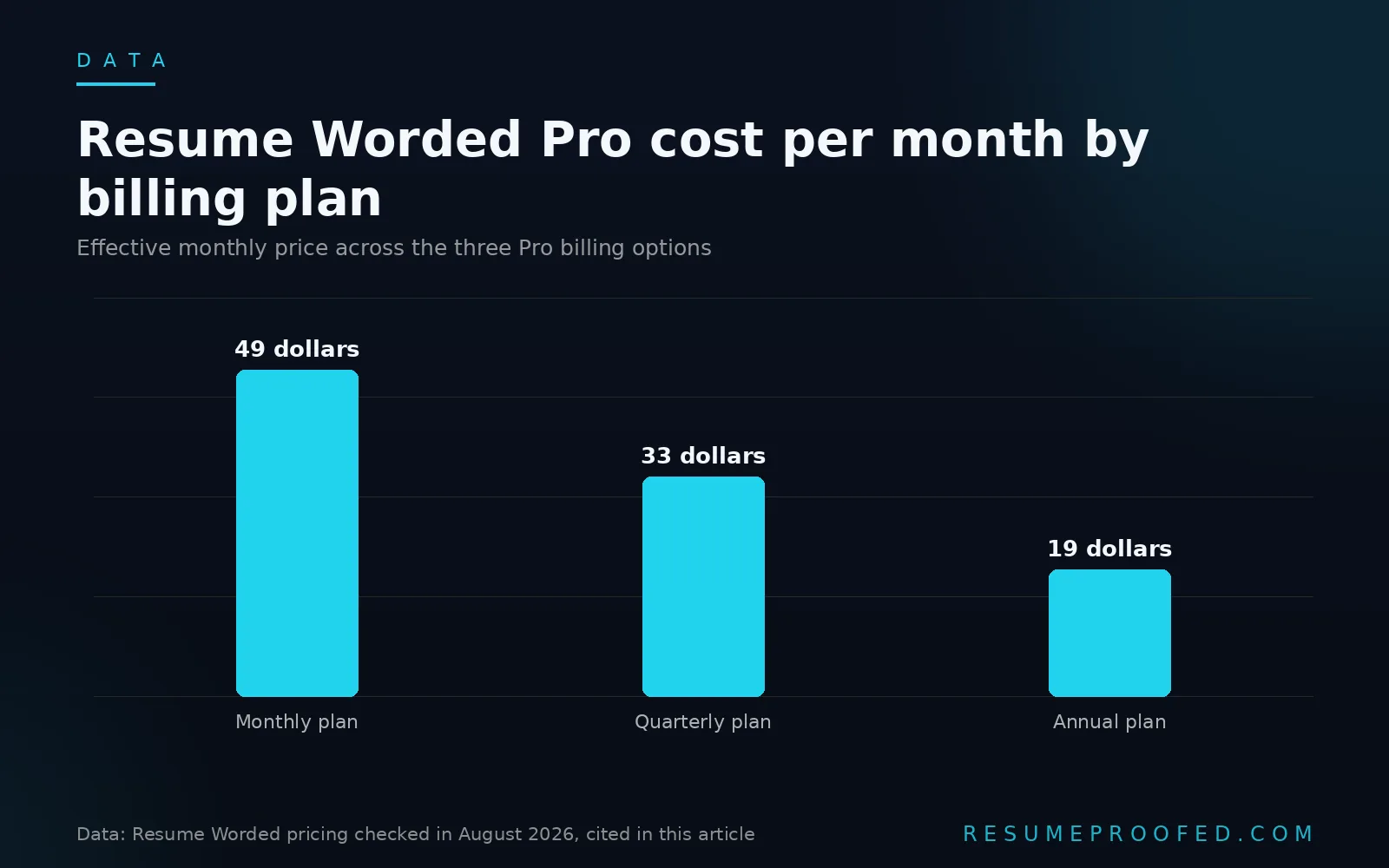
As of pricing checked in August 2026, Resume Worded Pro runs three tiers: $49 a month with no commitment, $99 billed every three months which works out to roughly $33 a month and is marked as the most popular option, and $229 billed annually, close to $19 a month and marked as the best value tier. All three are cancel anytime. Prices in this category move without much notice, so check Resume Worded's own pricing page before you commit a card.
The refund policy is worth reading before you subscribe rather than after. First-time Pro buyers are not eligible for a refund, and the stated reasoning is that enough free functionality exists to evaluate the product before paying. Existing subscribers get a narrow three day window to request a credit if a renewal charges before the plan is cancelled. Trustpilot shows Resume Worded sitting at a strong 4.8 out of 5 from close to three thousand reviews as of early 2026, though Trustpilot itself has flagged the company's review solicitation practices as a pattern worth scrutinising, which is worth knowing even though it does not on its own tell you the product is bad.
Where the free score is genuinely useful

Give credit where the checks are real. The action verb and quantification scoring catches something that quietly wrecks a huge share of resumes: bullets that describe a duty rather than an outcome. "Managed a team" tells a reader nothing "Managed a team of eight, cutting onboarding time from six weeks to three" does not tell them far more effectively, and the tool is reasonably good at flagging the first kind of sentence and nudging you toward the second.
The formatting checks are also grounded in real parsing risk rather than invented rules. Icons standing in for the word "email", contact details stuck in a header, inconsistent date formats: these genuinely confuse some parsers, and catching them costs you nothing on the free tier. We have written before about how much of the fear around applicant tracking systems is built on a myth about a resume score that does not exist inside any real ATS. Resume Worded's checks, to its credit, mostly stay in the lane that does matter: is this document well written, and will a parser read it correctly, rather than claiming to simulate a pass or fail gate no mainstream system actually runs.
For a first pass on a resume that has gone stale, badly written bullets, missing numbers, an outdated format, the free score will find real problems and describe them clearly, without a credit card.
Where a generic score is the wrong tool
Here is the limitation that matters most, and it is structural rather than a bug: Score My Resume grades your resume against itself. It has no job description in the loop. A score of 82 tells you the document is reasonably well written in isolation. It does not tell you whether you are the right candidate for the Senior Product Manager role you are about to apply for, because the tool never sees that job ad in the first place.
That distinction is not academic. Two resumes can each score 85 on Score My Resume, one built for a data analyst role and one for a marketing manager role, and both scores will look equally confident, equally polished. Neither score moves an inch based on whether the specific vocabulary, tools, and requirements of your actual target job appear anywhere in the document. A resume can be well written and still miss the handful of terms a recruiter is searching for on a given req, and the free score has no way to tell you that, because measuring it was never the job it was built to do.
To be fair to Resume Worded, it is not entirely blind to this problem. A separate free page, Targeted Resume, does let you paste in an actual job posting alongside your resume and returns a relevancy score built from keyword overlap, closer in spirit to what Jobscan's match rate does, and we cover that comparison in more depth in our Jobscan review. The catch is discoverability: almost nobody arrives at Resume Worded through Targeted Resume. They arrive through Score My Resume, because that is the page ranking first for "resume score", and a first time visitor has no obvious reason to know a second, job-specific tool exists behind a different link. The tool that gets found is the generic one. The tool that actually answers "will this get me an interview for this job" is a click most visitors never make.
This is the same isolation problem we think about constantly in our own product. A resume that grades well in a vacuum and a resume that matches a specific job ad are two different things, which is why ResumeProofed generates its Proof Score only after you paste in the actual job description you are applying against, never before, so the number reflects fit to that role rather than polish in general.
Resume Worded at a glance
| Question | Answer |
|---|---|
| Founded | 2018, by Rohan Mahtani, bootstrapped |
| Free score tool | Score My Resume, 0 to 100, no job ad required |
| Job-specific free tool | Targeted Resume, keyword match against a pasted job ad |
| Pro monthly | $49, no commitment |
| Pro quarterly | $99 every three months, about $33 a month |
| Pro annual | $229 a year, about $19 a month |
| Refund policy | None for first-time buyers, three day window for existing subscribers |
| Ranking | Position one for "resume score", roughly 608,540 monthly organic visits |
A worked example

Take a resume that has not been touched in two years, written for a mid-level operations role, competent but generic. Run it through Score My Resume and a realistic first result lands somewhere in the high 70s: a handful of duty-phrased bullets flagged for missing numbers, a couple of buzzwords like "team player" called out, maybe a formatting note about an inconsistent date style. Fix the flagged bullets, add real numbers where you have them, re-upload, and the score climbs into the mid to high 80s. That is a genuinely better written resume by the end of it, and it cost nothing.
Now apply that same, freshly improved resume to an actual job posting for a Senior Operations Manager role requiring specific experience with vendor contract negotiation and inventory forecasting software. Score My Resume has no way to tell you whether either term appears anywhere in your document, because it never saw the job ad. You could have an 88 on the generic score and still be missing the two phrases a recruiter is searching for on that specific requisition. Only a tool that takes the job ad as an input, whether that is Resume Worded's own Targeted Resume, a scanner like Jobscan, or a tailoring tool built around one, can tell you that.
Who should use the free score, and who needs more
If your resume has not been reviewed by anyone in years and you suspect it reads like a list of duties rather than results, Score My Resume is a genuinely useful, zero cost first pass. Run it, fix what it flags, and you will have a materially better generic resume by the end.
If you are already applying to a specific role and want to know whether that resume matches that job, Score My Resume is the wrong tool for the question, even though it is the one you will land on first. Use Targeted Resume instead, or a dedicated match scanner, or paste the job ad into a tool built to compare the two documents directly. Paying $49 a month for Pro mainly buys automated rewriting of what the free score already told you was wrong, which is a reasonable trade if you want the editing done for you and dislike doing it yourself, and a weak one if a generic score was never the diagnostic your job search actually needed.
Common questions
Is Resume Worded's free resume score actually accurate?
It is accurate at what it measures: writing quality, quantification, and ATS formatting risk in your resume considered on its own. It says nothing about whether that resume matches a specific job you are applying for, because the free score tool does not take a job description as an input.
How much does Resume Worded Pro cost?
As of pricing checked in August 2026, Pro is $49 a month with no commitment, $99 billed every three months at roughly $33 a month, or $229 billed annually at roughly $19 a month. Confirm current prices on Resume Worded's own pricing page before subscribing, since prices in this category move.
Can I get a refund from Resume Worded?
First-time Pro purchases are not refundable, based on the reasoning that free features exist to evaluate the product beforehand. Existing subscribers have roughly a three day window to request a credit if a renewal is charged before cancellation goes through.
What is a good Resume Worded score?
Resume Worded's own guidance describes 85 and above as strong, with 90 plus considered exceptional and clear of the issues its checks flag. Below 80 signals real room for improvement in the underlying writing and structure, according to the checks the tool runs.
Does Resume Worded compare my resume to a specific job description?
The flagship free tool, Score My Resume, does not. A separate free tool called Targeted Resume does let you paste in a job posting and returns a relevancy score based on keyword overlap, but it is a different page from the one most visitors land on first.
Is Resume Worded better than Jobscan?
They overlap on keyword and formatting checks but differ on emphasis: Resume Worded's flagship tool is stronger on writing craft and quantification, judged without a job ad, while Jobscan's core product is built specifically to compare your resume against a pasted job description. Our Jobscan review covers what that $49.95 a month buys you in more detail, and our Teal vs Jobscan comparison covers a third option if tracking your search matters as much as scoring it.
Try ResumeProofed free: two tailored applications on the house, no card required.