Jobscan review: is it worth $49.95 a month in 2026?
An honest Jobscan review: how the match rate actually works, what the free tier really gives you, and whether $49.95 a month earns its keep.
- Job search
- Resume tools
- ATS

Jobscan is the tool most job seekers land on first when they go looking for an "ATS resume checker". It has been around since 2014, it ranks for almost every relevant search term, and its match rate percentage has become shorthand across job search forums for whether a resume is "good enough" to send. The question worth answering honestly is whether the $49.95 a month behind that percentage is buying you something real.

We think the honest answer is: partly. Jobscan measures something genuinely useful, the keyword overlap between your resume and a job description, and it measures it competently. What it does not do is fix your resume, and the gap between diagnosis and treatment is where most subscribers either get their money's worth or waste it.
What Jobscan is and who makes it
Jobscan was founded by James Hu in 2014, after eight months of unemployment during which he researched, largely by trial and error, why his own applications were going nowhere. That origin story matters a little, because it explains the product's shape: it was built by someone reverse engineering the applicant tracking process from the outside, not by a recruiting platform opening its own black box. Jobscan is a private, Seattle based company, not a side feature of a larger job board, and resume optimisation is its entire business.
The core product is the resume scanner: paste in your resume and a job description, and it returns a match rate percentage along with a breakdown of missing hard skills, soft skills, and formatting issues. Around that core sit a handful of adjacent tools: a cover letter scanner and generator, a LinkedIn profile optimiser that scores your headline and summary against a target role, and a job application tracker with a kanban board and a browser extension for saving listings as you browse.
How the match rate actually works
The match rate is a keyword comparison, not a judgement. Jobscan parses your resume and the job description you paste in, pulls out the hard skills, soft skills, and recurring terms from the job ad, then checks how many of them also appear in your resume. The percentage it shows you is roughly the proportion of that vocabulary you have covered.
That is a useful diagnostic and a limited one, and it is worth being precise about which. It tells you, accurately, whether the language a recruiter is likely to search for exists somewhere in your document. It does not tell you whether that language is well used, well evidenced, or attached to a real accomplishment. A resume that pastes "stakeholder management" into a skills list at the bottom scores the same as one that demonstrates stakeholder management inside a specific, numbered bullet. The tool cannot see the difference, because it is counting words, not reading sentences.
Jobscan itself recommends aiming for a match rate around 75%, while noting that pushing meaningfully higher usually means overstuffing keywords rather than genuinely improving the resume. That is a candid admission worth taking at face value: even Jobscan's own guidance concedes there is a ceiling past which the score stops correlating with quality. We have written before about the wider version of this problem, the belief that an actual ATS scores your resume out of 100 and rejects you below a cut-off. No mainstream applicant tracking system does that. Jobscan's match rate is the company's own invented metric, shown to you, not a number any recruiter or hiring system ever sees. It is a reasonable proxy for keyword coverage. It is not, and Jobscan does not claim it is, an official verdict from anywhere.
What it does well

Credit where it is due, because several things here are genuinely well built.
The keyword gap analysis is fast and specific. Within seconds of pasting a job description, you get a ranked list of terms present in the ad but missing from your resume, split into hard skills and soft skills. For someone applying broadly across a specific industry, that list is a quicker way to spot a gap than reading the job ad three times yourself.
The formatting checks catch real problems. Jobscan flags issues like tables, text boxes, headers and footers holding contact details, and non-standard section titles, all of which can genuinely scramble how a parser reads your document. This overlaps with basic ATS hygiene rather than inventing new rules, which is exactly what you want from a formatting checker.
The LinkedIn optimisation tool fills a gap most resume tools ignore entirely. Recruiters search LinkedIn as often as they search an applicant database, and a profile with thin keyword coverage in the headline and summary is genuinely less discoverable. Scoring that surface against a target role is a legitimately useful, and fairly rare, feature.
The job tracker is a straightforward, well executed kanban board, and pairing it with a browser extension that saves listings as you find them removes a real piece of friction from a high volume job search. It is not a differentiated idea, but it is done cleanly.
Pricing: what the free tier really gets you
Jobscan's pricing sits on three tiers. The free plan gives you five resume scans a month with basic keyword gap analysis, no card required to start. The monthly plan is $49.95, billed every month with no commitment. The quarterly plan works out to roughly $29.98 a month, billed as $89.95 every three months, which is close to a 40% discount against paying monthly, but only if you commit to the full quarter up front. An annual option runs close to $300 for the year.
Five scans a month sounds workable until you consider how a real job search runs. Each scan is one resume against one job description, and if a single round of edits and a re-check counts as two scans, five gives you two and a half applications a month before you hit the wall. For someone applying to one or two roles a month, the free tier might be enough. For anyone running a genuine high volume search, meaning ten or more applications a week, it is a taster, not a workflow, and the paywall arrives quickly.
The refund policy is worth checking before you subscribe rather than after: user reviews consistently describe a very tight refund window, honoured only shortly after purchase and only on unused plans. We have not verified the exact terms against Jobscan's current policy page, so read it yourself before committing, but the pattern of complaints is consistent enough to take seriously, alongside general grumbling that a resume feedback tool at this price point should include more of the fix, not just the diagnosis.
Where it falls short
The structural limitation is simple to state: Jobscan tells you what is missing and leaves the writing entirely to you. The match rate is a diagnosis without a treatment. You still open your resume, decide where each missing term belongs, phrase it so it reads like a sentence a human wrote rather than a keyword drop, and re-check. That loop can run five or six times before a resume clears 70%, and every one of those cycles is manual editing, not something the subscription does for you.
The bigger risk sits inside that loop: score-chasing. Once a percentage is visible and climbing it becomes the goal, it is easy to optimise the number instead of the sentence. We have written in detail about why the underlying premise, that an ATS scores your resume out of 100 and gates it at a threshold, does not match how these systems actually work. Jobscan's match rate is a real and useful signal, but it inherits the same trap the myth does: treat 75% as a pass mark and you will happily paste in keywords a recruiter's eye will immediately flag as unnatural. Reviewers who have used Jobscan for a while report exactly this pattern, resumes that climb the percentage while reading noticeably worse, dense with terms that do not connect to anything the candidate actually did.
There is also no evidence review built in. Jobscan checks whether a word exists in your document. It has no way of knowing whether "led a cross functional team of 12" is true, exaggerated, or invented, because that is not the problem it was built to solve.
Worked example: one application, start to finish

Here is what running a single, realistic application through Jobscan actually looks like in practice, based on how the tool is designed to be used.
Minute 0 to 2. Paste your current resume and the job description into the scanner. The report returns almost instantly: a match rate, a hard skills list with the missing terms highlighted, a shorter soft skills list, and a formatting section flagging anything structurally off.
Minute 2 to 5. Read the missing keywords list. A typical mid-level job ad surfaces somewhere between eight and fifteen terms your resume does not currently contain: specific tools, certifications, methodologies, and role-specific phrases. Not all of them apply to you. This is the point where judgement, not the software, does the real work: deciding which missing terms reflect genuine experience and which are simply not yours to claim.
Minute 5 to 20. Rewrite. For every term you can honestly support, find the bullet where it belongs and rewrite the sentence so the term sits inside a real accomplishment rather than bolted onto the end. This is the slowest part of the process by a wide margin, and it is entirely manual: Jobscan tells you what to add, not how to phrase it.
Minute 20 to 22. Re-scan. The match rate moves, typically by ten to twenty-five percentage points depending on how many terms you genuinely had evidence for. If it still sits below Jobscan's own 75% guideline, you repeat the rewrite step for whatever remains addressable.
Minute 22 to 25. Export and apply, assuming the cover letter for this role is handled separately.
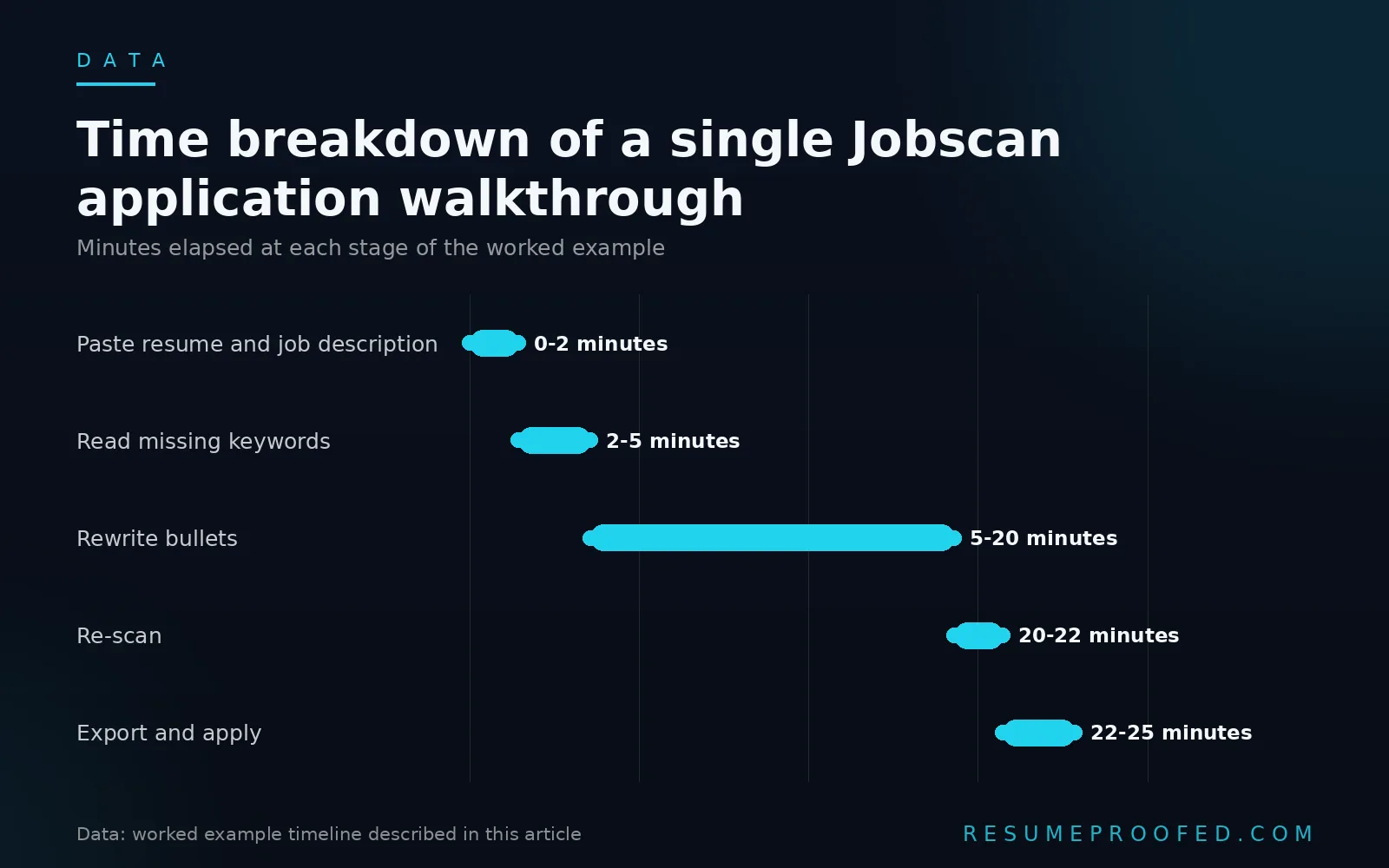
Call it twenty to twenty-five minutes per application once you know the workflow, most of it spent writing, not scanning. Across ten applications a week, that is three to four hours of editing time the software has correctly directed but has not actually done.
Who should buy it, and who should not
Jobscan makes the most sense for a specific kind of applicant: someone running a genuinely high volume search, comfortable with manual editing, who wants a fast diagnostic rather than a finished draft. If you enjoy the process of tightening a sentence and you mainly need to know what is missing before you start, the quarterly plan is a reasonable $30 a month for that signal, and the LinkedIn and job tracker tools add real value on top for a search that runs across many channels at once.
It makes less sense for someone applying to a handful of roles a month, where the free tier's five scans and a careful manual read of the job ad will get you most of the same benefit without a subscription. It also makes less sense for anyone who finds the editing loop tedious rather than satisfying: paying $49.95 a month for a list of missing words you then have to rewrite yourself, five or six times over, is a worse deal if writing is the part of job searching you want solved rather than pointed at.
The verdict
Jobscan does what it says it does, competently and without the inflated claims some competitors make. The match rate is a real, if limited, keyword diagnostic, the formatting checks catch genuine parsing risks, and the LinkedIn and job tracker tools are useful additions most rivals skip. At $49.95 a month billed monthly it is expensive for what remains, at heart, a keyword gap report you still have to act on yourself, and the quarterly plan at roughly $30 a month is the more defensible way to buy it if you decide the diagnostic is worth paying for. Our honest read: worth it for high volume, hands-on applicants who want a fast, accurate list of what is missing and are happy to do the writing. Not worth it if what you actually want is a resume that is already rewritten and ready to send.
Where ResumeProofed fits, honestly
We should say plainly that ResumeProofed is a competitor here, and we built it, so weigh what follows accordingly.
We approach the same problem from the opposite end. Jobscan scores what you have already written and leaves you to rewrite it. ResumeProofed skips the scoring step and rewrites for you, generating a tailored resume and cover letter for each job description from a verified master profile you build once, an evidence interview rather than a blank page, so nothing on the page is invented. It comes with four ATS-safe templates and exports to Word. The free tier gives you two full generations with no card required, and paid plans start from A$29 a month, roughly a third of Jobscan's monthly price.
The honest trade-off runs the other way too. ResumeProofed does not have a job tracker or a LinkedIn optimiser, and if you are managing a search across many channels and want your LinkedIn profile scored alongside your resume, Jobscan covers ground we currently do not. If you want a percentage and enjoy doing your own rewriting, Jobscan is a solid, if pricey, tool for that. If you would rather start from a document that is already tailored and edit from there, that is the gap we built ResumeProofed to close. For more on why we think the score itself is the wrong thing to chase in the first place, see our piece on the ATS resume score myth.
Common questions
Is Jobscan worth it?
For high volume applicants who want a fast keyword diagnostic and are happy to rewrite their own resume, yes, particularly on the quarterly plan at roughly $30 a month. For occasional applicants, the free tier's five scans a month usually covers the need without a subscription.
How much does Jobscan cost?
The monthly plan is $49.95 with no commitment. The quarterly plan is $89.95 billed every three months, working out to about $29.98 a month. An annual plan runs close to $300 for the year. A free tier offers five scans a month with no card required.
What is a good Jobscan match rate?
Jobscan itself recommends aiming for around 75%. Its own guidance also notes that pushing much higher usually means overstuffing keywords rather than genuinely improving the resume, so treat 75% as a rough target, not a pass mark.
Does Jobscan actually work?
It works well for what it is built to do: comparing the keyword vocabulary in your resume against a job description and flagging gaps and formatting risks. It does not rewrite your resume for you, verify that your claims are true, or guarantee an interview.
What does the Jobscan free plan include?
Five resume scans a month with basic keyword gap analysis, no payment card required to start. It does not include the cover letter scanner, LinkedIn optimisation, or the full job tracker, which sit behind a paid plan.
What is the difference between Jobscan free and paid?
The free plan caps you at five scans a month and basic keyword feedback. Paid plans unlock unlimited scans, the cover letter scanner and generator, LinkedIn profile optimisation, and the full job application tracker with its browser extension.
Try ResumeProofed free: two tailored applications on the house, no card required.