Rezi review: pricing, the Rezi Score, and where it falls short
Rezi pairs an AI resume builder with a 100-point Rezi Score. Here is what a Rezi review finds on pricing, the score, and user complaints.
- Job search
- Resume tools
- ATS
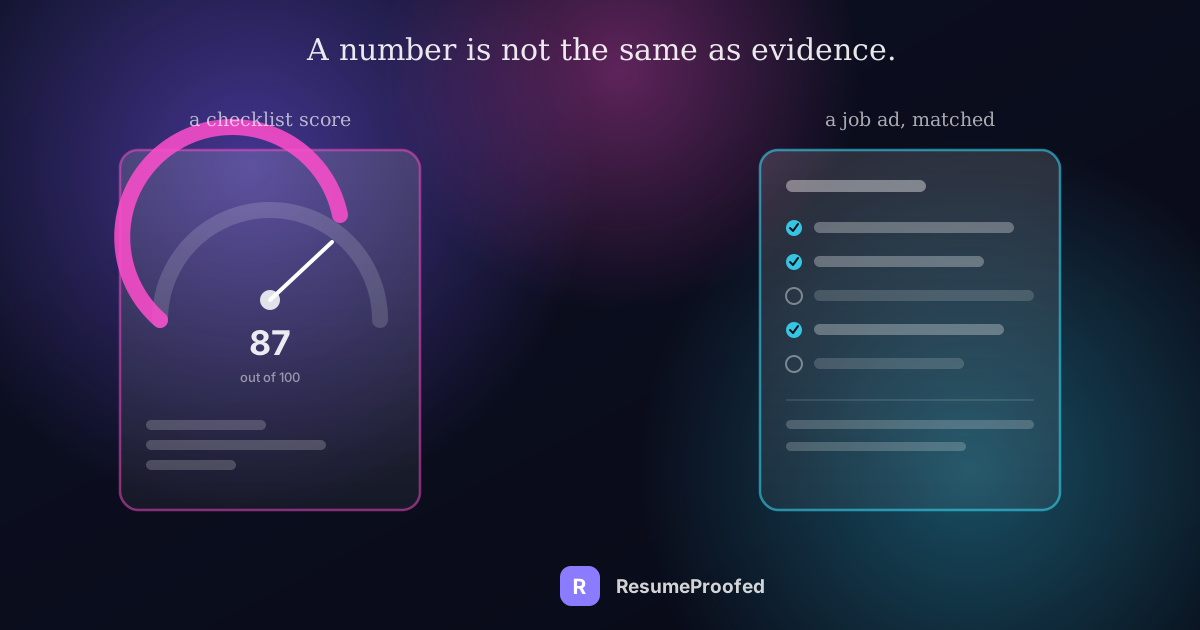
You have probably landed on Rezi because it promises a number. Paste your resume, get a score out of 100, fix what is red, watch the number climb. That is a genuinely appealing pitch when you are staring at a job application with no idea whether your resume is any good, and it is worth working out early whether the number is measuring something real before you build your whole editing process around chasing it.
The position worth stating early: Rezi is a competent, purpose-built resume builder with a real AI writer and a genuinely useful keyword-matching tool underneath the score gimmick. The Rezi Score itself is the part to treat with the most scepticism, not because it is dishonest, but because "resume readiness out of 100" sounds a lot like the mythical ATS pass mark that does not actually exist in any real applicant tracking system, and it is easy to start optimising for the number instead of the document.
What Rezi actually is
Rezi is a dedicated resume-building tool built around three things: an AI writer that drafts bullet points and summaries from a prompt, a keyword-matching feature that compares your resume against a pasted job description, and the Rezi Score, a gauge-style meter that scores your document out of 100 across categories the tool labels Content, Format, Optimization, Best Practices and Application Ready. On Rezi's own site, the pitch is that you can "know exactly where you stand" and "see it, then fix it," rather than guessing at what a recruiter or a parser might object to.
That framing matters, because Rezi is careful not to call the number an "ATS score" outright. It is marketed as a resume readiness measure, not a claim about what a specific applicant tracking system will do with your file. That is a meaningfully more honest position than some competitors take, and it is worth giving Rezi credit for it. It does not change the underlying risk for you as a user, though: a single number inviting you to chase it upward behaves the same way whether the marketing calls it an ATS score or not, and we covered why no legitimate ATS actually produces a pass-or-fail score in our piece on the ATS resume score myth. Treat the Rezi Score as one tool's internal opinion of your draft, useful as a checklist prompt, not as a verdict from the system that will actually process your application.
Pricing: what free gets you, and what Pro actually costs
As of pricing checked in September 2026, Rezi's pricing page lists four tiers.
Free costs nothing and includes one resume, one AI mock interview, three PDF downloads, the standard-format templates, the AI Resume Writer and Editor, and a limited version of the Rezi Score and keyword targeting. This is enough to build and download a genuine, complete resume with no card required, though the "limited" scoring and keyword tools are clearly there to nudge you toward the paid tier.
Pro runs $29 a month and unlocks unlimited resumes, unlimited AI mock interviews, unlimited PDF downloads, every template, the full Rezi Score and keyword targeting, and one expert human resume review included per month.
Lifetime is a one-time $149 payment for all Pro features permanently, with additional expert reviews available as a separate purchase rather than a recurring one.
Enterprise is priced at $99 a month per 200 users, aimed at universities, agencies and career centres rather than individual job seekers, and adds team management features like SSO, webhooks and domain restrictions.
All paid plans carry a 30-day money-back guarantee, which is a longer window than the 14-day refund policy we found when we reviewed Kickresume. Rezi prices in USD regardless of where you are browsing from, so the raw dollar figure is more stable across regions than tools that localise pricing, but it is still worth checking the live page before you commit a card, since any subscription tool in this category can change terms.
The Rezi Score, in more detail
The score sits front and centre in the editor as a gauge meter reading toward 100, broken into the five categories listed above. Each category expands into specific, checkable suggestions: whether your bullets start with strong action verbs, whether your dates are formatted consistently, whether the document avoids graphics and columns that could confuse a parser, and whether your summary includes enough of the target role's language.
Most of those individual suggestions are genuinely reasonable advice, and several of them line up with structural rules we have written about at length, including avoiding multi-column layouts and keeping contact details in the document body rather than a header, both covered in our breakdown of what actually breaks ATS parsing. The problem is not any single suggestion. It is the aggregate number. A resume that is honestly, specifically written about modest achievements can score lower than a resume padded with generic action verbs and buzzwords that happen to tick every formatting box, because a formatting and keyword checklist cannot tell the difference between a true, specific claim and a well-phrased empty one. If you find yourself editing a true sentence to make it sound more like what the score rewards, that is the score doing more harm than good.
Keyword targeting: the more genuinely useful feature
Separate from the overall score, Rezi's keyword targeting tool lets you paste in a job description and get back a list of terms your resume is missing. You then confirm, one by one, whether each suggested keyword genuinely applies to your experience before it gets added. That confirmation step is the right design choice: it stops the tool from silently inserting language you cannot back up, which is exactly the failure mode that makes keyword stuffing look tempting and then read badly to an actual recruiter, a problem we cover in more depth in how to find the right resume keywords in a job ad.
Used this way, keyword targeting is closer to a checklist than a shortcut: it surfaces terms you might have genuinely forgotten to mention, rather than terms to paste in regardless of whether they are true. That is the feature worth using Rezi for, more than the overall score.
What actual users report
Rezi holds a strong 4.7 out of 5 on Trustpilot from 264 reviews as of the review checked in September 2026, with 82 percent five-star and roughly 9 percent combined at one and two stars. The positive reviews cluster around a clean, modern editor, an AI writer reviewers describe as genuinely useful for drafting bullet points quickly, and support that responds fast when something goes wrong.
The recurring complaints are more specific than a generic "AI tool disappoints" story. Several reviewers note the AI writer can produce bullets that read as unrealistic or overly generic unless you feed it real detail first, the same pattern documented in our review of Kickresume's AI writer. Others flag limited flexibility in customising fonts and formatting once you have picked a template, and at least one reviewer describes a gap between Rezi's marketing claims and the actual day-to-day product experience. None of these are dealbreakers on their own, but they are worth knowing before you pay, particularly the formatting limitation if you were hoping to heavily customise a template's visual design rather than working within Rezi's defaults.
A worked example: what the score misses
Say you managed a small customer support team and reduced average response time. Written honestly and specifically: "Cut average first-response time from 6 hours to 90 minutes across a 4-person support team by introducing a shared ticket triage system." That sentence is true, specific, and defensible in an interview. Feed it through a scoring tool built around checklist categories like "strong action verbs" and "quantified impact," and it likely scores well, because it happens to satisfy the checklist and be true at the same time.
Now compare a second, less honest version: "Spearheaded transformative customer support initiatives, driving significant improvements in operational efficiency and client satisfaction metrics." That sentence contains no real number, no real scope, and nothing an interviewer could ask a follow-up question about, but it hits several of the surface-level signals a checklist-style scorer rewards: strong verbs, confident language, buzzword density. A tool scoring format and word choice rather than truth cannot reliably tell these two bullets apart, and might even score the second one higher purely on phrasing. The lesson is not that Rezi's score is useless. It is that the score measures what a checklist can measure, and the thing that actually gets you hired, true and specific evidence, is something only you can verify.
Who should use Rezi, and who needs something else
If your bottleneck is genuinely getting from a blank page to a complete, well-formatted resume with AI help drafting the language, Rezi does that job competently, and the free tier is enough to test the editor and the AI writer before paying anything. The keyword targeting feature, used with the confirm-before-adding discipline built into it, is a legitimately useful checklist against a specific job ad.
It is the wrong tool if you are relying on the Rezi Score as a stand-in for knowing whether your resume is actually good, or worse, editing true sentences to chase a higher number. A resume score, from any vendor, measures surface features a checklist can detect. It does not, and cannot, measure whether the achievement behind the sentence is real. If what you actually need is a second opinion on how a resume matches a specific job posting rather than an abstract quality score, our roundup of resume tailoring tools covers options built specifically around that comparison.
Common questions
Is Rezi worth paying for?
For the AI-assisted drafting and the keyword targeting feature, reasonably yes, and the free tier lets you test both before committing. For the Rezi Score specifically, treat it as one checklist's opinion rather than a verdict, since no real applicant tracking system produces a comparable pass-or-fail number.
How much does Rezi cost?
As of pricing checked in September 2026, Rezi Pro is $29 a month, a Lifetime plan is a one-time $149 payment, and a free tier exists with one resume, one AI interview and three PDF downloads. All paid plans carry a 30-day money-back guarantee.
Is the Rezi Score the same as an ATS score?
Not officially. Rezi markets it as a resume readiness score rather than an ATS score specifically, which is a fairer framing than some competitors use. In practice it is still a checklist-based number scoring format and word choice, not a measure any real applicant tracking system generates or that a recruiter ever sees.
Does Rezi's AI writer produce generic content?
It can, particularly if you give it only a job title or role name to work from. Reviewer feedback on Rezi matches the same pattern documented in our review of Kickresume's AI writer: specific, real detail fed in before generating produces noticeably more defensible, specific output.
Is Rezi better than Jobscan?
They solve different problems. Rezi is primarily a resume builder with AI drafting and an internal readiness score. Jobscan is primarily a match-rate scanner comparing an existing resume against a job description. If you already have a resume and want to check it against a specific ad, our Jobscan review covers that comparison directly.
Can I cancel a Rezi subscription easily?
Rezi's 30-day money-back guarantee applies to paid plans, and the Lifetime option removes the recurring billing question entirely since it is a one-time payment. Check the current cancellation process on Rezi's own account settings before subscribing if a self-serve cancel flow matters to you.
Where ResumeProofed fits, and where it doesn't
ResumeProofed does not generate a readiness score of any kind, for the same reason we would have to invent one: no real applicant tracking system produces a comparable number, so a score is always one tool's opinion dressed up as a measurement. What it does instead is tailor a resume and cover letter to one specific job ad's actual language, built from facts about your own career that you have confirmed as true, rather than checklist categories a generic sentence can satisfy just as easily as a genuine one.
ResumeProofed opens soon. Join the waitlist to be first in.