Resume Worded vs Jobscan: which should you use?
Resume Worded scores your resume free, no job ad needed. Jobscan scores it against a specific job ad for $49.95 a month. Here is the honest comparison.
- Job search
- Resume tools
- ATS
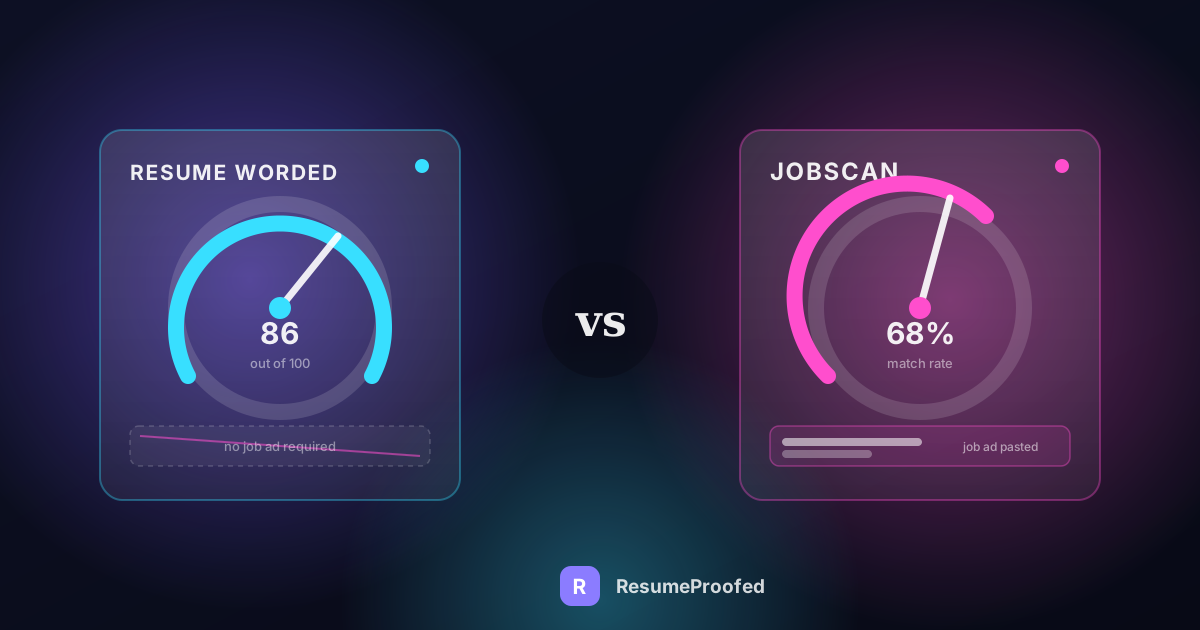
You have narrowed your search down to two names that keep showing up in every "best resume checker" roundup: Resume Worded and Jobscan. Both hand you a number. Neither one tells you, on its own, which number actually matters for the job you are about to apply for. If you are trying to work out which is better, Resume Worded or Jobscan, the honest answer depends on a question most comparison posts skip: are you asking "is this resume well written" or "does this resume match this specific job ad"? Those are two different questions, and each tool was built to answer one of them.
Here is the position worth stating early. Resume Worded's flagship tool grades your resume in isolation, for free, in under a minute. Jobscan grades your resume against a job description you paste in, for $49.95 a month once the free scans run out. They overlap at the edges, both flag weak formatting, both check for missing keywords in some form, but they are answering different questions, and picking the wrong one for your actual situation wastes either your time or your money.
What each tool actually is
Resume Worded: free instant scoring, paid rewriting
Resume Worded's front door is Score My Resume: upload a resume as a PDF or Word file and within seconds you get a score out of 100. Resume Worded's own pages do not fully agree on the shape of that score, describing it in one place as more than thirty checks across four areas, impact and quantification, brevity and style, growth and leadership signals, and ATS formatting compatibility, and in another as a leaner twenty-plus checks across three groupings, impact, brevity, and style, as we noted in our Resume Worded review. Crucially, whichever count you use, it does this without asking for a job description. The score reflects whether your resume is well written in general, not whether it matches any particular role. We covered this tool in full in our Resume Worded review, including the gap between the page almost everyone lands on and the page that actually answers a job-specific question.
That second page is called Targeted Resume, a separate free tool where you paste in an actual job posting alongside your resume and get back a relevancy score built from keyword overlap, closer in spirit to what Jobscan does. Resume Worded's own guidance says a relevancy score under 80 means your resume is missing skills the job posting is looking for. The catch is discoverability: almost nobody arrives at Resume Worded through Targeted Resume, because Score My Resume is the page ranking first in search and the one nearly every visitor lands on by default.
The free tier gets you the score, a ranked list of top issues, and unlimited re-scoring after edits. Resume Worded Pro adds line-by-line feedback on individual bullets, AI rewriting suggestions, and a feature called AutoFix that rewrites flagged lines automatically.
Jobscan: paid scoring against a specific job ad
Jobscan works the other way around: the job description is not optional, it is the whole point. Paste in your resume and a job posting together, and Jobscan returns a match rate percentage along with a breakdown of missing hard skills, soft skills, and formatting issues specific to that pairing. Run the same resume against two different job ads and you will very likely get two different scores, because the tool is measuring fit to that particular posting, not general writing quality. We covered the mechanics in detail in our Jobscan review.
The free plan gives five resume scans a month with basic keyword gap analysis, no card required to start, as we found when we reviewed Jobscan on its own. Paid plans unlock unlimited scans plus a cover letter scanner, a LinkedIn profile optimiser, and a job application tracker with a browser extension, none of which are available for free.
Pricing, checked today
Pricing in this category moves without much notice, so we re-verified both companies' current rates rather than assuming the numbers in our earlier reviews still held. As of pricing checked in September 2026, both are unchanged from what we reported in August.
Resume Worded Pro runs three tiers: $49 a month with no commitment, $99 billed every three months (about $33 a month), and $229 billed annually (about $19 a month). Refunds are not available for first-time Pro purchases, on the stated reasoning that the free tier is generous enough to evaluate the product first. Existing subscribers get roughly a three day window to request a credit if a renewal charges before cancellation goes through.
Jobscan's paid plan is $49.95 a month with no commitment, or $89.95 billed every three months (about $29.98 a month), a real discount for committing to the quarter. An annual plan runs close to $300 a year, working out to roughly $25 a month. The free plan gives five scans a month at no cost.
Here is where the jobscan vs resume worded pricing comparison actually lands: at the entry monthly rate they are close, $49 versus $49.95, near enough to call a tie. The real gap opens at the free tier. Resume Worded's free score is unlimited, re-run it as many times as you want. Jobscan's free scans are capped at five a month, and because each scan pairs one resume with one job ad, five scans covers roughly two and a half real applications once you count a re-check after edits. If you apply to more than a couple of roles a month and want Jobscan's job-specific diagnostic every time, you will hit that wall inside the first week.
Resume Worded or Jobscan for ATS formatting
Both tools run formatting checks aimed at the same underlying risk: a parser that cannot read your document correctly. Resume Worded flags inconsistent date formats, contact information stuck somewhere a parser will not look, and icons standing in for words like "email." Jobscan flags tables, text boxes, headers and footers holding contact details, and non-standard section titles. Neither tool claims to simulate a real applicant tracking system's pass or fail gate, and that restraint is correct: no mainstream ATS actually issues a score out of 100 that either tool can see. Both scores are the company's own invented metric, useful as a proxy for formatting hygiene and keyword coverage, not an official verdict from anywhere.
On formatting specifically, the two are close to equivalent. Where they diverge is scope. Resume Worded's ATS check happens without a job ad in view, so it catches structural problems (headers, dates, parsing traps) but cannot tell you whether the vocabulary a specific applicant tracking system's recruiter will search for is present. Jobscan's formatting check runs inside the same scan as its keyword match, so a single report tells you both whether your layout is parser-safe and whether the terms that job ad's recruiter is likely to search for actually appear in your document. If ATS formatting risk is your only worry, either tool answers it. If you want formatting and job-specific keyword coverage in one pass, Jobscan's structure is built for that; Resume Worded splits the two jobs across two different tools.
The shared blind spot: a score does not rewrite your resume
This is the part that matters more than either feature list. Both tools, at their core, are diagnostic. They tell you something is wrong. Neither one sits down and writes the fixed sentence for you as a default behaviour.
Resume Worded's free score will tell you a bullet reads "Managed a team" and flags it as weak on impact. It will not know that you actually cut onboarding time from six weeks to three while managing that team, because it never asked. Its paid AutoFix feature will attempt an automated rewrite, but that rewrite is generated from the pattern it expects a strong bullet to follow, not from a fact you confirmed happened.
Jobscan's match rate will tell you the job ad mentions "stakeholder management" and your resume does not. It will not tell you where that belongs, how to phrase it as an accomplishment rather than a keyword bolted onto a list, or whether you can honestly claim it at all. Every rewrite in Jobscan is manual, every single time you apply, because the product was built to diagnose the gap, not close it.
Put plainly: a score is a diagnosis, not a treatment. You still do the writing. That is true whether you paid $0 for Resume Worded's free score or $49.95 for a month of Jobscan, and it is the single biggest thing both companies leave out of their marketing pages.
A worked example: the same job ad, two tools
Take a realistic case. You are a marketing coordinator with three years of experience, applying for a Digital Marketing Specialist role. The job ad asks for hands-on experience with Google Analytics 4, HubSpot, paid social campaign management, and SEO content strategy. Your resume is competent but was last updated eighteen months ago, written for a slightly more junior title, and undersells the campaign work you have actually been doing.
Through Resume Worded's free score. You upload the resume with no job ad attached. A realistic result lands in the low 80s: a couple of bullets flagged for using "helped" instead of a stronger verb, a note about a buzzword like "results-driven," maybe a formatting flag for an inconsistent date style. You fix what is flagged, the score climbs into the high 80s. The resume reads better. It still says nothing about whether "Google Analytics 4" or "HubSpot" appear anywhere in it, because the tool never saw the job ad. If you then click through to Targeted Resume specifically and paste in that same job posting, you get a relevancy score, and if it comes back under 80, that is the tool telling you the specific gap Score My Resume could never see.
Through Jobscan. Paste the resume and the job ad in together. Within seconds you get a match rate, and for a hypothetical resume this out of date against a specific ad you might reasonably land somewhere in the 50 to 70 percent range, plus a ranked list of missing terms: "Google Analytics 4," "HubSpot," "paid social," "SEO content calendar," and a formatting note if your layout uses columns. Now you spend fifteen to twenty minutes deciding which of those you can honestly support, finding the bullet where each belongs, and rewriting the sentence so the term sits inside a real accomplishment instead of a keyword dropped at the end. Re-scan, and the percentage moves; treat any specific figure here, ours included, as an illustration rather than a number you should expect to hit. If it is still under Jobscan's own suggested 75 percent guideline, you repeat the loop.
Net time is close either way, fifteen to twenty five minutes of your own writing regardless of which tool told you what was missing. The real difference is what you are holding at the end. Resume Worded's free path gives you a better-written generic resume plus, if you find your way to Targeted Resume, a rough sense of fit to one job. Jobscan's paid path gives you a complete, job-specific gap list every time, at the cost of a subscription and a five-scan ceiling on the free tier.
Resume Worded vs Jobscan, compared
| Dimension | Resume Worded | Jobscan |
|---|---|---|
| Core question answered | Is this resume well written? | Does this resume match this job ad? |
| Job description required | No, for the flagship free score | Yes, every scan |
| Free tier | Unlimited Score My Resume checks | 5 scans a month, basic keyword gap analysis |
| Paid price (checked September 2026) | $49/month, $99/quarter (about $33/month), $229/year (about $19/month) | $49.95/month, $89.95/quarter (about $29.98/month), about $300/year |
| Job-specific free option | Targeted Resume, a separate tool | Every scan, by design |
| Rewrites for you | Pro tier: AutoFix and AI rewrite suggestions | No, diagnostic only, all writing is manual |
| LinkedIn tool | Yes, LinkedIn Review | Yes, paid LinkedIn optimiser |
| Job tracker | No | Paid only |
| Best for | A generic, stale resume that needs a writing pass | Tailoring one resume to many specific job ads |
Prices in this category shift without much warning, so treat this table as a September 2026 snapshot and confirm current figures on each company's own pricing page before you subscribe.
Who should actually pick which
Pick Resume Worded if your resume has not been touched in years, you suspect it reads like a list of duties rather than results, and you want a free, unlimited first pass before you spend anything. Run Score My Resume, fix what it flags, then use the free Targeted Resume tool once you have an actual job ad in hand. Pay for Pro only if you specifically want the automated AutoFix rewriting rather than doing the editing yourself.
Pick Jobscan if you are applying to enough different roles that a job-specific gap list every time is worth paying for, you write confidently and mainly want to know what is missing before you start, and five free scans a month genuinely is not enough for your volume. The quarterly plan at roughly $30 a month is the more defensible way to buy it over the full $49.95 monthly price.
Pick neither, for now, if you apply to a handful of roles a month. Resume Worded's free score plus its free Targeted Resume tool, used carefully, covers most of what Jobscan's paid tier offers, without a subscription. For a third option built around tracking a high-volume search rather than scoring it, our Teal vs Jobscan comparison covers that ground, and our Jobscan alternatives roundup looks at six other tools trying to close the same gap.
Where ResumeProofed fits, and where it doesn't
We should say plainly that ResumeProofed is a competitor to both tools described here, and we built it, so weigh what follows accordingly.
Both Resume Worded and Jobscan stop at the diagnosis. One scores your resume in isolation, the other scores it against a specific job ad, and both then hand the actual rewriting back to you. ResumeProofed starts from the opposite end: you build a master profile once, through an evidence interview that pulls out your real accomplishments and has you confirm each one, and then pasting in a job description generates a tailored resume and cover letter from that confirmed evidence, not from a fresh blank page and not from AutoFix guessing at a rewrite pattern. It comes with four ATS-safe templates and exports to Word. The free tier gives two full generations with no card required, and paid plans start from A$29 a month, which is less than either Resume Worded Pro or Jobscan's monthly plan.
The honest limits matter just as much as the pitch. We do not have a job tracker, so if losing track of applications across dozens of roles is your actual problem, neither Jobscan's bundled tracker nor Resume Worded solves that cleanly either, and a dedicated tool like Teal is the better fit. Our LinkedIn support is limited compared to the dedicated LinkedIn tools both Resume Worded and Jobscan offer. And our own Proof Score, like every score in this comparison, measures how well a tailored resume is backed by evidence you confirmed. It is not, and never claims to be, an official ATS verdict, because no mainstream applicant tracking system issues one that any third-party tool can see. If what you want is a percentage to chase and you enjoy doing the rewriting yourself, both tools in this comparison remain honest, competent choices for that. If you would rather start from a document that is already tailored to the job ad and edit from there, that is the gap we built ResumeProofed to close.
Common questions
Which is better, Resume Worded or Jobscan?
Neither is better in general, because they answer different questions: Resume Worded is stronger for a free, unlimited check of your resume's writing quality on its own, while Jobscan is stronger for a job-specific keyword match against a particular posting. Choose based on whether your resume needs a general writing pass or tailoring to a specific ad.
Is Resume Worded or Jobscan better for ATS formatting?
Both catch similar formatting risks, like inconsistent dates, tables, and contact details a parser might miss, so on formatting alone they are close to equivalent. Jobscan bundles that formatting check with a job-specific keyword match in every scan, while Resume Worded's ATS check runs separately from its job-specific tool, Targeted Resume.
How much does Resume Worded cost compared to Jobscan?
As of pricing checked in September 2026, Resume Worded Pro runs $49 a month, $99 a quarter, or $229 a year, while Jobscan runs $49.95 a month, $89.95 a quarter, or close to $300 a year. The monthly rates are nearly identical; the bigger difference is that Resume Worded's core score is free and unlimited, while Jobscan's free tier caps you at five scans a month.
Can I use both Resume Worded and Jobscan together?
Yes, and many job seekers effectively do, since they answer different questions. A reasonable free workflow is to run your resume through Resume Worded's Score My Resume for a general writing pass, then use its free Targeted Resume tool or Jobscan's free scans for job-specific keyword checks against the roles you are actually applying for.
Do Resume Worded or Jobscan actually rewrite my resume for me?
Not by default. Jobscan's core product is diagnostic only, giving you a gap list you rewrite yourself every time. Resume Worded's free score is also diagnostic, though its paid Pro tier adds AI rewriting suggestions and an AutoFix feature that will attempt an automated rewrite of flagged lines.
What is the best resume checker comparison to trust?
Trust comparisons that show current, verified pricing and are specific about what each tool's score actually measures, rather than ranking tools by affiliate commission. Read each company's own pricing page before subscribing, since prices in this category change without much notice.
Try ResumeProofed free: two tailored applications on the house, no card required.