LinkedIn Hiring Assistant explained: how its AI ranks you first
LinkedIn's Hiring Assistant AI sourcing agent now ranks candidates before a recruiter looks. Here is what signals it weighs, and what it cannot see.
- AI resumes
- Job search tools
- Career strategy
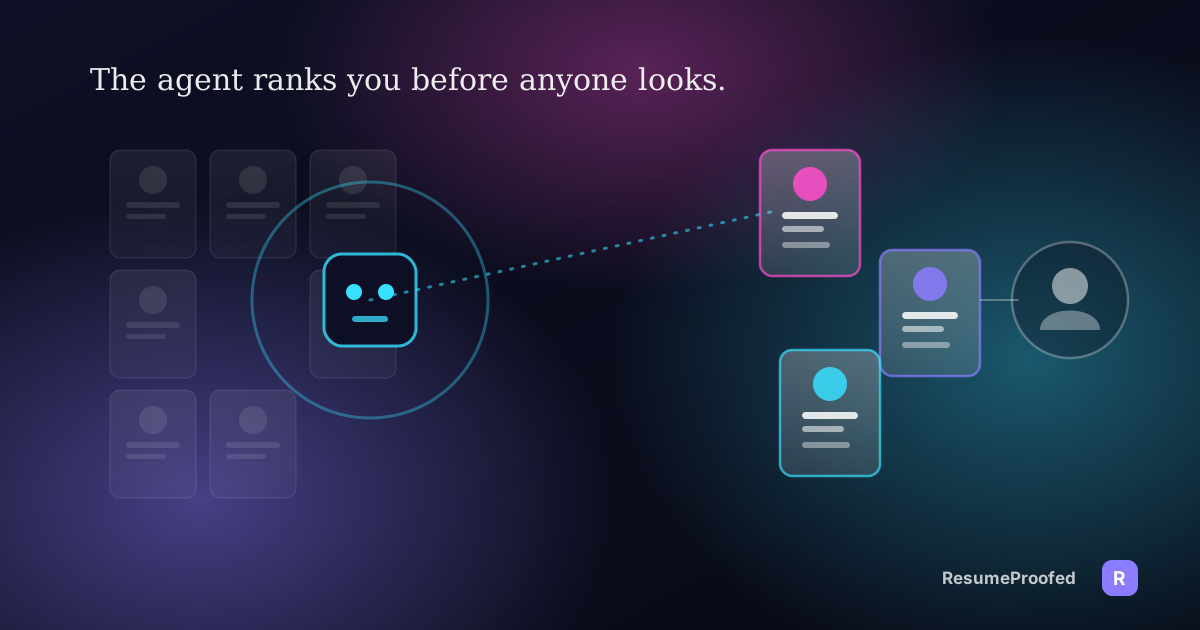
You didn't apply to this job. You never saw it. A recruiter typed a sentence into LinkedIn, an AI agent read thousands of profiles against that sentence, ranked them, and handed the recruiter a short list. If your profile wasn't in the group the agent judged worth surfacing, nobody ever made a human decision about you at all. That's not a hypothetical. It's how LinkedIn's Hiring Assistant now works, and LinkedIn is building integrations with hundreds of applicant tracking systems, including Greenhouse and Workday, that a large share of employers run their hiring through.
The position worth stating plainly: this is a different mechanism from the resume screening most job search advice already covers, and it deserves its own routine. A resume gets evaluated after you apply. A LinkedIn profile gets evaluated, or ignored, before you ever get the chance to. If you haven't touched your profile since your last job change, or if it still describes the career you're trying to leave rather than the one you're trying to enter, you can write a flawless resume for every application you send and still be invisible to a growing share of the roles you'd actually want, because nobody ever typed a prompt that matched what your profile currently says about you.
What LinkedIn's Hiring Assistant actually is
Hiring Assistant is LinkedIn's own AI sourcing agent, not a third party tool bolted onto the platform. A recruiter describes the role and the kind of person they want in a natural language prompt, something closer to a paragraph than a keyword string, and the agent searches LinkedIn's full member base against that description, ranks the results, and drafts outreach messages for the recruiter to review and send. It's built into LinkedIn Recruiter, and, as of 2026, LinkedIn is building integrations with hundreds of applicant tracking systems, including Greenhouse and Workday specifically, so a role posted and managed inside a company's ATS will eventually be able to pull candidate sourcing from the same agent without a recruiter switching tools. Tata Consultancy Services was one of the named pilot customers for the product, and has publicly described it as taking over the repetitive parts of sourcing so recruiters spend more time actually talking to candidates and hiring managers.
That's a meaningful shift from how LinkedIn search worked before. A recruiter used to type keywords and Boolean operators, "senior AND (python OR sql) AND fintech", and the results depended heavily on whether your profile happened to contain those exact words. Hiring Assistant is described by LinkedIn's own product team as working differently: matching on evidence of capability rather than a literal keyword or a job title. Hari Srinivasan, LinkedIn's VP of Product, gave a concrete example to industry press: the agent can identify someone with semantic search experience because they hold a patent in it, worked on it in a previous role, and published research on the topic, even if none of those words appear in a current job title. The tool is, in his framing, "looking across all kinds of different evidence, not making axe-like cuts based on title." That's good news if your resume already reflects a pivot. It's no help at all if your LinkedIn profile has nothing written down for the agent to find in the first place.
The numbers, and where the reporting doesn't quite agree
LinkedIn's own claims for Hiring Assistant are large enough to be worth checking against more than one source, and checking two independent write-ups turns up a real, worth naming discrepancy rather than a single tidy figure. BusinessToday reported that Prashanthi Padmanabhan, VP of LinkedIn Talent Solutions Engineering, told them customers using Hiring Assistant have seen an 80 percent reduction in the number of profiles a recruiter needs to review before deciding who to approach, alongside a 66 percent increase in InMail acceptance rates among customers using the tool. HCAmag's separate reporting, drawing on its own LinkedIn briefing, put early adopter figures at 62 percent fewer profiles reviewed and a 69 percent improvement in InMail acceptance, alongside a reported four hours saved per role filled. A third account, from SocialTalent's interview with Srinivasan, cited a 70 percent reduction in profiles viewed to reach a shortlist and a figure "nearly 70 percent" for the InMail acceptance increase.
None of these three sources contradicts the direction of the claim, and all three are citing figures that trace back to LinkedIn itself rather than independent audits, which is worth keeping in mind before treating any single percentage as precise. But the exact number moves depending on who's asked and when: 80 versus 70 versus 62 percent for the same basic metric is a real spread, not rounding noise, and none of the pieces reconciles the difference. The honest read is that Hiring Assistant is cutting the pool of profiles a recruiter manually reviews by somewhere in the region of two thirds to four fifths, a genuinely large change to how sourcing works, without a single number precise enough to quote as gospel. Industry analyst Josh Bersin, who has also interviewed LinkedIn's own product lead about the tool on his podcast, estimated the time savings for recruiters at "30 to 40 to 50%," calling it "a miraculous solution for recruiters" for taking over the administrative load of manual sourcing. Whatever the exact percentage, the mechanism is the same across every account: fewer humans looking at fewer profiles, because an AI agent already decided which ones were worth their time.
This is a genuinely different problem from the one covered in our piece on how recruiters use AI to screen resumes. That article is about what happens to an application after you submit it into a portal. This is about whether you ever get found before you apply at all, or whether a recruiter's outreach message lands in your inbox before a job posting even exists publicly.
The blind spot: AI can only see what's on the page
Here's the catch that matters more than any of the percentages above. As BusinessToday's reporting put it plainly, "AI can only evaluate candidates whose data it can access, for example having a profile on LinkedIn." That sounds obvious stated flatly, but it has a sharp practical edge. An AI sourcing agent doesn't know what you actually did in your last role, what you're capable of now, or what direction you're trying to move in. It knows what your profile says, in the words your profile uses, and nothing else. A recruiter's prompt might describe exactly the kind of hybrid, self-taught, or transitioning candidate you are, and the agent will still never surface you, not because you're unqualified, but because there's no text on your profile that maps onto the prompt's language.
Two groups are most exposed to this. The first is anyone with a genuinely incomplete profile: a headline that's just a job title, an empty or generic About section, a skills list that hasn't been touched in years. The second, and the more costly case, is anyone mid career pivot whose LinkedIn still describes the job they're leaving rather than the one they're aiming for. Your resume can be freshly tailored for every application. If your LinkedIn profile is three years stale and still reads as your old career, the sourcing agent that might have found you for the new one never gets the chance, because it isn't reading your resume. It's reading your profile, and only your profile. Our guide to writing a resume for a career change with no direct experience covers how to reframe a resume for a pivot; the same reframing has to happen on LinkedIn too, or the resume never gets its chance to be read by anyone, human or AI.
It's also worth being clear about what this isn't. It isn't a replacement for actually applying, and LinkedIn is only one channel among several worth working, alongside company career pages, referrals, and increasingly video and short-form platforms for younger job seekers, a shift we cover in TikTok versus LinkedIn for Gen Z job search. But for the large and growing share of hiring now running through Recruiter and Hiring Assistant, an outdated or thin profile is a real, quantifiable way to never be considered, independent of how strong your actual resume is.
What signals the agent is actually weighing
Evidence over job titles
The clearest description LinkedIn has given of how Hiring Assistant ranks candidates is that it looks for evidence of capability, projects, publications, patents, described outcomes, rather than pattern matching a single job title against the prompt. Practically, that means the About section and experience descriptions carry more sourcing weight than the headline alone. A headline that only repeats your current job title gives the agent almost nothing extra to match against a rich, descriptive recruiter prompt.
Skills that match how recruiters actually phrase prompts
Recruiters using Hiring Assistant write natural language, not a rigid keyword string, but the words in your Skills section and experience bullets still have to overlap with the vocabulary a recruiter would plausibly use to describe the role. If you did the work of "stakeholder management" but the word never appears anywhere on your profile, that's a real gap between what you can do and what the agent can find.
Profile completeness generally
LinkedIn has separately maintained for years that a fuller profile, one that clears its own "All-Star" completeness threshold, surfaces more often in on-platform search generally, independent of the newer AI agent layer. An empty About section, no listed skills, and a headline that's just your title stack multiple disadvantages on top of each other at exactly the moment an AI agent is deciding who's even in the candidate pool worth ranking.
Recency and active signals
A profile that hasn't been touched since a job started rarely reflects everything you've since taken on. Recruiters and sourcing tools alike treat recent activity, whether that's an updated role description, a new skill added, or a visible open to work signal set to be visible to recruiters only, as a cue that a profile is current rather than an abandoned artefact from your last job hunt.
A worked example: rewriting a profile after a pivot
Take a real shape of career change this affects directly: a high school mathematics teacher, nine years in the classroom, moving into corporate learning and development. Her resume, freshly tailored for instructional design roles, already leads with curriculum design, LMS administration, and adult training delivery. Her LinkedIn profile, unchanged since she started teaching, does not.
Before, headline: "Mathematics Teacher at Lincoln High School"
Before, About section: "Dedicated teacher with 9 years of experience helping students succeed in mathematics. Skilled in classroom management and lesson planning."
A Hiring Assistant prompt like "instructional designer with curriculum development and LMS experience" will not surface this profile. Nothing on it uses those words, and the headline reads as a career, teaching, that has nothing obviously to do with the search.
After, headline: "Instructional Designer, transitioning from 9 years in classroom education | Curriculum Development, LMS Administration, Adult Learning"
After, About section: "Instructional design professional moving from 9 years as a classroom mathematics teacher into corporate learning and development. Built and delivered curriculum for 150+ students per year, administered Canvas and Google Classroom as learning management systems, and led professional development workshops for 12 colleagues. Applying that same curriculum design, platform administration, and adult training experience to L&D and instructional design roles. Skills: instructional design, curriculum development, LMS administration, adult learning theory, stakeholder training, learning analytics."
Nothing about her actual history changed between the two versions. What changed is that the second version now contains the words a recruiter's prompt would plausibly use, and states the pivot directly instead of leaving a reader, human or AI, to infer it. That's the entire fix, and it costs an evening, not a career change.
A routine for keeping your profile visible to AI sourcing
- Rewrite your headline to name the role you want, not only the one you have. If you're mid pivot, say so directly; the agent has no way to infer intent from a job title alone.
- Rebuild your About section around outcomes and the vocabulary of your target role, not a list of duties from your current one. Aim for the specific words a recruiter would plausibly type into a sourcing prompt.
- Fill the Skills section deliberately, adding anything genuinely true of your target role even if it's not reflected in your current job title.
- Set Open to Work to recruiter only visibility if you're actively looking, since that's a direct, current signal rather than something an agent has to infer from stale text.
- Update your most recent role's description to reflect what you actually did, including anything that supports a pivot, rather than leaving the default text from when you started.
- Revisit all of this every time you meaningfully update your resume. If your resume changed for a new kind of role, your profile needs the same update, or the two documents are now describing two different candidates.
Common questions
What is LinkedIn Hiring Assistant?
It's LinkedIn's own AI sourcing agent, built into LinkedIn Recruiter, that searches and ranks candidates from a recruiter's natural language description of the role before drafting outreach. LinkedIn is building integrations with hundreds of applicant tracking systems, including Greenhouse and Workday, so sourcing will eventually be possible without a recruiter leaving their ATS.
Does LinkedIn AI screen job applicants?
Not quite in the way an ATS screens applications you've submitted. Hiring Assistant sources and ranks candidates before you apply, based on your public profile content, which is a different mechanism from the resume screening that happens after you send an application, covered in our piece on how recruiters use AI to screen resumes.
How do I optimize my LinkedIn profile for AI recruiters?
Rewrite your headline and About section to use the specific words a recruiter would plausibly type when describing your target role, fill out your Skills section completely, and make sure your most recent role description reflects what you actually do now rather than what it said on day one. Evidence and vocabulary matter more to an AI sourcing agent than a polished but generic headline.
Why doesn't my LinkedIn profile show up after a career change?
Most likely because the profile still uses the vocabulary of your old role and never states the pivot directly. An AI sourcing agent can only match against the text actually on your profile, so a resume that's already updated for your new direction won't help if your LinkedIn profile hasn't caught up.
Is LinkedIn Hiring Assistant the same as an ATS?
No. An ATS mainly manages applications you've already submitted. Hiring Assistant sources candidates proactively from LinkedIn's member base, often before a role is even posted publicly, and LinkedIn is building integrations so it will feed directly into ATS platforms like Greenhouse and Workday as part of the same hiring workflow.
Does having a complete LinkedIn profile actually matter for getting hired?
It matters for whether you're found at all in a growing share of hiring processes. LinkedIn's reported figures put the reduction in profiles a recruiter manually reviews somewhere between roughly 62 and 80 percent depending on the source, meaning an incomplete or outdated profile can mean never entering that shortlist regardless of how strong your resume is.
Where ResumeProofed fits, and where it doesn't
ResumeProofed tailors resumes to specific job ads. It doesn't touch your LinkedIn profile, and it has no visibility into how any recruiter's Hiring Assistant prompt is worded or who it surfaces, because that happens entirely on LinkedIn's own platform before an application ever exists. What this article argues, and what ResumeProofed can't do for you, is the profile side of the work: rewriting your headline, About section, and skills to reflect where you're actually heading, not just where you've been. Where ResumeProofed does help is the next step in that same pipeline, once a role is on your radar, whether you found it through a recruiter's outreach or your own search, tailoring the resume you send to that specific job's actual language.
Try ResumeProofed free: two tailored applications on the house, no card required.