AI auto-apply tools now meet AI screening agents: what that means for you
Auto-apply bots flooded job boards with applications. Employers responded with their own AI agents. Here is what that changes about how you should apply.
- AI resumes
- Job search tools
- ATS
You set up an AI tool that finds job postings matching your profile and submits an application to each one automatically, sometimes dozens or hundreds in a sitting. It felt like a fair response to a job market where you're competing against hundreds of other applicants per posting. What it actually did was put your application in front of a system the employer built for exactly this situation: an AI agent screening incoming applications with very little human involvement.

The position worth stating early: auto-apply tools and employer-side AI screening aren't two separate trends, they're a response to each other, and understanding that changes what "getting more applications out" is actually worth. Volume was a reasonable strategy when the bottleneck was your own time. Once both sides of the process run on automation, volume mostly moves the bottleneck rather than removing it, and it's worth knowing exactly where it moved to before you decide how to spend your effort.
Why application volume exploded
Joveo's 2026 Recruiting Benchmarks Report found that applicant volume grew up to 9 times in certain occupations between November 2022 and 2025. That's not a gradual increase from more people job hunting. It's a friction change: one-click apply features lowered the cost of applying, and AI auto-apply agents removed most of what was left, letting a candidate submit to hundreds of roles overnight, each with an AI-generated resume tuned to that specific posting, without the candidate personally reading most of them.
From the applicant's side, that looks like leverage. From the employer's side, it looks like a flood. A recruiter who used to receive 50 applications for a role and now receives 450 hasn't gained 400 more qualified candidates, in most cases, they've gained 400 more variations of the same handful of people applying to everything remotely relevant, submitted by tools that don't know or care whether the fit is real.
How employers responded

Joveo, the recruitment marketing platform behind that 2026 Recruiting Benchmarks Report, has outlined four countermeasures employers have adopted as a direct response to this volume in a companion blog post on AI auto-apply agents, and they're worth knowing because each one changes what actually gets your application read.
They stopped optimising for raw application counts. Recruiting teams now track completed, qualified applications and actual hires rather than total volume, which means a job ad drawing 900 applications isn't treated as 900 opportunities, it's treated as a filtering problem to solve before a human looks at any of them.
They added early knockout screening. Role-specific, conversational screening questions now filter out mismatched applicants before a recruiter ever opens a resume, which means an application that doesn't clear a basic fit check never reaches the stage where tailoring would have mattered.
They deployed their own AI agents for triage, scoring and routing. This is the direct answer to auto-apply volume: if a machine is submitting the applications, a machine screens them first. How recruiters actually use AI to screen resumes covers the mechanics of this in more detail, but the short version is that an AI system is now frequently the first reader, not a human being skimming a stack.
They track applicant-to-hire ratios and qualified-application rates by source, which means an employer can see, in aggregate, that a given sourcing channel or application pattern produces a low ratio of qualified candidates to volume, and deprioritise it, even without evaluating any single application from that channel individually.
The deeper shift: from assistive AI to autonomous agents
Separately from the volume problem, Gem, a recruiting software vendor that sells AI sourcing and screening agents, describes a shift in what employer-side AI is actually doing in a 2026 blog post. Assistive AI, the earlier and more familiar kind, suggests candidates for human review, drafts messages a recruiter edits and sends, and flags applications that need a closer look, but a person makes every real decision. Autonomous agents go further: they independently identify candidates who meet stated criteria, run personalised outreach sequences, and screen applications with minimal human intervention at each step.
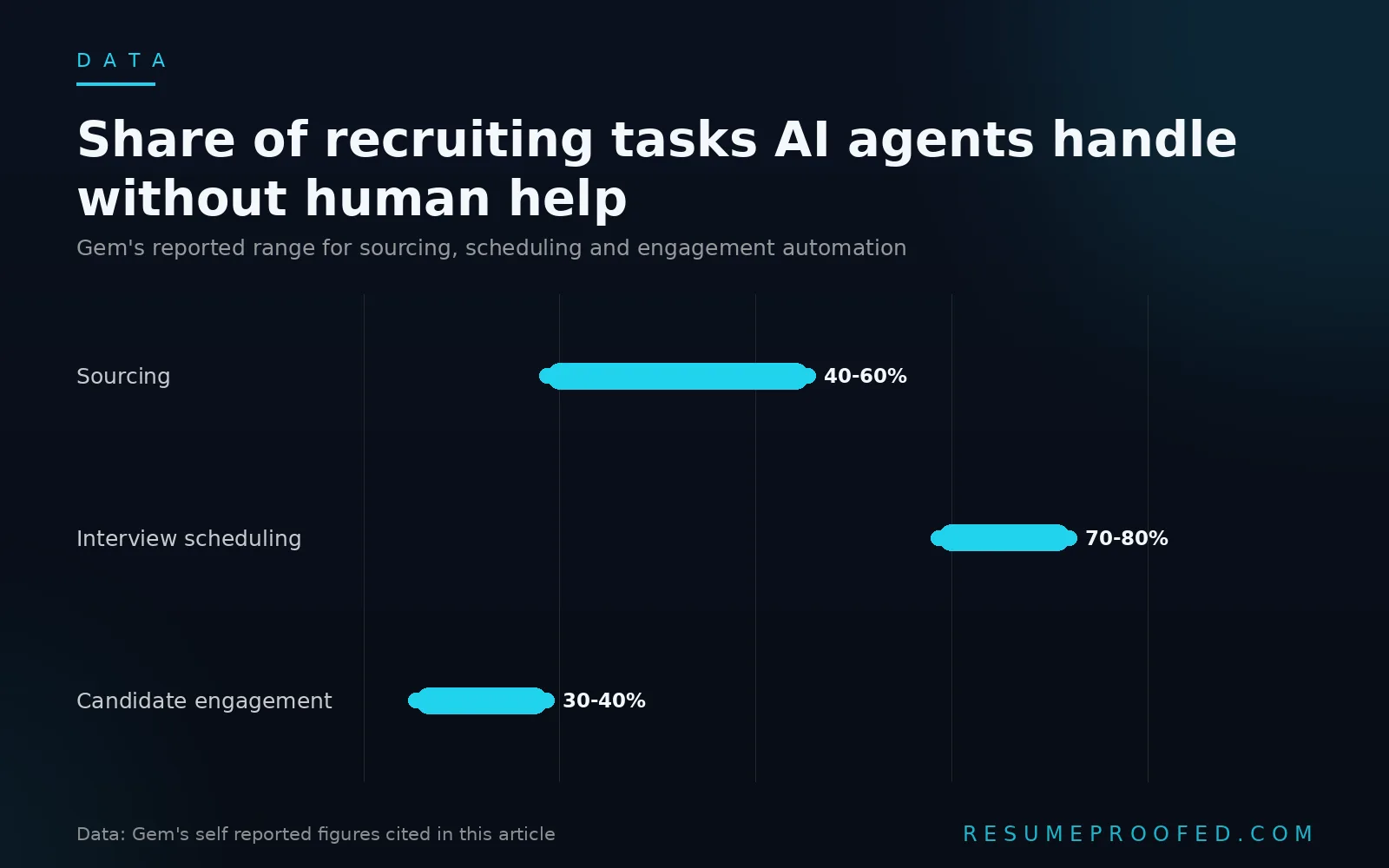
Gem's figures on how far this has already gone are specific, though they're the vendor's own reported numbers rather than an independently audited study, since Gem doesn't publish a methodology or sample size behind them: the company states that at organisations using autonomous AI agents, 40 to 60 percent of sourcing now happens without human intervention, 70 to 80 percent of interview scheduling completes automatically, and 30 to 40 percent of candidate engagement sequences run end to end without a recruiter involved. Gem also reports that recruiters using these systems can handle two to three times more open roles without adding headcount, which, if accurate, is a structural change in capacity rather than just an efficiency tweak.
Put the two findings together and the picture is direct: your AI-assisted application is often being read, first, by their AI-assisted screening system, particularly at larger employers with the volume to justify autonomous agents. Survey data on how recruiters use AI to screen resumes shows a more mixed picture at the average hiring manager level, where a human often still reviews AI-flagged results rather than an agent deciding alone, so the two findings describe different points on the same spectrum rather than a single universal rule. Neither side is lying about using automation, and neither side is doing anything wrong by using it. But it means the old assumption, that a human recruiter will eventually see your specific resume and judge it on its merits, holds later in the process than it used to, if it holds at all before a screening stage narrows the pool.
What this changes about how you should apply
The volume arms race mostly cancels itself out. If auto-apply tools let you submit to 300 postings a week, and every other applicant with the same tool is doing the same thing, and the employer's screening agent is trained specifically to separate genuine fit from AI-generated approximate matches, then raw volume stops being the lever it looks like. Our diagnostic on why you're not getting interviews makes a related point about spray-and-pray applying generally, and this AI-versus-AI dynamic is the 2026 version of the same underlying problem: more low-effort applications don't beat a smarter filter, they just get filtered faster.
What still works is the same thing that worked before AI screening agents existed, applied more precisely because the bar has moved: genuine, specific matching between your real experience and a role's actual requirements, in a form that reads as a real fit rather than an approximate one to whatever is doing the first read, human or machine. How many jobs should you apply for each week already argues that a smaller number of properly tailored applications outperforms a larger number of generic ones. The addition worth making now is that an AI screening agent is often the audience for that tailoring before a human ever is, which raises the cost of an application that only superficially matches the posting's language without genuinely fitting its requirements.
A worked example: two applicants, one posting

Both apply to the same Operations Analyst role. Both use AI tools somewhere in their process.
Applicant one runs an auto-apply tool that scans job boards for postings containing "Operations Analyst" or adjacent titles and submits a lightly templated version of their resume to each match, adjusting only the job title in the header. Across a week, they apply to around 200 roles this way, spending almost no time on any single application.
Applicant two applies to 15 roles that week, each one read in full first. For this specific Operations Analyst posting, which asks for experience with supply chain forecasting and a named inventory system, they check that their resume genuinely reflects both, add the specific system's name where it applies, and lead with a quantified achievement that matches the posting's stated priority rather than a generic operations summary.
An employer-side screening agent evaluating both applications isn't judging effort, it's evaluating match quality against the posting's actual requirements. Applicant one's resume matches on job title and a scatter of generic operations keywords. Applicant two's resume matches on the specific requirements the posting names, because they read it and adjusted for it. The screening agent has no way to reward applicant one's higher volume, because volume isn't one of the things it's measuring.
A short routine for applying in an AI-screened market
- Assume a machine reads your application first, at least at larger employers, and write for genuine match quality against the posting's specific requirements rather than for keyword density alone.
- Cap how many postings you apply to in a sitting at a number where you can still read each one fully. If a tool is submitting on your behalf faster than you could personally read the postings, you've lost visibility into what you're actually applying to.
- Check for named tools, systems or certifications in the posting and confirm your resume states them explicitly if you genuinely have them, since a generic auto-applied resume frequently misses this level of specificity.
- Track your own applicant-to-interview ratio, the same way employers now track applicant-to-hire ratios. A very high volume of applications with a very low interview rate is the same signal for you that it is for them: the current approach isn't finding genuine matches.
- Reserve any auto-apply tool for genuinely low-stakes, high-volume tiers of your search, if you use one at all, and put your real time into the smaller number of roles where a properly tailored, specific application against the actual posting gives you a real shot at clearing an AI screen and reaching a person.
Common questions
Do AI auto-apply tools actually work in 2026?
They increase how many applications you submit, but employer-side AI screening has adapted specifically to filter high-volume, low-specificity applications, so the interview rate per application from an auto-apply tool tends to be considerably lower than from a smaller number of properly tailored applications.
How much has application volume grown because of AI tools?
Joveo's 2026 Recruiting Benchmarks Report found applicant volume grew up to 9 times in certain occupations between November 2022 and 2025, driven substantially by one-click apply features and AI auto-apply agents removing most of the remaining friction to submitting an application.
Do employers really use AI to screen resumes now, not just humans?
Yes, and increasingly with limited human involvement at the earliest stages. Gem, a recruiting software vendor, reports that at organisations using autonomous AI recruiting agents, 40 to 60 percent of sourcing and 70 to 80 percent of interview scheduling now happens without human intervention, though that figure is the vendor's own reporting rather than independently audited research.
Does using an AI tool to tailor my resume still help if an AI is screening it?
Genuine tailoring, matching your real experience to a posting's actual stated requirements, still works, because a screening agent is evaluating fit against those requirements, not detecting whether AI was involved. What stops working is an approximate, generic match dressed up to look tailored.
Should I stop using auto-apply tools completely?
Not necessarily, but treat volume as a weak lever rather than a strong one. Employer-side screening has been built specifically to filter high-volume, low-specificity applications, so time spent on a smaller number of genuinely matched applications tends to outperform time spent maximising how many postings you reach.
How can I tell if my applications are being screened by AI before a human sees them?
You usually can't tell directly, but assume it's likely at any employer receiving a high volume of applications for a role, which describes most postings now. Writing for genuine, specific match quality against the posting's stated requirements works whether the first reader is a person or a system.
Where ResumeProofed fits, and where it doesn't
ResumeProofed is built for the applicant-two approach above: it tailors a resume to one specific job description at a time, drawing only on achievements you've confirmed as true, rather than submitting a volume of loosely-matched applications. It won't help you apply to 200 postings in an afternoon, because that isn't the problem it's solving. What the data above suggests is that the 200-postings approach is losing ground to AI screening anyway, which makes a smaller number of genuinely tailored applications a better use of your time, not just a more careful one.
Try ResumeProofed free: two tailored applications on the house, no card required.