How recruiters actually use AI to screen your resume in 2026
A 2026 survey of 1,000 US hiring managers shows how much of resume screening is really AI, how much is human, and where the two overlap.
- ATS
- AI resumes
- Job search
You send an application into a portal, hear nothing back, and the question that actually keeps you up is not "was I qualified" but "did a person ever see this." In 2026 that's not a paranoid question. It's a reasonable one, and it finally has a real answer instead of a guess, because hiring managers were asked directly, at scale, exactly how much of their screening process AI now touches.

The position worth stating first: AI is genuinely involved in resume screening at most companies now, but "involved" and "deciding alone" are very different things, and the survey data draws that line more precisely than the general anxiety around this topic usually allows. A large share of screening AI is assistive, ranking and flagging for a human who still reads the result. A meaningfully smaller, but real, share operates with little to no human review at all before a rejection happens. Knowing which one you're up against changes almost nothing about how you should write a resume, which is the useful part of this article.
What the 2026 data actually shows

Resume Genius surveyed 1,000 US hiring managers, screened to confirm each one was directly responsible for hiring decisions at their organisation, through Pollfish using random device engagement sampling for a demographically balanced sample. The Resume Genius 2026 Hiring Insights Report was published in January 2026 and updated in March 2026, and it breaks the AI-in-hiring question down further than most coverage of this topic bothers to.
Seventy nine percent of the hiring managers surveyed said their company has automated at least some part of the hiring process. Thirty five percent specifically use AI to screen or rank resumes or applications. That's the headline most articles stop at, and it's the number that produces the "a robot is reading my resume" anxiety. The more useful number sits one layer down: only 19 percent of hiring managers said they use AI to purposefully screen out applications before a human ever reviews them, and just 6 percent said AI is allowed to move candidates forward or reject them with limited human review. The rest of that 79 percent breaks out as 32 percent where AI recommends candidates but humans make every final decision, and 22 percent where AI is used for administrative support rather than evaluation at all.
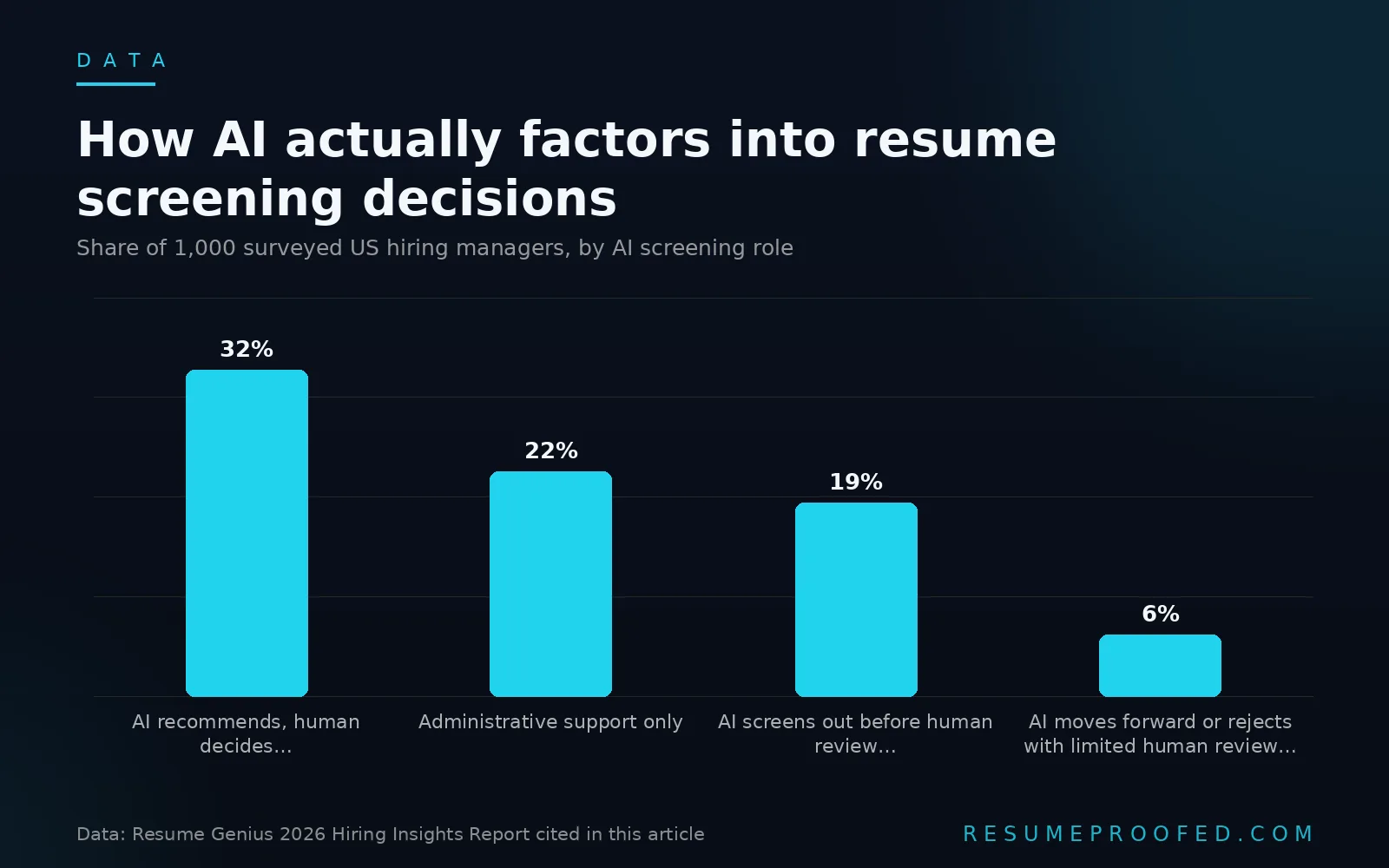
Read plainly: most AI involvement in hiring in 2026 is a human still making the call, with AI doing the sorting first. A minority, real but well short of a majority, involves a genuine autonomous rejection step before a person looks at anything.
This is a different mechanism from the ATS keyword myth
It's worth separating this from a related but distinct question we've written about before: whether a traditional applicant tracking system automatically rejects resumes based on a hidden pass or fail score. It generally doesn't, and our piece on that specific myth covers why the "75 percent of resumes never seen by a human" claim doesn't hold up against how these systems actually work.
What the 2026 data above describes is newer and different: not a keyword parser rejecting malformed formatting, but generative and predictive AI models actively ranking, scoring or filtering candidates based on the content of the resume itself, often layered on top of the ATS rather than replacing it. The two systems can coexist at the same company. A resume can clear a basic ATS parsing check and still be ranked, scored or filtered by a separate AI screening layer further down the pipeline. That's the mechanism this article is actually about.
Why this doesn't change what you should write
Here's the part that surprises people expecting a trick: none of this changes the underlying advice. Every legitimate account of what these screening layers optimise for, whether the older keyword-matching kind or the newer generative kind, comes back to the same thing a well written, specific resume already does well: clear, standard section headings a parser can identify, language that mirrors the actual job ad rather than a synonym you think sounds equally good, and quantified, concrete achievements rather than vague duty descriptions. The mechanism reading your resume got more sophisticated. What it's actually looking for did not fundamentally change, which is the same discipline covered in how to find the right resume keywords in a job ad.
What genuinely doesn't work, and is worth naming directly because people search for it, is trying to defeat or trick an AI screener, invisible white text stuffed with keywords, prompt injection phrases aimed at a hypothetical AI reader, or formatting hacks meant to game a score. Beyond the ethical problem, it's a practical one: a resume built to fool a filter reads badly to the human at the other end of the 32 percent and 22 percent categories above, which together make up the majority of what's actually happening. You're optimising for a person far more often than you're optimising for an autonomous system, even in 2026.
A worked example

Resume bullet written for a human alone, before this data existed: "Responsible for handling customer escalations and helping improve team processes."
This survives most screening layers poorly, human or AI, because it describes a duty rather than a result and uses none of the specific language a screener, human or automated, is actually trying to match.
The same bullet, rewritten with the job ad's actual terms and a real number: "Resolved an average of 35 escalated customer cases weekly, reducing repeat-contact rate by 18 percent by building a root-cause tracking process the team still uses." This version works identically well whether a human reads it first, an AI ranking layer reads it first, or both do in sequence, because it's simply a better, more specific sentence. That convergence, the same fix working against every layer in the pipeline, is the most practical takeaway in this entire topic.
The regulatory backstop most job seekers don't know exists
One more piece of this picture matters if you're applying to roles at companies with a New York City office, even for a fully remote position. Since 2023, NYC Local Law 144 has required employers using an "automated employment decision tool," broadly, any AI, machine learning or statistical model that generates a simplified score, classification or recommendation about a candidate, to commission an independent bias audit at least once a year, publish a summary of that audit publicly, and give candidates at least 10 business days' notice before the tool is used to evaluate them. Enforcement has been uneven: a December 2025 New York State Comptroller audit found weak oversight of the law, and the city's Department of Consumer and Worker Protection has since opened targeted investigations across a wider set of employers. The law doesn't guarantee a fair outcome, and it doesn't apply everywhere, but it's a real, checkable signal that autonomous AI screening carries enough recognised risk that at least one major jurisdiction now legally requires it to be audited and disclosed, rather than treating it as a neutral, unregulated black box.
A short routine for applying in an AI-screened market
- Write the resume for the human first, structurally. Standard section headings, reverse chronological order, no graphics standing in for text, because that serves both a human reader and any parsing layer in front of them.
- Mirror the job ad's own specific language in your summary and at least one bullet per relevant requirement, the same discipline that has always mattered, now doing double duty against a more sophisticated reader.
- Quantify everything you can honestly quantify. Both a ranking algorithm and a time-pressed human respond to the same signal: a number is easier to evaluate quickly than an adjective.
- Never attempt to hide text, stuff keywords invisibly, or write instructions aimed at a hypothetical AI reader. It doesn't reliably work against sophisticated screening models, and it actively damages the document for the human majority of readers described above.
- If you're rejected fast with no explanation, don't assume it was an autonomous AI decision. The data says that's the minority case. A fast rejection is just as likely a human making a quick, informed call, or the AI ranking simply placing you lower among stronger competing applicants, not filtering you out categorically.
Common questions
Does AI automatically reject resumes before a human sees them?
Sometimes, but less often than the general anxiety around this topic suggests. A 2026 survey of 1,000 US hiring managers found only 6 percent allow AI to move candidates forward or reject them with limited human review, and 19 percent use AI to screen out applications before human review under rules humans set. The majority of AI involvement in hiring keeps a human in the final decision.
Is AI resume screening different from a normal ATS?
Often layered on top of it rather than replacing it. A traditional ATS mainly parses and stores your resume and lets recruiters search it by keyword. Newer AI screening tools can additionally rank, score or filter candidates based on resume content, sometimes at the same company, as separate systems in the same pipeline.
How can I tell if a company uses AI to screen resumes?
Usually you can't know for certain from the outside. If the employer has a New York City office, NYC Local Law 144 requires at least 10 business days' notice before an automated employment decision tool is used to evaluate you, which is one of the only legally required disclosure points in this space.
Can I write my resume to beat an AI screener?
Not reliably, and attempts to do so, like hidden keyword stuffing, tend to backfire with the much larger share of screening that still involves a human reader. The advice that works against AI screening and human screening is the same: clear structure, the job ad's own language, and quantified real achievements.
Are companies required to audit their AI hiring tools for bias?
In some places, yes. NYC Local Law 144 requires an independent annual bias audit, public disclosure of the results, and candidate notice for employers using qualifying automated tools to evaluate candidates in New York City, including for remote roles. Enforcement has been inconsistent, and most jurisdictions have no equivalent requirement yet.
Does a fast rejection mean an AI screened me out?
Not necessarily. It could reflect an AI ranking placing you behind stronger applicants, a human making a quick decision, or simply a high volume of applicants for the role. Survey data suggests fully autonomous AI rejection with no human involvement is the minority scenario, not the default one.
Where ResumeProofed fits, and where it doesn't
ResumeProofed can't see inside any individual employer's screening pipeline, and it doesn't claim to defeat or detect any specific AI hiring tool, because no honest product can make that promise. What it does is generate a resume tailored to a specific job ad's actual language from a confirmed history of what you've done, which is the same underlying discipline this article argues works against both the human and AI layers of modern screening, because it was never really two different problems.
Try ResumeProofed free: two tailored applications on the house, no card required.