Does an ATS automatically reject your resume? What actually happens
No, in almost all cases. Automatic rejection is driven by the knockout questions you answer, not a robot judging your resume. Here is what really happens.
- ATS
- Job search
- Résumé writing
No, almost never on the basis of your resume's content. In the overwhelming majority of applications, nothing reads your resume, scores it, and bins it. What actually happens is narrower: your answers to specific knockout questions on the application form, things like work rights, a required licence, or a stated minimum of years of experience, can trigger an automatic rejection. Your prose is not being judged by a machine. Your yes or no answers are.

That distinction matters because the opposite claim is everywhere, usually dressed up as a statistic: "75% of resumes are rejected by ATS before a human ever sees them." It shows up in career advice articles, in paid resume tools, in LinkedIn posts written to sound authoritative. It is one of the most repeated numbers in job search advice, and it does not hold up.
Where the 75 percent figure actually comes from
The number has a traceable origin, and it is not a study.
Recruiter and author Jan Tegze went looking for the source and found a citation chain that keeps circling back to the same place: a 2012 marketing pitch from Preptel, a resume optimisation vendor that shut down the following year. Preptel never published a methodology, a sample size, or a survey behind the figure. It was a number used to sell a product to job seekers who were, understandably, anxious about a process they could not see inside.
From there the number spread the way unsourced statistics usually do. A Forbes contributor piece in 2014, written by the founder of a resume service with a direct commercial interest in the claim, repeated it without new evidence. CIO.com picked it up in 2018 with no citation at all. Along the way, at least one widely shared article placed the figure next to a quote from a genuinely credentialed researcher, creating the impression that respected labour market analysis backed the number when it did not. The figure itself has never stayed still either. Different retellings put it at 70, 75, or as high as 88 percent, which is itself a signal that nobody is measuring anything. If there were a real study, the number would not drift.
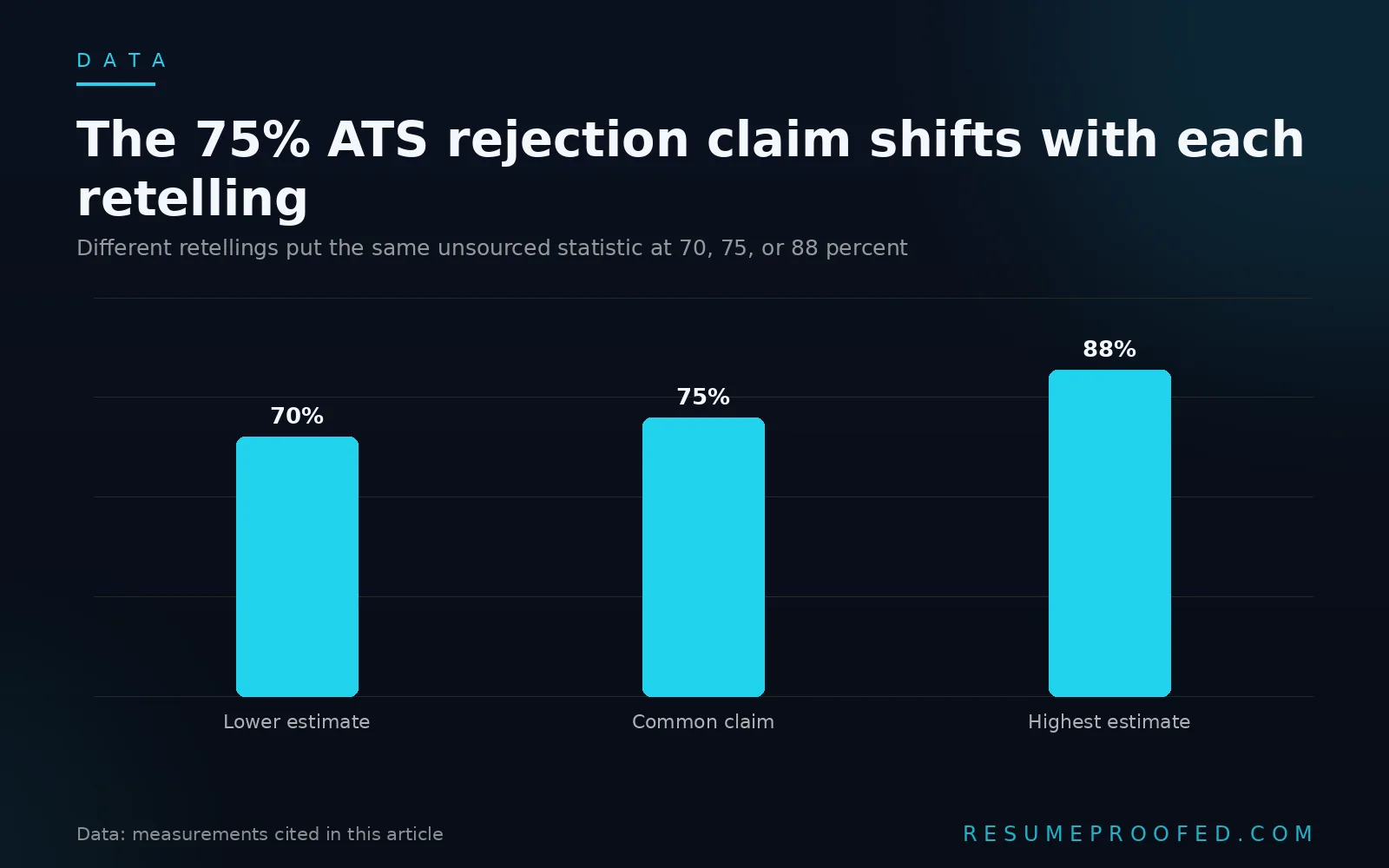
None of this means automated screening is a non issue. It means the specific claim, that a machine reads your resume and rejects it on quality before a person ever sees it, is not supported by anything. What is real is more precise and, for a job seeker, more useful to understand.
What an applicant tracking system is actually built to do

An applicant tracking system is a database with a workflow layered on top of it. Greenhouse, Lever, Workday, SmartRecruiters, Taleo: these platforms exist to help a recruiting team manage volume, not to render a verdict on any individual document.
Jobscan's 2025 audit of Fortune 500 career pages found that 97.8 percent of those companies run a detectable ATS, so this is close to universal at the large employer end of the market. The same research describes how recruiters actually use these systems day to day: the majority search and rank stored candidates by the specific skills named in a job description, then narrow further by education, job titles, licences, certifications, and years of experience. That is the core loop. Store the application, extract structured fields from it, let a person search and filter.
Broken into steps, applying through an ATS looks like this:
- You submit a resume, and the system parses it into fields: name, contact details, employers, titles, dates, and often a raw text block for full-text search.
- Your record joins every other applicant in a list, usually sorted by date received.
- A recruiter searches that list, typically by the terms that matter most for the role, and builds a shortlist.
- They read the shortlist properly, and a smaller number moves to interview.
A quality score computed by the software and used to reject you automatically does not appear anywhere in that sequence, because in most configurations of most major platforms, that feature either does not exist or is not switched on.
Where automated rejection genuinely does happen
This is the part that gets flattened in most retellings of the myth, so it is worth being specific about it, because automated rejection is real. It is just a different mechanism to the one people imagine.
Knockout questions. Most major platforms let an employer configure application questions with an automatic rejection rule attached. Greenhouse's own support documentation describes the feature plainly: an application rule triggers a rejection "based on an applicant's answer to a question," using custom questions the employer writes, such as whether you hold a Class A commercial driver's licence for a role that requires one. The rejection fires on your answer to that specific question. It does not scan your resume, your cover letter, or your work history to arrive at that decision. If you already read our piece on whether an ATS scores your resume, this is the same conclusion from a different angle: the filter that actually bites is a discrete, visible question you answered, not a hidden analysis of your document.
Hard requirements set as gates. The same mechanism covers work rights, security clearance, required certifications, and minimum years of experience when an employer has chosen to make that a disqualifying question rather than a soft preference. These are usually the exact criteria you would expect to see spelled out in the job ad, turned into a yes or no field on the form.
Some high volume graduate and early career programmes. This is the closest thing to the imagined robot, and it deserves an honest look rather than a dismissal. Large graduate schemes, historically at firms including the big professional services and banking employers, have used minimum academic criteria such as UCAS point thresholds in the UK as an automatic filter at high volume, precisely because thousands of similarly inexperienced applicants apply for a small number of seats and something has to narrow the field before a human can read individually. It is worth saying that several of these same employers have since moved away from rigid academic cutoffs toward contextualised recruitment, because the cutoffs were found to disadvantage capable candidates for reasons unrelated to ability. Where this pattern still exists, it behaves exactly like a knockout question: a stated, checkable criterion, not a judgement about the quality of your writing.
Rigid configured criteria, which is a real and different problem. A 2021 study from Harvard Business School and Accenture, surveying employers across several countries, found that a large majority, 88 percent for high-skilled roles and 94 percent for middle-skilled roles, believed their own hiring systems screened out qualified candidates because those candidates did not exactly match criteria such as an unbroken employment history or a specific degree. This is a genuine and documented failure mode. It is worth separating clearly from the 75 percent myth, though, because the mechanism is different. It is not a machine reading your resume and scoring it down. It is an employer choosing, deliberately or by default, a filter that is stricter than the job actually requires, then applying it uniformly. The fix on your end is not formatting. It is making sure you meet, or can credibly argue you meet, the stated requirement, and not self-selecting out of an application where you are close.
What all four of these have in common is that they are visible, or at least discoverable. You can usually see the questions you are answering. You can look up whether a graduate scheme still runs on academic cutoffs. None of them are the invisible content-scoring robot the 75 percent claim describes.
So if it's not a content score, why do good candidates still disappear
Because the two real risks in this process are duller than a robot villain, and they are worth taking seriously precisely because they are so ordinary.
The first is that a recruiter's keyword search never surfaces you. If a role searches its database for a specific tool, standard, or job title and your resume does not contain that exact vocabulary, you are outside the result set, which functions identically to a rejection even though nothing rejected you. We wrote about how to work out which terms actually matter in finding the right resume keywords in a job ad, and it is a more productive use of your time than chasing a phantom score.
The second is that your resume parses badly, so the structured record a recruiter searches is wrong or incomplete. A two column layout can scramble reading order. Text inside an image is invisible to a parser. Contact details sitting in a header can vanish entirely. None of that is the software rejecting you on merit. It is the software failing to read you correctly in the first place, which then makes you unfindable in step three of the process above.
If you have sent a genuinely high volume of applications with almost no response, both of these are worth ruling out before anything else, and it is exactly the kind of pattern covered in why you're not getting interviews.
What to actually do differently

Given all of this, the useful checklist looks different from the one built around beating an imaginary scorer.
- Read every application question carefully, especially yes or no ones about work rights, licences, and years of experience. These are the questions with real rejection logic attached, so answer them accurately rather than optimistically.
- Make sure the genuine vocabulary of the job ad, tools, standards, certifications, the standard job title for the work, appears somewhere true in your resume, inside a bullet that proves it. This is what a recruiter's search actually finds.
- Confirm your resume parses cleanly. Copy the text out into a plain text editor and check that your job titles, dates, and contact details come out in the right order. If they do not, a recruiter's search can pull up a broken record with your name on it.
- If you are genuinely close to a stated requirement rather than clearly short of it, apply anyway and let a human make the judgement call, rather than filtering yourself out on the assumption that a machine already has.
- Stop spending time on tools that promise an "ATS score." There is no such number for them to calculate, which means whatever they show you is that tool's own invention, not something a recruiter's system produces or sees.
This is also roughly the philosophy behind how Resume Proofed works. Rather than inventing an ATS score that no employer's system actually generates, it tailors your master resume to one specific job ad and returns a Proof Score, a measure of how well each claim in the tailored version is backed by facts you have confirmed about your own career. The goal is a document that is genuinely findable by a real search and genuinely defensible at interview, not one optimised for a robot that does not exist.
Common questions
Does an ATS automatically reject your resume?
Almost never based on the content of your resume. Automatic rejection is generally driven by knockout questions you answer on the application form, such as work rights, required licences, or a stated minimum of years of experience. The resume itself is stored and made searchable, not scored and rejected.
Where does the "75% of resumes are rejected by ATS" statistic come from?
It traces to a 2012 marketing claim from Preptel, a resume optimisation vendor that closed in 2013 without ever publishing a study, survey, or methodology behind the number. The figure was repeated across blog posts and a few larger outlets without new evidence, and different versions of the claim range from 70 to 88 percent, which is itself a sign that nothing was actually being measured.
What does an ATS actually do with my resume?
It parses your resume into structured fields such as name, employers, titles, and dates, stores that record alongside every other applicant, and gives a recruiter tools to search, filter, and rank the resulting database. The recruiter, not the software, makes the decisions about who moves forward.
Are there cases where automated screening genuinely happens?
Yes. Knockout questions configured by an employer, hard requirements like work rights or a required certification, and some high volume graduate or early career programmes using minimum academic thresholds can all trigger an automatic rejection. All of these operate on a specific, usually visible criterion rather than an analysis of your resume's writing or formatting quality.
Can a resume be too badly formatted for an ATS to read?
Yes, and this is the more common way a good candidate genuinely disappears. Multi column layouts, text inside images, and contact details hidden in a header can cause a resume to parse incorrectly, which makes the resulting database record wrong or incomplete. That is a parsing failure, not a content based rejection, but the practical effect on a job seeker looks similar.
Should I trust a tool that gives my resume an ATS score out of 100?
Treat it with scepticism. No mainstream applicant tracking system generates a quality score that a recruiter sees or that gates your application. A number produced by a third party checker is that tool's own calculation, not a reflection of anything inside Workday, Greenhouse, Lever, or any other real system.
Resume Proofed opens soon. Join the waitlist to be first in.