Does resume length matter to an ATS? One page or two, answered
The one page rule is really two different questions tangled together. Here is what the ATS parser actually does with length, and what recruiters prefer.
- ATS
- Résumé writing
- Job search
You've written a genuinely strong second page and now you're staring at it wondering whether an applicant tracking system quietly punishes you for going past page one. It's a reasonable thing to worry about, because the one-page rule gets repeated as though it were a technical requirement rather than a piece of advice, and nobody tells you which one it actually is.
The position worth stating early: "does resume length matter" is really two separate questions that most advice merges into one. Does the parsing software itself treat a second page as a problem? On the evidence available, no, not in the way people fear. Does a human recruiter have a preference between a one-page and a two-page resume? Yes, and the honest data on that question doesn't say what the one-page rule assumes it says.
What the parser actually does with page count
An applicant tracking system's parsing engine, the software layer that reads your file and extracts text into structured fields, is not counting pages and comparing the total against a threshold. It is reading text, the same way it reads a one-page or a five-page document, extracting names, dates, employers and bullet points as it goes. We covered how this extraction actually works in our breakdown of what happens when an ATS reads a resume: the system pulls out structured text and stores it, and there is no evidence, in any documentation from major platforms like Workday, Greenhouse, Lever or SmartRecruiters, of a rule that discards or penalises content specifically because it appears on a second page.
What genuinely does break parsing has nothing to do with length and everything to do with construction, the same conclusion we reached in our deep dive on what actually breaks resume parsing: a multi-column layout, text inside an image, contact details trapped in a header, decorative fonts converted to outlines. Every one of those problems can appear on a one-page resume just as easily as a two-page one, and a clean, single-column, real-text two-page resume parses exactly as reliably as a clean one-page version, because the parser is working through text in sequence, not counting sheets.
That's a genuinely different answer from "does length matter," and it's worth being precise about the difference: there's no verified evidence of a length penalty built into ATS software, but that isn't the same as a guarantee, since undocumented vendor-specific quirks are always possible in software this fragmented. What the evidence does support is that length itself is not the mechanism worth worrying about. Formatting is.
What a human recruiter actually prefers
The question that has real, measured data behind it isn't about the parser at all, it's about the person reading your resume after it clears the database, and the data here genuinely contradicts the one-page rule as commonly stated.
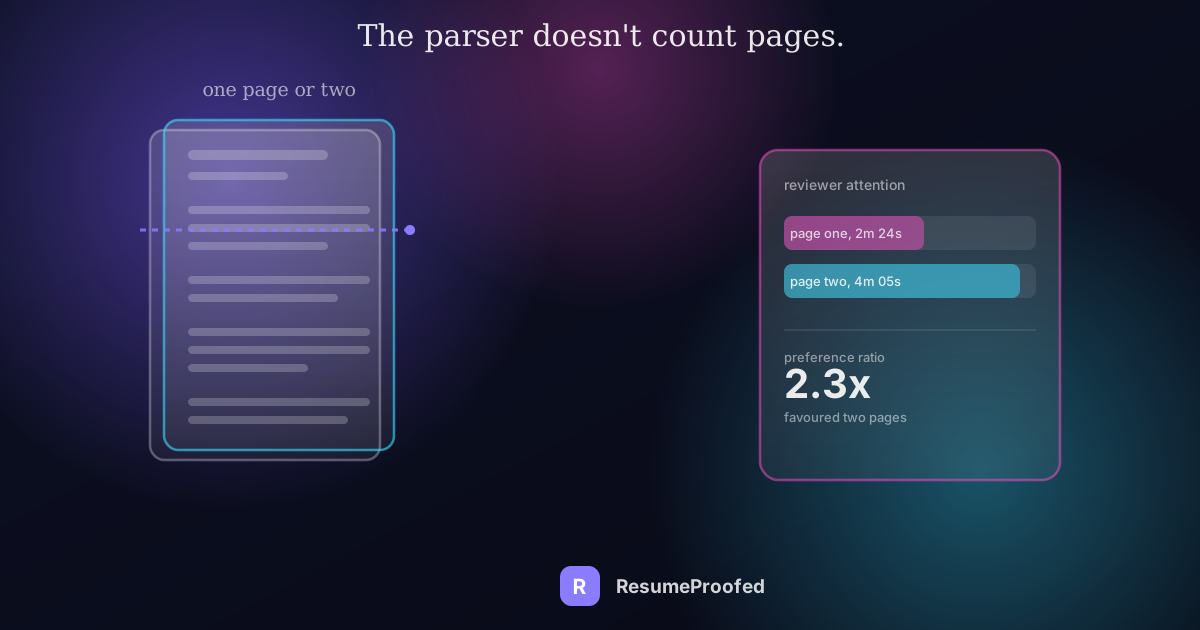
ResumeGo's field study, one of the few controlled experiments on this specific question rather than an opinion survey, had 482 recruiters, hiring managers, HR professionals and C-suite executives review a combined 7,712 resumes for candidates with matched skills, education and experience, comparing one-page and two-page versions side by side. Two-page resumes were selected 2.3 times as often as one-page resumes, 5,375 of the 7,712 chosen were the two-page version, and they scored an average of 8.6 out of 10 against 7.1 for one-page resumes, a 21 percent gap. Reviewers also spent close to twice as long with the two-page resumes, 4 minutes 5 seconds against 2 minutes 24 seconds, which the study's authors read as deeper engagement rather than reluctant obligation. The preference held across seniority levels too, though it strengthened with seniority: a 1.4-times preference for entry-level candidates, rising to 2.6 times at mid-level and 2.9 times at managerial level.
It's worth being upfront that this study dates to 2018, and we haven't found a more recent, equally rigorous controlled experiment on the same specific question, unlike the callback-rate research on cover letters we cite in our piece on whether you need a cover letter, which is newer. Treat the exact numbers as the most solid data point available on this question rather than a fixed, current-year statistic, and treat the direction, that recruiters do not uniformly prefer shorter, as the more durable finding than the precise percentages.
So how long should your resume actually be
Put the two answers together and a clear, practical rule falls out. Length is not a parsing risk, so don't compress a genuinely strong second page's worth of real, specific achievements down to fit an arbitrary page count out of fear a machine will penalise you for it. It isn't. But length also isn't a virtue on its own, and the ResumeGo data doesn't say "longer is always better," it says two pages outperformed one page for candidates with enough real substance to fill it credibly.
That points to a simple test: fill the page with real, specific, defensible content, and stop when you run out of it, rather than stretching thin material to hit two pages or cutting strong material to force one. Early-career candidates with two or three years of experience genuinely may not have enough substantive, specific achievement to justify a second page without padding, and padding reads worse to a recruiter than a shorter, denser page does. A candidate with ten or more years across multiple roles frequently does have that much real substance, and the data above suggests recruiters engage with it rather than penalising it.
A worked example: when a second page earns its place
Priya has eleven years of experience across three roles in operations management. Compressed to one page, her resume lists three job titles with two or three bullets each, cutting most of the specific, quantified detail to fit the space: "Led operational improvements across multiple sites" stands in for what was actually a detailed, multi-year process redesign with real before-and-after numbers.
Expanded to a well-used second page, the same experience keeps four to six bullets per role, each with a real figure: "Cut average dispatch delay from 46 minutes to 19 minutes across 3 depots by rebuilding the scheduling process, over 8 months" instead of the compressed, vague version. Nothing here is padding. It's the same true history, given enough room to be specific rather than summarised into vagueness. That's the difference the ResumeGo data is actually measuring: not "more text" scoring better, but genuine, detailed evidence being read as more credible and more engaging than a thin summary of the same career.
A two-minute check before you commit to a length
Rather than guessing, run this test on your own draft before deciding how long it should be.
- Read every bullet and ask whether it's specific or summarised. A bullet that could describe several different people in your role is summarised. A bullet with a real number, a real scope, or a real outcome is specific. Count how many of each you have.
- If more than half your bullets are summarised, cut length rather than add it. A shorter resume with tighter, more specific content beats a longer one padded with generalities, regardless of what the length research shows for genuinely substantive content.
- If you have real, specific detail that a one-page limit is forcing you to compress into vague summaries, let it run to a second page. That's precisely the situation the ResumeGo data describes recruiters engaging with more, not less.
- Regardless of length, run the copy-paste parsing test described in our guide to what actually breaks ATS parsing: paste your resume into a plain text editor and confirm it reads cleanly, in order, with nothing missing. This confirms your formatting is sound independent of how many pages it runs to.
- Never add a second page purely to look thorough. The data supports substantive length, not length for its own sake, and a recruiter skimming for specifics can tell the difference within a few seconds.
Common questions
Does an ATS reject or penalise a two-page resume?
There's no verified evidence of a documented rule in major platforms that penalises a resume specifically for running to a second page. Parsing engines extract text regardless of page count. What genuinely breaks parsing is formatting, such as multi-column layouts or text trapped in images, not length itself.
Is a one-page resume still the standard rule?
Not as a strict rule for every candidate. Controlled research from ResumeGo found recruiters and hiring managers preferred two-page resumes over one-page versions by a factor of 2.3 to 1 for candidates with comparable experience, with the preference strengthening at more senior levels.
How long should a resume be for someone with less experience?
Generally one page. With two or three years of experience, there usually isn't enough substantive, specific achievement to fill a second page without padding, and a thin, padded second page reads worse than a tight, specific first one.
How long should a resume be for someone with ten or more years of experience?
Two pages is a reasonable default if the content is genuinely specific and substantive rather than summarised to fit. ResumeGo's data found the preference for two-page resumes strongest at managerial and senior levels, closely tied to the candidate having enough real detail to justify the length.
Does resume length affect how an ATS parses PDF versus Word files?
No, length and file format are separate variables. A clean, text-based file of either type parses reliably regardless of page count, and a poorly constructed file, one with columns, images or headers holding key content, fails the same way whether it's one page or two.
Should I add content just to reach two pages?
No. The data supports genuinely substantive, specific two-page resumes outperforming thin one-page versions for experienced candidates, not length as a goal in itself. Padding a page with vague or repeated content reads worse than a shorter, denser resume that stops where the real substance runs out.
Where ResumeProofed fits, and where it doesn't
ResumeProofed doesn't enforce a fixed page length, because the evidence above doesn't support one. It builds a tailored resume from your confirmed, specific achievements and lets the length follow from how much genuine, relevant evidence you actually have for a given role, rather than compressing real detail to hit an arbitrary page count or padding a thin history to look more substantial than it is.
ResumeProofed opens soon. Join the waitlist to be first in.