Do you need a cover letter in 2026? What the data says
A 7,287 application field study and conflicting recruiter surveys disagree. Here is what the cover letter data actually supports, and what does not.
- Cover letters
- Job search
- Career research
Some job postings mark the cover letter optional. Others make it a required upload field. Most say nothing at all, and leave you staring at an empty text box wondering whether the next twenty minutes are worth spending or wasted.

Do you need a cover letter is the wrong question, and it is worth saying that plainly before going anywhere near the data. The honest answer is not yes or no. It is that a cover letter is ignored outright by a meaningful share of the people who open your application, decisive for a smaller share you cannot identify in advance, and actively counterproductive when it is generic rather than absent. That last part is the one most advice pieces skip, because "should I bother" is a simpler question to answer than "which kind is worth sending."
What the data actually says

Start with the study everyone eventually cites, because it is the closest thing this topic has to a controlled experiment rather than an opinion poll.
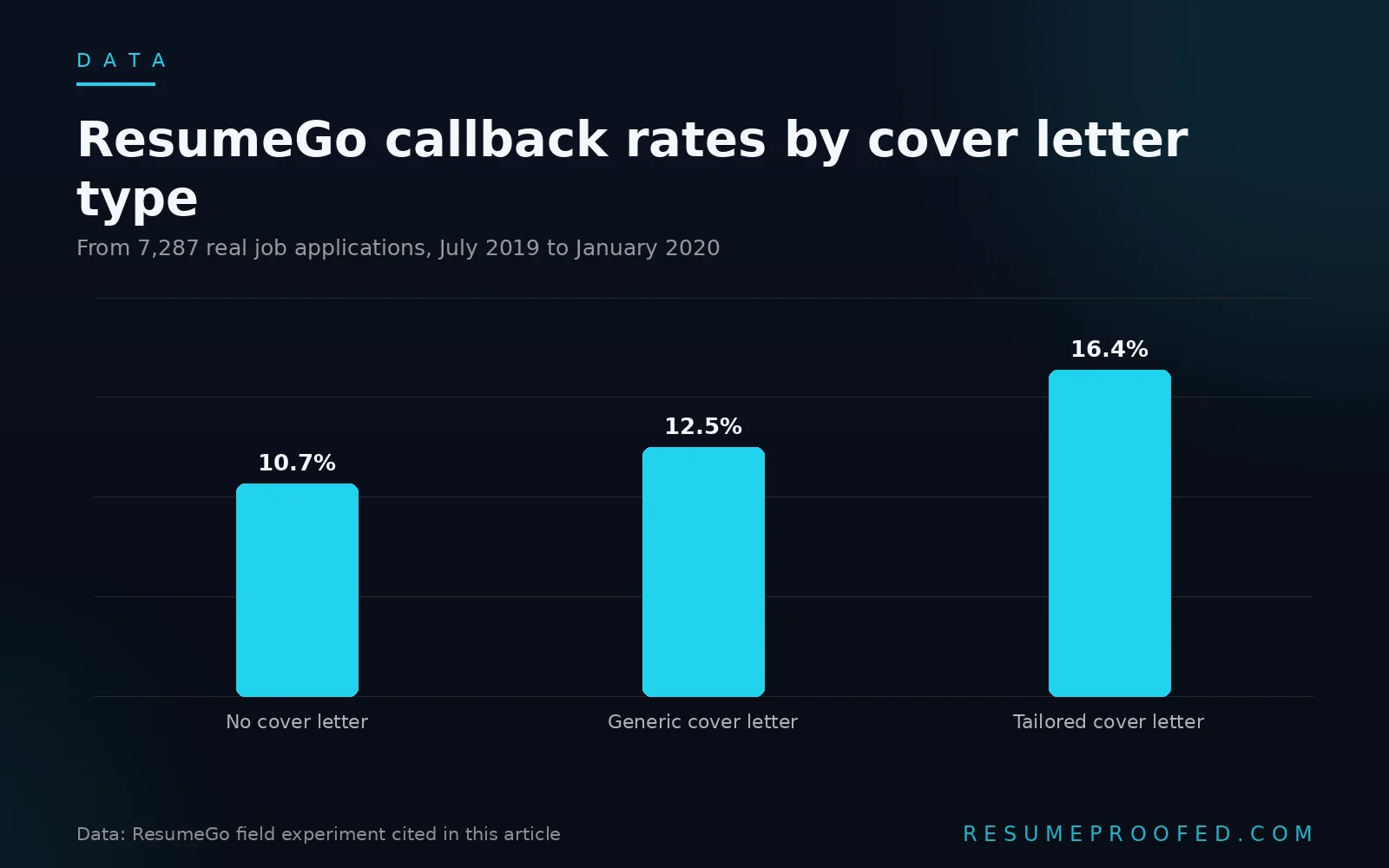
The ResumeGo field experiment. Between July 2019 and January 2020, the resume writing service ResumeGo submitted 7,287 real applications to live job postings, split into three groups: no cover letter, a generic cover letter, and a cover letter written for that specific job. ResumeGo reports callback rates of 10.7% for no cover letter, 12.5% for the generic version, and 16.4% for the tailored one, a 53% lift over sending nothing at all. Two things in that result matter more than the headline number. First, having any letter at all helped only modestly (10.7% to 12.5%). Second, almost the entire benefit came from tailoring specifically, not from the mere presence of a letter.
Whether anyone reads it is genuinely contested. This is where the honest answer gets messier, and the mess is itself informative. A 2024 survey of 948 US hiring managers by ResumeBuilder.com found that only 26% always or frequently read cover letters, while 44% said they never read them. Contrast that with a separate ResumeGo survey of hiring professionals, which reported that 87% read cover letters and that 78% say it is easy to tell when a candidate has invested time tailoring one. Both are real surveys asking a similar question of a similar population, and they land roughly forty points apart. That spread is not a reason to dismiss either study. It is evidence that "does anyone read this" depends heavily on which recruiter opens your file, and you have no way of knowing which one you will get. Treat every cover letter as a coin flip weighted somewhere between a quarter and the majority of the time, not as a certainty in either direction.
A newer piece of research explains why generic tailoring is losing its power. A 2025 paper by Jingyi Cui, Gabriel Dias and Justin Ye, published on arXiv under the title "Signaling in the Age of AI: Evidence from Cover Letters," studied over five million cover letters across roughly 100,000 job postings on the freelance platform Freelancer.com, after the platform introduced an AI cover letter writing tool. Access to the tool did raise the textual match between letters and job posts, and it did raise callback rates at first. But the researchers also found that the correlation between that textual alignment and getting a callback fell by 51% after the tool became available, because employers adapted once alignment stopped being a costly, meaningful signal that a candidate had actually put in the work. The one thing that stayed predictive of success was time spent editing the AI draft into something specific and true. In other words, once matching the job ad's language became cheap and automatic, employers stopped trusting the match itself and started looking for evidence of real effort behind it.
Put those three findings together and a consistent picture emerges. A letter is not a formality that either gets read or does not. It is a document a meaningful minority of readers use to make a real decision, and what they are actually evaluating, consciously or not, is whether you did the work or copied a template.
When a letter is required, when it is pointless, and when it is decisive
Not every application deserves the same amount of thought here. Three situations, and they call for different responses.
Required. The posting has an upload field marked mandatory, or the application system will not submit without one. Write it. An application that ignores an explicit instruction reads as inattentive before anyone has assessed your actual experience, and that is a self inflicted problem you can simply avoid.
Effectively pointless. High volume, low touch postings where an applicant tracking system is doing the first pass and a human may never open the letter field at all: large retail chains, seasonal hiring, some graduate schemes processing thousands of applications through a single portal. Here your ten minutes are better spent tightening the resume itself, since tailoring the resume to the job description is the part of the application that is checked at scale, keyword by keyword, before a person ever gets involved.
Genuinely decisive. Smaller companies, senior or specialist roles, anything where a founder, hiring manager, or department head is personally reading applications rather than delegating the first pass, and any role where you have a real reason for wanting that specific employer rather than any employer in the category. This is the group the ResumeBuilder and ResumeGo hiring manager numbers both point to, whichever figure you trust more: the readers who matter most, meaning the people with final say, read cover letters at noticeably higher rates than first pass screeners do. When you cannot tell which bucket a posting falls into, and most of the time you genuinely cannot, the field experiment above is the tie breaker. A tailored letter cost the applicants in that study roughly the same ten to fifteen minutes as a generic one and returned nearly three times the lift.
Why a generic letter is barely better than no letter at all
Be precise about what the numbers actually show here, because it is tempting to round this up to something stronger than it is. In the ResumeGo data, a generic letter did not underperform sending nothing (12.5% beat 10.7%). What it did was capture barely a third of the benefit that a tailored letter delivered, for close to the same time cost as writing a properly tailored one from a document that already holds your facts.
That is the real argument against generic letters: not that they actively damage your application in a measurable, aggregate sense, but that they are close to the worst possible return on the ten minutes involved, and the signaling research explains the mechanism. A paragraph that swaps in a company name and otherwise reads identically to what you sent the last four employers is exactly the kind of low cost, low effort signal that a reader who has seen five hundred of them can spot immediately, and that the Cui, Dias and Ye paper found readers increasingly discount. It tells a decisive reader nothing they could not have guessed, and it wastes the one channel on the application where you are allowed to explain, in your own words, why this role specifically. Worse, it can cost you time you would rather spend elsewhere: writing a generic letter for every application and tailoring none of them is the same total effort as writing fewer, properly tailored ones and applying to fewer roles with a materially better shot at each.
A worked example: the same application, two letters
Here is what the difference actually looks like on the page. Callum Reyes is applying for a Customer Success Manager role at a fictional mid-size SaaS company, Fernwood Analytics. The job ad emphasises reducing customer churn, shortening onboarding time, and working closely with the product team on renewal risk.
The generic letter, the kind that could be sent to any company hiring for any customer facing role:
Dear Hiring Manager,
I am writing to express my interest in the Customer Success Manager position at your company. I have several years of experience in customer facing roles and believe I would be a valuable addition to your team. I am a strong communicator, a fast learner, and passionate about delivering excellent customer experiences. I have attached my resume for your review and would welcome the opportunity to discuss my qualifications further.
Sincerely, Callum Reyes
Nothing in that letter is false. Nothing in it is specific either. Swap the company name and it fits a hundred other postings without a single other word changing, which is exactly the property that makes a reader stop trusting it.
The tailored letter, built from the same true facts about Callum's actual work history, pointed at this specific job ad:
Dear Fernwood Analytics team,
Your posting for a Customer Success Manager centres on cutting churn and shortening onboarding, which is the exact pair of problems I spent the last two years solving at my current company. I rebuilt our onboarding sequence for mid-market accounts, cutting time to first value from 34 days to 12, and that change was the biggest single factor in taking our 90 day churn rate from 9.4% to 5.8% across the following two quarters.
Your ad also mentions working closely with product on renewal risk, which was a direct part of my role: I ran a monthly at risk review with our product team that fed roadmap decisions rather than just flagging accounts for a save call after the fact. I would like to bring that same approach to Fernwood.
Sincerely, Callum Reyes
Same person, same true facts, same amount of writing time once those facts are already sitting in a document somewhere rather than being reconstructed from memory. The second letter names the company, mirrors the ad's own priorities back with real numbers attached, and gives a decisive reader a specific reason to keep reading. It also happens to be the harder one to fake, which is precisely why the research above suggests it still moves the needle when the generic version barely does.
The ten minute method, once you have a master profile
The gap between those two letters is not a gap in writing skill. It is a gap in whether the facts were sitting somewhere ready to use. Ten minutes is a realistic number only if you are not reconstructing your work history from memory under deadline pressure, which is the entire argument for keeping a master resume of your real, numbered achievements rather than starting from a blank page each time.
With that document in hand, the routine is short.
- Read the job ad once and note its two or three genuine priorities, ignoring the wallpaper phrases about fast paced environments and passionate team players.
- Search your master resume for the achievements that speak most directly to those priorities, not the achievements you are proudest of in general.
- Open with one sentence that names the company and states plainly why this specific role, not a reworded version of the job title.
- Build the middle paragraph around one or two of those achievements, each with a real number attached, mirroring the ad's own language where it genuinely describes what you did.
- Close with a short, direct line. No restating of your resume, no generic enthusiasm paragraph, no line about how you look forward to hearing from them that says nothing an interviewer could ever ask you about.
- Read it back and delete every sentence that would still make sense sent to a different company. If a sentence survives that test, it is not doing its job.
That is the whole method. It works because the slow part, which is knowing your own numbers and having them written down accurately, has already happened before you open the job ad.
Common questions
Do you need a cover letter in 2026?
Only sometimes strictly, but usually worth including anyway. Write one whenever the application explicitly requires it, and write one for any role where a human is likely to read applications personally, such as smaller companies or specialist positions. For high volume postings processed mostly by software, your time is often better spent tightening the resume itself.
Are cover letters necessary in 2026, or just a formality left over from paper applications?
They are not strictly necessary in the sense of being required everywhere, but they are not pure formality either. Field research on real applications found tailored cover letters lifted callback rates well above sending nothing, so treating the letter as pointless paperwork means giving up a genuine, if modest, advantage for a fairly small time cost.
Do employers read cover letters?
It depends heavily on who is reading and at what stage, and the surveys genuinely disagree with each other. One 2024 survey found only about a quarter of hiring managers read them regularly, while a separate hiring manager survey reported the large majority do. What is more consistent across the research is that the people with final hiring authority read cover letters more often than first pass screeners do, so the letter matters more the smaller and more senior the hiring process is.
When can you skip a cover letter?
Skip it when the application system has no field for one and adding it would require an awkward workaround, and lean toward skipping when you are applying to a very high volume posting at a large company where an applicant tracking system is doing the first filter. Never skip it when the posting explicitly marks it required.
How long should a cover letter be?
Three short paragraphs, roughly 200 to 300 words, is the practical range. Long enough to name the company, connect two real achievements to the role's actual priorities, and close, but short enough that a reader giving it thirty seconds gets the whole point. A cover letter longer than a page is read as padding, not thoroughness.
Should a cover letter repeat your resume?
No. A cover letter should select one or two facts from your resume and explain the connection to this specific role in your own words, not restate your work history in paragraph form. If a sentence in your letter could be replaced by a bullet from your resume with nothing lost, cut it.
How ResumeProofed handles this
ResumeProofed generates a tailored cover letter alongside every tailored resume, built from the same verified facts in your master profile rather than written fresh each time from a template.
It only ever draws on achievements, numbers, and roles you have confirmed as accurate. It will not invent an achievement to fill a paragraph, and it will not claim your application is guaranteed to get a callback, because no honest tool can promise that. What it removes is the part that turns a good idea, writing a tailored letter for every application, into a habit that quietly stops happening after the third or fourth application of the week: the ten minutes of hunting for the right number from memory. The facts are already there, confirmed once, so the letter mirrors the job ad's actual priorities instead of reading like the fourth draft of the same generic paragraph.
Try ResumeProofed free: two tailored applications on the house, no card required.