Do employers use an ATS in 2026? What the data shows
Not every employer runs an applicant tracking system. Here is the real 2026 adoption data, from Fortune 500 giants down to small, informal hiring teams.
- ATS
- Job search
- Résumé writing
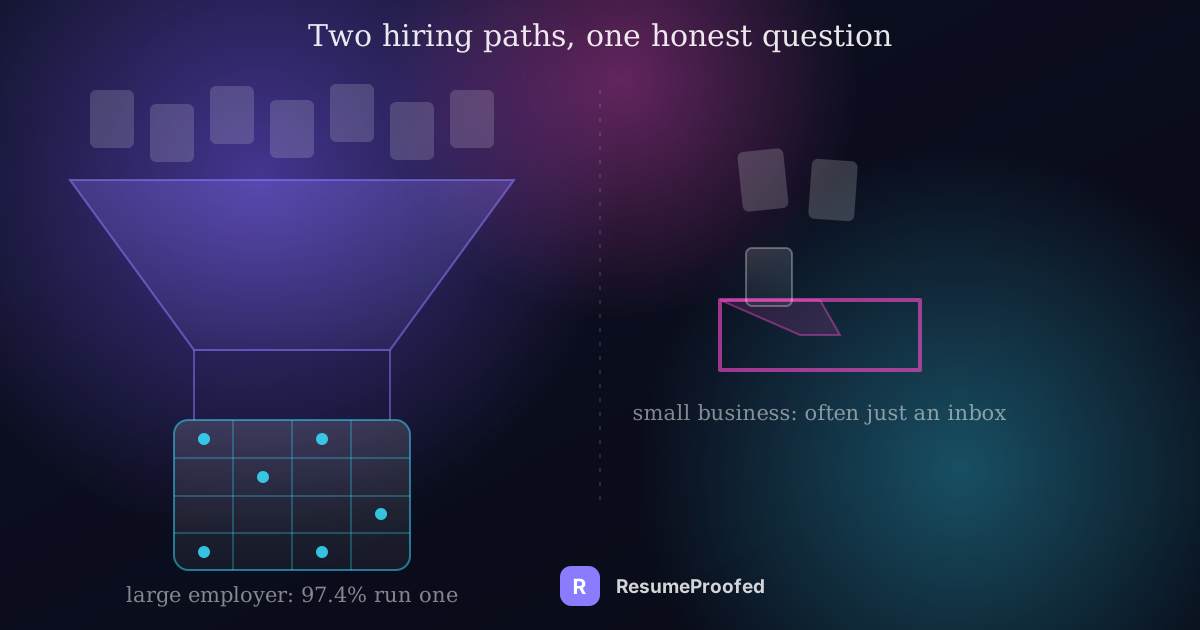
Before you spend an hour formatting a resume around ATS advice, it's worth asking a more basic question: does the company you're applying to actually run one of these systems at all? The honest answer is that it depends heavily on who you're applying to, and the gap between a Fortune 500 employer and a twenty-person business is larger than most job search advice admits.
The position worth stating first: an applicant tracking system is close to universal at large employers and meaningfully less common the smaller you go. That's not a hedge, it's the actual shape of the data. Assuming every employer runs identical software, and formatting every application the same defensive way regardless of who's on the other end, means over-engineering some applications and under-thinking others.
Do employers use an ATS? Start with the number that's closest to certain
If you want the single most reliable figure on ATS adoption, it comes from the top of the market. Jobscan's 2026 Applicant Tracking System Usage Report found that 487 of the 500 Fortune 500 companies, 97.4 percent, use an applicant tracking system. Jobscan didn't get this by surveying companies and hoping for honest answers. Its in-house data team manually reviewed the careers pages and job listings of all 500 companies on the list and reverse-engineered which specific ATS platform each one runs, gathered shortly after the Fortune 500 list's 3 June 2026 release. That's a directly observed number, not a self-reported one, which makes it about as solid as adoption data gets.
So if your answer to "does every company use an ATS" is aimed specifically at the largest employers in the country, the answer is close enough to yes that you should plan around it. Only 13 of the 500 largest companies in America appear to run hiring without one, and there's no guarantee those 13 are actually manual, some may simply run a system Jobscan's methodology couldn't detect from the outside.
Worth flagging: this exact figure moves a little from year to year. Jobscan re-runs this audit annually, and its own multi-year tracking shows 97.8 percent in 2025 and 98.4 percent in 2024, both in the same high-97-to-98-percent band as the current 97.4 percent. If you've seen a slightly different Fortune 500 percentage elsewhere, including elsewhere on this site, that's most likely an earlier year's edition of the same annual Jobscan audit rather than a contradiction, the number simply hasn't moved by more than a point in a given year.
The wider picture: it's common, but nowhere near universal outside the giants
The Fortune 500 figure describes the very top of the market. A separate, broader piece of research gives a clearer read on the rest of it. Resume Genius's 2026 Hiring Insights Report surveyed 1,000 U.S. hiring managers, screened to confirm they genuinely have hiring responsibilities, using Pollfish's Random Device Engagement methodology. Across that broader, more representative sample of employers of varying sizes, 71 percent of hiring managers said their company uses an applicant tracking system.
That's still a clear majority, but it's a full 26 percentage points below the Fortune 500 figure. The same survey found that 79 percent of companies have automated at least some part of their hiring process, a wider category than a full ATS, covering things like automated resume parsing or scheduling without necessarily including a complete tracking platform. And 19 percent of hiring managers said they use AI specifically to screen out applications before a human ever reviews them, a meaningfully smaller and more specific slice than the overall automation figure.
Put those two data points side by side and the pattern is exactly what you'd expect: the biggest employers in the country are almost universally running an ATS, and the broader population of employers, which includes plenty of mid-size and smaller companies, sits closer to seven in ten. The gap between 97.4 percent and 71 percent isn't noise. It's company size doing what company size does to any operational system: the more applications you receive, the harder it becomes to manage them without one.
Why ATS usage drops off by company size
Nobody has published a precise adoption percentage broken down small business by small business, and this piece won't invent one. But the direction of the trend is not really in question, and it follows directly from why these systems exist in the first place. An applicant tracking system earns its cost by solving a volume problem: sorting, searching, and tracking hundreds or thousands of applications a recruiting team could not otherwise manage by hand. A Fortune 500 company might field thousands of applications for a single popular role. A twenty-person company hiring for one open position might field twenty.
At that smaller scale, the entire justification for the software weakens. A hiring manager who can read every resume for a role personally in an afternoon has far less reason to pay for and maintain a platform built to manage what they don't have: overwhelming volume. That's why adoption drops off well before you reach small-business hiring, even without a specific figure to attach to exactly how far it drops. Many small employers run hiring through nothing more sophisticated than a shared inbox, a spreadsheet, or a free-tier tool bundled into whatever payroll or HR software they already use, not because they haven't heard of an ATS, but because the problem it solves doesn't exist at their scale yet.
This is also where the two verified figures above actually agree with each other rather than conflicting. A survey of 1,000 hiring managers across companies of every size lands at 71 percent specifically because it includes a meaningful share of smaller employers pulling the average down from the near-universal 97.4 percent seen at the Fortune 500 end. Same underlying trend, two different slices of the market.
A worked routine: how to tell if you're likely applying through an ATS
Rather than guessing, you can usually tell within about a minute of opening an application page. Run through this before you decide how cautious to be with formatting.
- Look at the application URL once you click "apply." If it redirects you to a domain like
boards.greenhouse.io,jobs.lever.co, amyworkdayjobs.comsubdomain, or a branded portal clearly running on Workday, Taleo, SmartRecruiters, or iCIMS, you're inside a real applicant tracking system. This is the single clearest signal there is. - Notice whether you're asked to create a candidate account or profile. Being prompted to set a password, verify an email, or build a persistent profile before you can even upload a resume is a strong sign there's a database behind the form, not just an inbox collecting attachments.
- Check whether the form parses your resume into separate fields. If uploading your file auto-populates boxes for employer, job title, and dates that you're then asked to confirm or correct, that's the parsing step of an ATS happening in front of you.
- Look for screening questions unrelated to your cover letter. Yes-or-no questions about work rights, licences, required certifications, or years of experience, especially ones marked as required before you can submit, usually sit inside an ATS's rule engine. We've covered what these actually do, and don't do, to your application in does an ATS automatically reject resumes, which is worth reading once you've confirmed one is in play.
- Check the company's size, if you can, against how the application felt. A small business with under roughly fifty staff asking you to simply attach a resume and write a short note in a plain form, no account, no parsed fields, is very likely reading applications manually, or close to it, rather than running a full ATS.
- When in doubt, default to caution rather than certainty. If you can't tell either way, it costs you nothing to format conservatively. It costs you a real shot at a role if you guess wrong in the other direction.
What this means for formatting, specifically
If the signals above point to a real ATS, treat your resume the way you would for any parsed system: single column, standard section headings, real text rather than text inside images, contact details in the body rather than a header. If you want the full formatting checklist once you've confirmed a system is genuinely in play, does an ATS score your resume covers what that system actually does with your document once it's stored, and how to write for the human search behind it rather than an imaginary scoring algorithm.
If the signals point the other way, a small team, a plain email-style form, no parsed fields, no branded portal, you have more formatting latitude, because a person is very likely reading the document as you designed it rather than a parser extracting fragments from it. That doesn't mean abandon good structure, a cluttered resume is still a cluttered resume to a human reader. It means the specific ATS-survival rules, like avoiding a two-column layout because a parser might scramble it, matter less when there's no parser in the loop at all.
Assume an ATS past a certain size, but don't assume it behaves the same way everywhere
The practical rule that falls out of this data is simple to state and worth actually following: once a company is large enough to have a recognisable brand, a dedicated HR function, or a multi-stage interview process, assume an applicant tracking system is involved and format defensively. That covers the Fortune 500 end of the market almost without exception, and a large share of the mid-size employers in between. But don't extend that same assumption, or the same level of formatting caution, all the way down to a genuinely small employer without evidence it applies. Overengineering a resume for a system that isn't there wastes effort you could spend on a stronger opening summary or better evidence in your bullet points, the things a human reader is actually weighing when there's no ATS between you and them.
It's also worth being honest about what this data doesn't tell you. Neither source claims to measure exactly which specific mid-size or small companies use an ATS, and neither promises that the presence or absence of a system changes your odds of getting an interview. What both figures do reliably tell you is how to calibrate effort: heavy formatting caution at a large, systemised employer, more flexibility at a small one, and a genuine benefit of the doubt anywhere you can't tell for certain.
Common questions
Does every company use an ATS?
No. Adoption is close to universal among the largest employers, 97.4 percent of Fortune 500 companies according to Jobscan's 2026 report, but drops meaningfully further down the market. Resume Genius's 2026 survey of 1,000 hiring managers across companies of varying sizes found 71 percent reporting their company uses one, which means close to three in ten don't.
What percentage of companies use an applicant tracking system?
It depends heavily on company size. Among Fortune 500 companies specifically, 97.4 percent use one. Across a broader, more representative sample of U.S. hiring managers, Resume Genius's 2026 Hiring Insights Report put the figure at 71 percent, with 79 percent having automated at least some part of their hiring process.
Do Fortune 500 companies use an applicant tracking system?
Almost all of them. Jobscan's 2026 Applicant Tracking System Usage Report found that 487 of the 500 Fortune 500 companies, 97.4 percent, run a detectable ATS, based on a manual review of each company's careers pages and job listings rather than a survey.
How can I tell if a specific company uses an ATS?
Watch what happens when you click apply. Being redirected to a branded portal or a domain belonging to a known platform, asked to create a candidate account, or given fields that auto-populate from your uploaded resume are all strong signs a real ATS is running behind the form. A plain form with no account and no parsed fields, especially at a small company, points the other way.
Does ATS usage really vary by company size?
Yes, and the two verified figures above show it clearly even without a small-business-specific number. The Fortune 500 sits at 97.4 percent adoption, while a broader survey spanning companies of different sizes lands at 71 percent, a gap best explained by smaller employers having far less application volume to justify the software.
Should I assume a small business uses an ATS?
Not automatically. There's no reliable published figure for adoption among small businesses specifically, but the reasoning behind why adoption falls with company size, less application volume to manage, applies most strongly at the smallest end. Check the actual application flow rather than assuming either way.
Where ResumeProofed fits, and where it doesn't
ResumeProofed can't tell you with certainty whether a specific employer runs an ATS behind their careers page, that's a judgement call you make from the signals above. What it can do is tailor your resume to the actual language of the job ad either way, so it holds up whether a parser reads it first or a person does, without you having to guess and hedge for both scenarios on your own.
ResumeProofed opens soon. Join the waitlist to be first in.