TikTok vs LinkedIn for Gen Z job search: what it means
TikTok has narrowly overtaken LinkedIn as where Gen Z looks for jobs. Here is what that shift means for finding openings versus actually getting hired.
- Job search
- Career strategy
- Job search tools
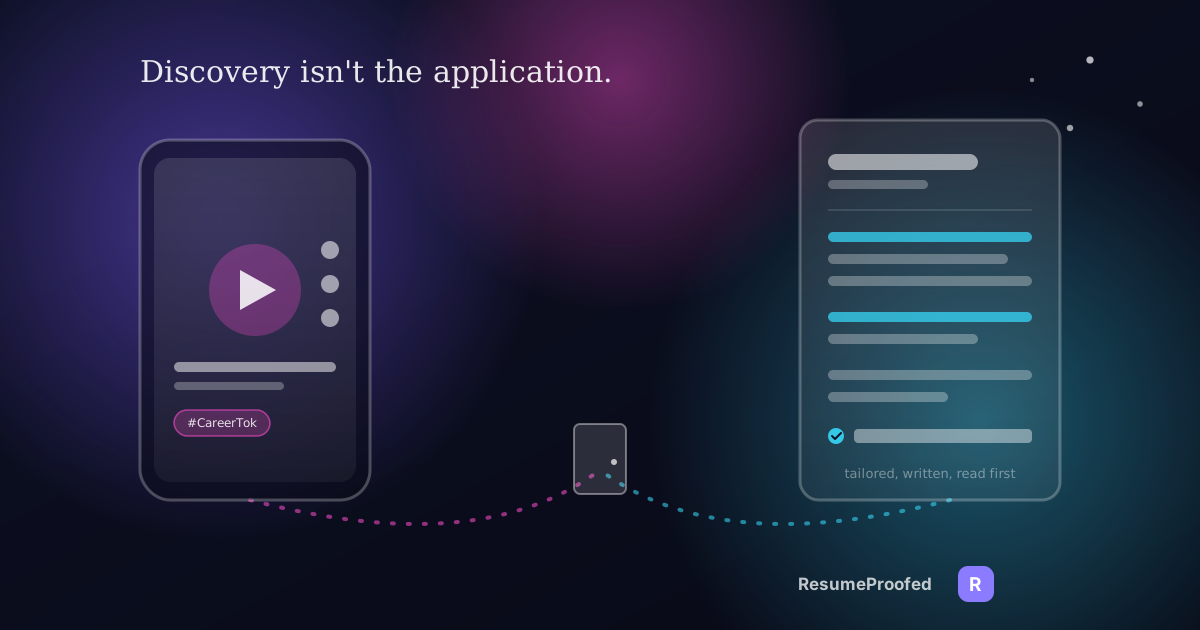
If you're under 25 and looking for work, there's a decent chance you found your last lead scrolling a video feed, not browsing a job board. TikTok has now narrowly overtaken LinkedIn as the job search tool Gen Z actually uses most, and that's a genuinely new finding worth taking seriously rather than dismissing as a novelty. It's also, if you read it the wrong way, an easy way to waste your effort on the wrong half of the job hunt.
The position worth stating early: TikTok and LinkedIn aren't competing for the same job in your job search. One is increasingly where you discover that a role or an employer exists. The other, or more precisely the tailored, written resume that follows either of them, is still what gets you past an ATS filter or a hiring manager's first read. Discovery and application are two different problems, and the mistake worth correcting here is treating a viral CareerTok clip as if it were the application itself.
The numbers behind the shift
The headline figure comes from iHire's generational job search data: 22.1 percent of Gen Z now say they use TikTok as a job search tool, against 20.8 percent who say the same of LinkedIn. It's a narrow gap, not a landslide, but it's real, and it's independently reported twice. Apollo Technical's roundup of social media recruiting statistics cites the iHire figures directly, and The Cool Down's coverage of Gen Z job seekers turning to TikTok reports the same crossover, attributing its numbers to Vice's reporting on the same underlying data. Two separate outlets landing on the same figures, from the same original source, is worth more confidence than a single citation would carry on its own.
What that gap actually tells you is narrower than the headline makes it sound. It doesn't mean TikTok has replaced LinkedIn as a hiring platform, and it doesn't mean recruiters have abandoned LinkedIn's search and messaging tools, which remain central to how most roles are actually filled once a candidate is in front of a hiring manager. It means that for the specific first step, noticing that a role, a company or an industry is worth pursuing, more Gen Z jobseekers are now finding that spark on TikTok than on LinkedIn. That's a discovery statistic, not a hiring statistic, and the distinction matters for everything that follows.
What CareerTok actually is, and what it's good for
The broader trend behind that single crossover statistic has a name: CareerTok, the loose community of hashtags, recruiter accounts, "day in the life" videos and company culture content that's built up around job seeking on the platform. Zety's Gen Z Career Trends Report, cited in the Apollo Technical roundup above, found that 46 percent of Gen Z have secured a job or internship with TikTok's help in some way, and that the #CareerTok hashtag has passed 2 billion views. The Cool Down's coverage, sourced to Vice rather than Zety, independently lands on a closely matching 46 percent figure, though it doesn't mention the hashtag or view count at all. The one-in-five figure for landing an interview directly from a TikTok post appears in both write-ups too, but its sourcing is more tangled than a single citation suggests: Apollo Technical's own page traces that specific number to Resume Genius research rather than to Zety, even while crediting the neighbouring 46 percent and 2-billion-views figures to Zety on the same page.
Those numbers describe a real, working discovery channel, not a fad. Recruiters post open roles and behind-the-scenes culture content because it reaches an audience that genuinely isn't opening LinkedIn every day. Employees post honest "what my job is actually like" videos that a formal careers page never will. Career coaches break down how a specific industry's hiring process actually works, in a format that's faster to absorb than a long article. None of that is video replacing the written word in the actual hiring decision. It's video replacing the cold job board search as the moment a candidate first hears about an opportunity.
Where the mistake creeps in: treating discovery as the application
Here's the part worth being direct about, because it's the actual, useful correction this piece exists to make. Finding a role on TikTok, or even building a following talking about your own job search, is not the same achievement as getting hired for that role. The application that follows still runs through the same filters it always has: an ATS parsing a written document for relevant, matched language, and then a hiring manager skimming that same document for ten to twenty seconds deciding whether you're worth a closer look. A video, however well made, does not go through either of those steps. In the near-total majority of hiring processes in 2026, it still isn't what gets read first, or evaluated at all, once you've actually applied.
This is where "video resume vs written resume" stops being an abstract debate and becomes a practical decision. A handful of creative, video-forward industries, some entertainment, media and influencer-adjacent roles, do genuinely welcome a video introduction alongside an application. Almost everything else still expects, and structurally requires, a written resume that can be parsed, searched, matched against a job description and forwarded internally as a document. If you've built genuine visibility through your own content and a recruiter reaches out to you directly off the back of it, you've skipped a discovery step that most candidates don't get. You still haven't skipped the step where that recruiter, or the hiring manager they report to, wants a written resume tailored to the specific role before a decision gets made.
Skipping that step, or treating a link to your TikTok profile as a substitute for it, is a genuinely common way a promising lead goes nowhere. If you've ever been confused about why a conversation that started warm never turned into an interview, our guide on why you're not getting interviews covers the same underlying pattern from a different angle: the gap is almost always in the tailored, written material that follows the initial spark of interest, not in the interest itself.
A routine for using TikTok for discovery without wasting effort on hype
The useful version of "TikTok job hunting tips" isn't a list of hashtags to follow. It's a short routine that keeps discovery and application cleanly separated, so you get the benefit of the platform's reach without letting a well-edited video substitute for the work an application still needs.
Follow a small, deliberate set of accounts, not a wide net of hype. Recruiters at specific companies you'd actually want to work for, industry-specific career coaches, and current employees at target employers posting honestly about the role, not just polished highlight reels. A handful of accounts you trust beats an algorithm feed of generic "how I got hired" content that isn't tied to a real, current opening.
Treat every video-sourced lead as a claim to verify, not an application to submit to. If a video mentions a company is hiring, or a recruiter posts an open role, go find that role on the company's own careers page or a job board before you do anything else. A surprising amount of CareerTok content promotes openings that have already closed, roles that were never formal postings, or generic "we're always hiring" content with no real vacancy behind it. Five minutes confirming the role actually exists and is still open saves you from tailoring an application to nothing.
Once you've confirmed a real, open role, switch entirely into written-application mode. Read the actual job ad, not the video that pointed you to it, and pull the specific language and requirements from that ad. This is where the discovery channel's job ends and the resume's job begins, and treating them as one continuous task is exactly the mistake worth avoiding.
Tailor your written resume to that specific ad, the same way you would for a role you found on a job board. The channel you discovered the role through doesn't change what a hiring manager or an ATS needs from the document itself: matched language, specific outcomes, and a structure that's easy to scan quickly.
If you do have a public TikTok presence relevant to the role, link it as supporting context, not as the application. A cover letter line noting "I've built an audience of several thousand talking about [relevant topic], linked here" can genuinely help in a role where that's relevant, marketing, content, community roles especially. It works as one data point among several, not as a replacement for the resume itself.
A worked example
Say you're a recent graduate who follows a handful of recruiter accounts at mid-size tech companies. One posts a short video about an open marketing coordinator role, filmed casually at their desk, mentioning the team is looking to hire "someone who gets short-form content." Rather than commenting on the video or DMing the recruiter with a link to your own TikTok, you spend ten minutes finding the actual job listing on the company's careers page, confirm it's still open and read the full description. It asks for experience with content calendars, basic analytics reporting and cross-functional coordination with a design team. You then update your resume's relevant bullet points to lead with the specific outcomes from your own content work, "grew a university society's account from 400 to 3,200 followers over one semester using a weekly content calendar," rather than a general "social media savvy" line, and submit that tailored resume through the same application process everyone else uses. The video got you there first. The tailored written resume is still what gets read.
Where LinkedIn still matters, even if it's no longer first
It's worth being precise about what the crossover statistic doesn't say. LinkedIn narrowly losing the "which tool do you use to job search" question among Gen Z doesn't mean it's become irrelevant to hiring generally. It remains the platform most recruiters actually search and message candidates through once a role is live, and it's still where a professional history, references and recommendations get checked before an offer. The practical read isn't "abandon LinkedIn for TikTok." It's "don't assume LinkedIn is still the only, or even the first, place a Gen Z candidate hears about a role," and build a search routine that uses TikTok for what it's actually good at, discovery and culture signal, while keeping LinkedIn, job boards and direct applications as the channels the actual, formal application still runs through.
Common questions
Does TikTok actually overtake LinkedIn for Gen Z job search?
Yes, on current data. iHire's generational job search figures put TikTok at 22.1 percent usage among Gen Z jobseekers against 20.8 percent for LinkedIn, a narrow but genuine crossover, independently reported by both Apollo Technical and The Cool Down.
Does TikTok help you get a job, or just find one?
Mostly the finding. Zety's data shows 46 percent of Gen Z have secured a job or internship with TikTok's help in some way, a figure The Cool Down's Vice-sourced reporting closely corroborates, and separate Resume Genius research puts the share who credit a TikTok post directly with landing an interview at roughly one in five, but the actual hiring decision still runs through a written application in almost every case.
Should I make a video resume instead of a written one?
No, not as a replacement. A small number of creative, video-forward roles welcome a video introduction alongside an application, but the large majority of hiring processes still require a written, parsable resume that an ATS and a hiring manager can both read and search.
What is CareerTok?
CareerTok is the loose community of job search and career content on TikTok, including recruiter accounts, employee "day in the life" videos and career coaching content. The hashtag has passed 2 billion views and functions mainly as a discovery and culture-research channel rather than an application channel.
How do I use TikTok for job hunting without wasting time on fake or expired postings?
Follow a small, deliberate set of recruiter and employee accounts rather than a broad algorithm feed, and treat every role mentioned in a video as a claim to verify on the company's own careers page before you invest any time tailoring an application to it.
Is LinkedIn still worth using if TikTok is now more popular for discovery among Gen Z?
Yes. The shift is about where Gen Z first hears about roles, not about where hiring actually happens. LinkedIn remains central to how recruiters search for and message candidates, and to how a professional history gets checked once an application is already underway.
Where ResumeProofed fits, and where it doesn't
ResumeProofed can't find you a role on TikTok, build your following, or tell you which recruiter accounts are worth following, that discovery work is genuinely yours to do. What it can do is take the actual job ad once you've found a real, open role, however you found it, and help you tailor a written resume to that specific listing, which is the step a well-edited video was never going to do for you.
ResumeProofed opens soon. Join the waitlist to be first in.