Does an AI cover letter still help? What a 2026 study found
A tailored cover letter used to be a reliable signal. New research shows that signal broke once AI made it trivial to fake, but one thing still works.
- Cover letters
- AI resumes
- Job search tools
You've read the advice, tailored your cover letter to the job ad, and used an AI tool to help get there faster. The question is whether that tailoring still means anything to the person reading it, now that every other applicant's AI tool can produce the same close match to the job posting in about the same amount of time.
The position worth stating early: it doesn't mean what it used to, and there's now a specific, current study measuring exactly how much that changed. A cover letter that closely mirrors a job ad's language used to be a reliable, if imperfect, signal that you'd put in real effort. Once AI made that kind of alignment trivial to produce, employers stopped being able to trust it as a signal at all. What still works is something AI can't fake for you: the time you actually spend editing the draft.
The study behind this
In September 2025, researchers Jingyi Cui, Gabriel Dias and Justin Ye posted a paper to arXiv titled "Signaling in the Age of AI: Evidence from Cover Letters", revised that November. It's a difference-in-differences analysis of what happened when a major online employment platform (a freelance marketplace) rolled out a built-in AI cover-letter generation tool to its users. The study's sample covers roughly 106,000 jobs and 5.5 million bids in two skill categories, PHP and internet marketing, over a 240-day window in 2023, so the underlying data is narrower than the platform's overall scale.
The pattern is worth walking through in order, because each step explains the next. First, once workers gained access to the AI tool, the textual alignment between their cover letters and the job posts they applied to increased, and callback rates rose too. AI-assisted tailoring worked, in the direct sense that closer alignment kept producing more callbacks, at least initially.
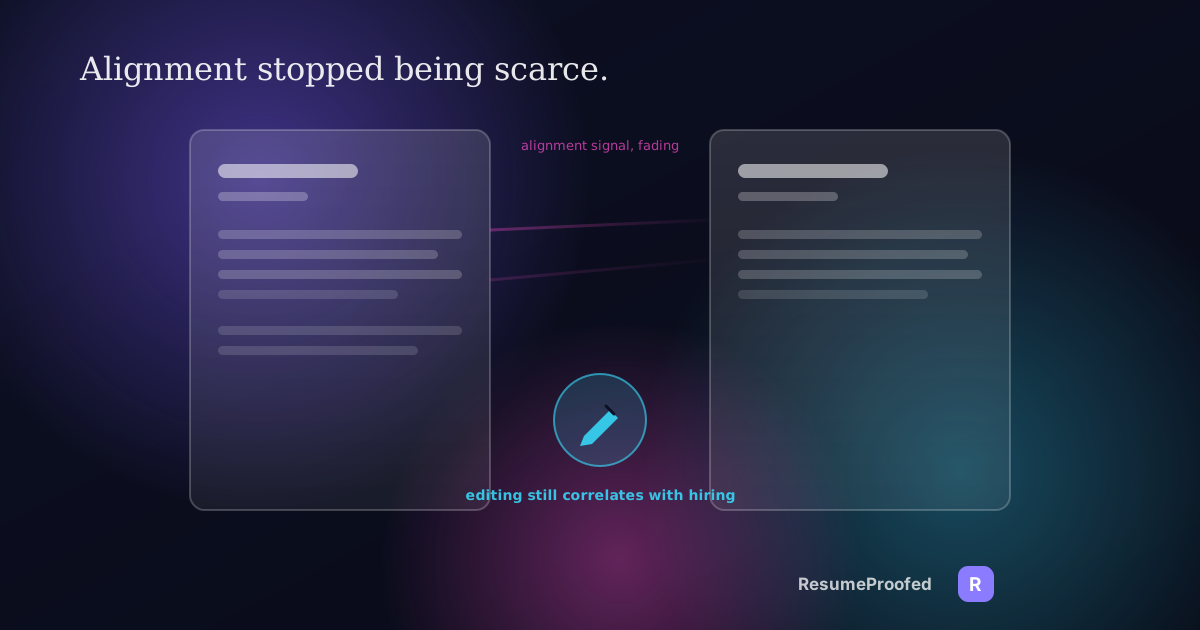
Then the signal broke. As AI-generated, closely-aligned cover letters became common rather than rare, the correlation between a letter's textual alignment and whether it earned a callback fell by 51 percent, and the correlation between alignment and actually receiving a job offer fell even further, by 78.57 percent. A March 2026 plain-language summary of the paper on a careers and management blog, Michael Roberto's analysis of the same research, confirms the same core finding independently: the correlation between cover-letter tailoring and getting invited to interview declined substantially once AI tools were widespread, and the correlation with actually receiving a job offer fell too. Employers hadn't stopped reading cover letters. They'd stopped being able to tell, from alignment alone, which applicants had put in genuine effort and which had generated a plausible match in thirty seconds.
The paper's authors describe employers responding by substituting toward "harder-to-fake indicators of quality" instead, things like a worker's prior job history and review scores on the platform, signals that are much more costly to fabricate than a well-aligned paragraph.
The one thing that kept working
Here's the finding that matters most if you're deciding how to actually use an AI tool for your own letter, rather than whether to use one at all: time spent editing an AI-generated cover letter draft remained positively correlated with hiring success, even after the raw alignment signal had broken down.
Most applicants who used the AI tool didn't bother revising what it produced. The ones who did invest real editing time saw a meaningfully better shot at landing the role. That's a specific, falsifiable claim, not a vague endorsement of "put in effort," and it lines up with something our own breakdown of cover letter research already established using older data: a cover letter tailored by a human to a specific role beats a generic one by a wide margin. This new study adds the missing piece for 2026: a cover letter that's tailored by an algorithm alone, with no human editing on top, is closer to the generic end of that spectrum than people assume, because the tailoring itself is no longer scarce.
Why this matters more for some applicants than others
If you're changing careers, this finding should worry you more than most, not less. Our guide to writing a cover letter for a career change argues that the letter is doing explanatory work a resume physically can't fit, connecting a nontraditional background to a new field's actual priorities. That explanation has to be genuine and specific to your real situation, the kind of content an AI tool can draft a plausible version of but can't originate on its own, because it doesn't know which two achievements from your actual career are the ones that make the transition credible. If you generate a career-change letter and send it unedited, you're sending exactly the kind of output the study found employers have learned to discount.
If you're applying within your own field, where the letter's main job is confirming fit rather than explaining a leap, the stakes of an unedited AI draft are somewhat lower, but the finding still applies. A closely-aligned letter alone no longer proves you read the job ad carefully. Editing it to sound like you, cutting the generic phrasing an AI tool defaults to, and adding one detail specific to that employer, is what still does.
A worked example: the same draft, edited two different ways
Say an AI tool generates this opening paragraph for a Marketing Coordinator application, based on a resume and a pasted job ad:
I am excited to apply for the Marketing Coordinator position at your company. With my strong background in content creation and campaign management, I am confident I would be a valuable addition to your team.
Sent as-is, this is the version the 2026 study describes losing its signal value: closely enough aligned to the job title to look tailored, but generic enough that dozens of other applicants' AI tools produced something functionally identical.
The unedited version's problem isn't grammar or structure, it's that nothing in it could only have been written by this specific applicant about this specific role. Swap the company name and job title and it reads exactly the same.
The edited version, five minutes of real work later:
I'm applying for the Marketing Coordinator role because your last two product launches ran the kind of tight, cross-functional campaign timeline I managed at my current job, coordinating a content calendar across four channels for a subscription box relaunch that hit its signup target in six weeks instead of the ten we'd planned for.
The second version keeps the same underlying claim, campaign management experience, relevant to this role, but it names something specific to the employer, replaces the vague "strong background" with one real, numbered example, and could not be mistaken for a template. That's the editing effort the study found still correlates with success, not because editing itself is magic, but because it's the only part of the process that requires the applicant to actually engage with the specific job and employer in front of them.
A short routine for using AI on a cover letter without losing the signal
- Let the AI tool produce a first draft, using your real resume and the actual job ad as input. This step alone is where most of the time savings come from, and there's nothing wrong with using it to skip the blank page.
- Read the draft and mark every sentence that could apply to a different company or a different candidate. If the sentence would still make sense with the employer's name swapped out, it's the generic layer the study found employers have learned to discount.
- Replace at least two of those marked sentences with something specific: a real number from your own work, a detail about the employer you found in the job ad or their own materials, or a direct connection between one past achievement and one stated priority in the posting.
- Cut anything the draft invented or exaggerated. An AI tool will sometimes phrase a claim more strongly than your actual experience supports. Editing time only helps if what you're editing toward is still true.
- Read it once more for voice. If it doesn't sound like something you'd say out loud to the hiring manager, it still reads as a draft rather than a letter.
This routine takes ten to fifteen minutes past the initial generation. That's roughly the editing investment the study associates with better outcomes, and it's a fraction of the time a fully from-scratch letter takes, which is the actual case for using an AI tool at all: not to skip tailoring, but to skip the blank page so you can spend your time on the part that still counts.
Common questions
Does an AI generated cover letter still help my application in 2026?
An unedited one helps less than it used to. Research on a major platform's rollout of an AI cover-letter tool found the correlation between how closely a letter matched a job ad and getting a callback fell 51 percent once AI-generated alignment became common. Editing the draft yourself remained positively linked to hiring success.
Should I edit my AI generated cover letter before sending it?
Yes. The same 2026 research found that applicants who spent real time editing an AI draft, rather than sending it unchanged, had meaningfully better outcomes, even though the raw "how well does this match the job ad" signal had lost most of its predictive power.
Why did tailored cover letters stop working as well as they used to?
Not because tailoring stopped mattering, but because it stopped being scarce. When most applicants can generate a closely-aligned letter in seconds, alignment alone no longer proves genuine effort, so employers shifted toward signals that are harder to fake, like work history and references.
What can an AI tool not do for a cover letter, even a good one?
It can't originate the specific, true detail that makes a letter credible: a real number from your actual work, a genuine reason you want this particular employer, or an honest case for how a nontraditional background applies. It can draft a plausible structure around whatever you give it, but the substance still has to come from you.
Is it still worth using AI to draft a cover letter at all?
Yes, for the first draft. The time it saves on the blank page is real. The mistake the research identifies isn't using the tool, it's sending what it produces without spending the editing time that the data shows still correlates with getting hired.
Does this apply to cover letters for career changes specifically?
It applies more, if anything. A career-change letter has to explain a nontraditional background credibly, the kind of specific, true reasoning an AI tool can phrase but can't invent on your behalf. Sending an unedited AI draft for a career-change application skips the exact explanatory work the letter exists to do.
Where ResumeProofed fits, and where it doesn't
ResumeProofed drafts a cover letter from achievements you've confirmed as true in your master profile, matched to the specific job description you're applying against, which handles the first-draft step this research shows still saves real time. It won't manufacture the specific, personal detail that makes a letter credible if you haven't given it that detail to work with, and it can't do your editing pass for you. The data above says that pass is the part that still matters most. It's worth the ten minutes.
Try ResumeProofed free: two tailored applications on the house, no card required.