Do AI cover letter generators actually work?
The data says yes and no at once: AI drafts get rejected when they read as generic, and accepted when they don't. Here is exactly where that line sits.
- Cover letters
- AI resumes
- Job search tools
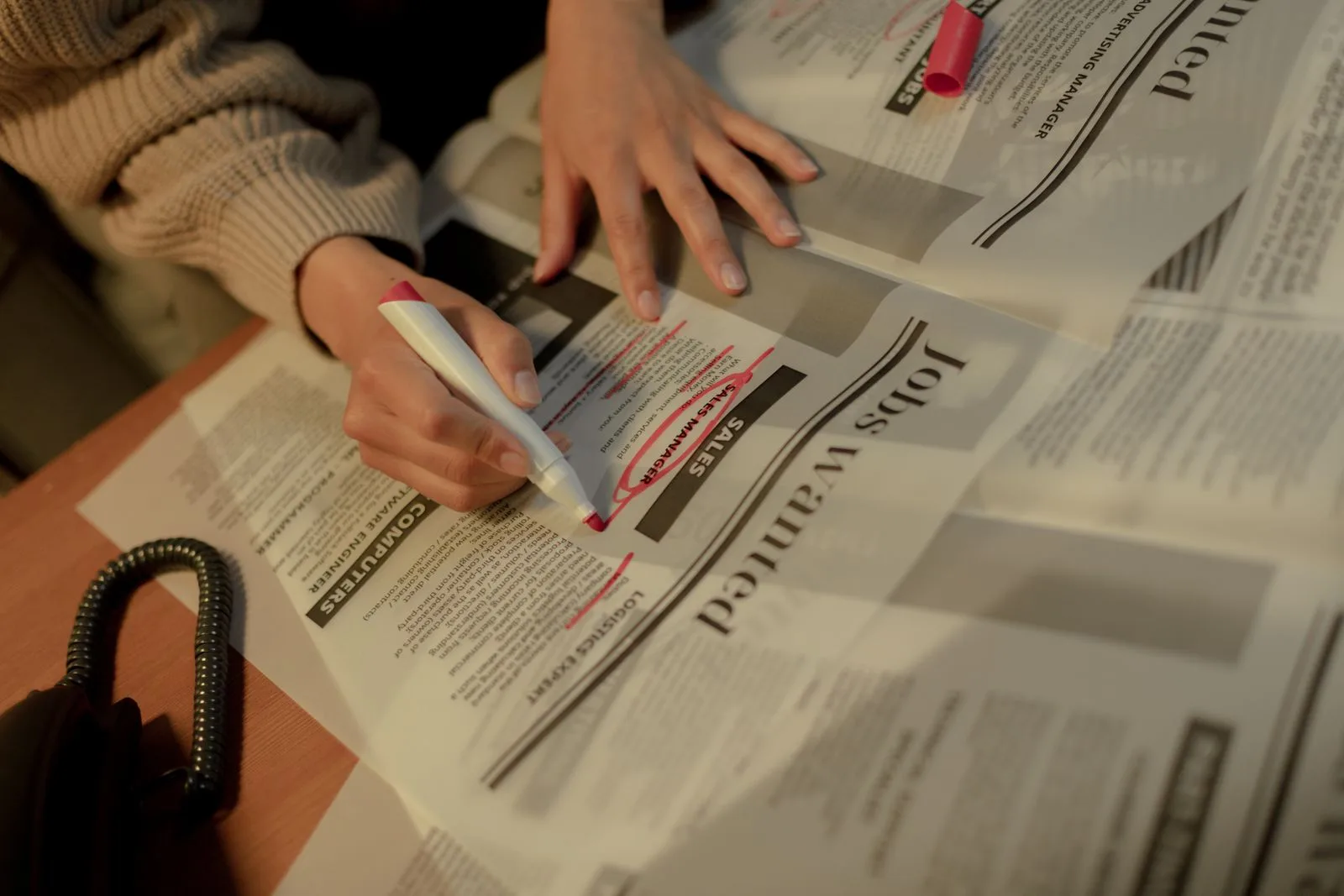
You pasted a job ad into an AI tool, it spat out a cover letter in four seconds, and now you're staring at it wondering whether sending it is smart or is the exact reason you won't hear back. Both instincts are correct, depending on which cover letter you actually send, because the data on this question doesn't point one way. It points at a specific, fairly narrow line, and most of the advice online never actually says where that line sits.

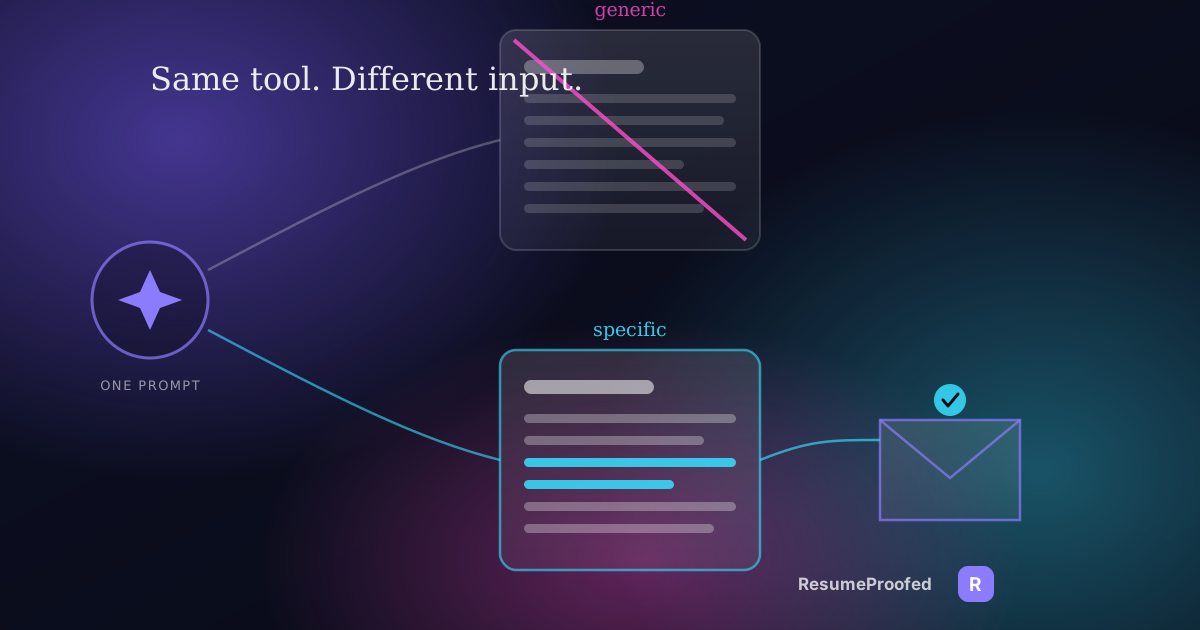
Here is the position worth stating before anything else: AI cover letter generators work when the input is specific and the output gets edited, and they fail, often badly, when neither of those things happens. The tool is not the variable that decides your outcome. What you feed it and what you do with what it gives you back is the whole story, and the rest of this article is about exactly that, backed by real hiring manager and job seeker survey data rather than a general vibe about AI in hiring.
What a hiring manager can actually detect, according to hiring managers
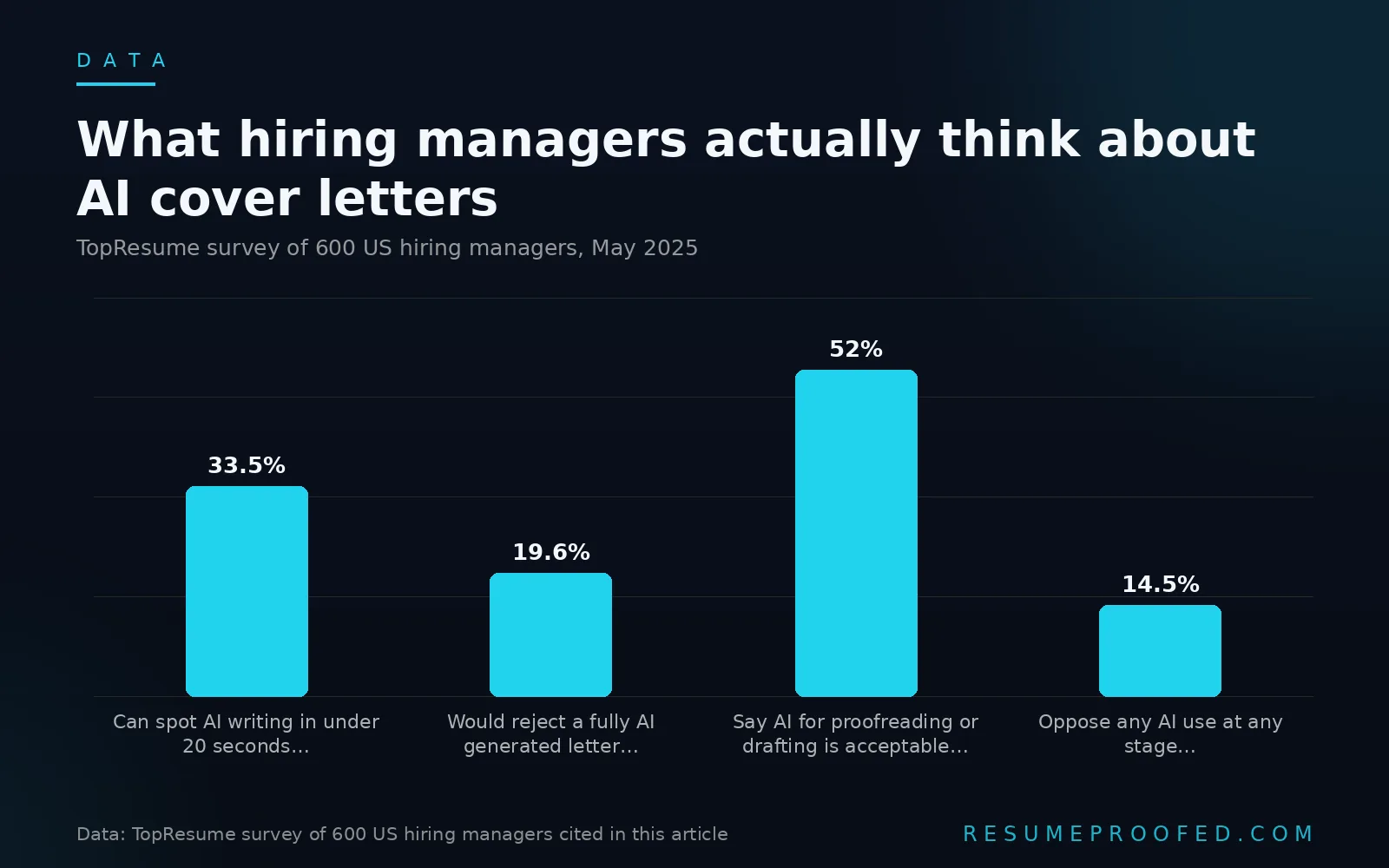
TopResume surveyed 600 U.S. hiring managers in full time work through Pollfish in May 2025, and the results are specific enough to be useful rather than just alarming. A third of hiring managers, 33.5 percent, said they can spot an AI generated resume or cover letter in under twenty seconds. One in five, 19.6 percent, said they would reject a candidate outright if they believed the resume or cover letter in front of them was entirely AI generated. See the TopResume AI in hiring survey for the full breakdown.
That sounds like a clear case against using AI at all, until you read the next set of numbers from the same survey. Just over half of hiring managers, 52 percent, said using AI for proofreading or drafting support is acceptable. Only 14.5 percent take the hardline position that AI shouldn't be used by a candidate at any stage of applying. The gap between "one in five would reject a fully AI generated letter" and "half find AI assisted drafting acceptable" is the entire subject of this article: hiring managers are not rejecting the tool, they're rejecting the tell. A generic, unedited AI output reads exactly like what it is, and that specific thing is what gets punished.
Nearly half of job seekers are already doing this
If using AI for a cover letter feels like it might be an unusual shortcut, the data says otherwise. Resume Genius surveyed 1,000 U.S. job seekers actively searching for work through Pollfish in March 2026, and found that 78 percent already use AI somewhere in their job search or would consider it. Broken down by task, 59 percent had used AI to help write a resume and 48 percent had used it to help write a cover letter specifically. See the Resume Genius 2026 Job Seeker Insights Report for the full survey.
That matters for two reasons. First, it means the honest baseline you're being measured against on the other side of the desk is not "candidates who wrote every word themselves versus candidates who used a shortcut." A large share of the pile a recruiter is reading has AI involvement somewhere in it already, whether disclosed or not. Second, it means the hiring managers producing the detection numbers above have almost certainly been reading a steady stream of AI assisted letters for a while now, which is exactly why 33.5 percent of them say they can spot one quickly. Practice built that instinct. It didn't come from a detector tool.
The tell isn't the sentences, it's the absence of anything specific
Read the two numbers above together and a pattern falls out: hiring managers aren't detecting AI by its grammar. Modern AI drafts are grammatically clean, arguably cleaner than most human first drafts. What gives a generic AI cover letter away is that it could be sent to any company in the same industry without a single sentence needing to change. Can recruiters tell if you used ChatGPT on your resume? covers the same mechanism on the resume side in more depth: the tells are structural, not stylistic, and cover letters have the exact same failure mode, just more exposed, because a cover letter has nowhere to hide behind a bullet point format the way a resume does.
An AI cover letter generator, fed nothing but a job title and a company name, produces confident, well formed, completely generic prose, because that's the only material it has to work with. Feed the same tool three specific facts about what you actually did, in numbers or concrete outcomes, and the sentence structure it returns is nearly identical, but the content is no longer swappable with a different applicant's letter. The tool didn't get smarter between those two attempts. The input changed, and that is the entire difference between a letter that gets a 19.6 percent rejection risk and one that doesn't read as AI generated at all, regardless of which tool wrote the first draft.
A worked comparison
Prompt with no specifics: "Write a cover letter for a marketing coordinator role at a mid sized retail company."
What comes back, roughly: "I am excited to apply for the Marketing Coordinator position at your company. With my strong background in marketing and passion for driving results, I believe I would be a valuable addition to your team. I have experience managing campaigns, collaborating with cross functional teams, and delivering results in fast paced environments." Every sentence there could sit under a different applicant's name with zero edits. That is precisely the pattern a hiring manager who reads fifty of these a week learns to spot in under twenty seconds.
Prompt with three specifics: "Write a cover letter for a Marketing Coordinator role at Coastline Retail Group. In my current role I grew email subscriber revenue 22 percent in eight months by rebuilding the welcome series, I ran the Instagram account from 4,000 to 11,000 followers without paid spend, and I've used Klaviyo daily for two years, which the job ad lists as a requirement."
What comes back, roughly: "Coastline Retail Group's focus on community driven retail is what drew me to this role. In my current position I rebuilt our email welcome series, which grew subscriber revenue 22 percent in eight months, and grew our Instagram following from 4,000 to 11,000 without paid spend. I've worked in Klaviyo daily for two years, which the role lists as a core requirement, and I'd bring that same hands on approach to Coastline's campaigns." Same tool, same four seconds of generation time, a genuinely different letter that couldn't be sent anywhere else without rewriting most of it.
A five step routine that keeps you on the right side of the data
- Never open with the job title and company name as your only input. That's the prompt that produces the generic version above. Gather three specific facts, real numbers, a tool you've used that the ad names, a result you can defend in an interview, before you generate anything.
- Name the company and something true about it in your first line. Not flattery, a specific reason drawn from the actual job ad or the company's own site. This is the single fastest fix for the "could be sent anywhere" problem.
- Delete every sentence that describes a feeling rather than a fact. "I am passionate about" and "I believe I would be a valuable addition" are the exact stock phrases that read as generic AI output even when a human typed them. Replace each one with something you actually did.
- Read it out loud once before sending. If a sentence doesn't sound like something you would say to a person, it's a tell, and it's worth rewriting in your own words even if the AI draft was factually accurate.
- Verify every claim is true before it goes out. An AI tool will happily phrase a number more impressively than you gave it, or round an estimate into something that reads as precise. If you can't defend a sentence in an interview next week, cut it now.
This is the same discipline ChatGPT vs a resume tailoring tool describes for resumes: the tool is genuinely useful for structure and phrasing, and genuinely risky as a source of the actual content, because it will confidently produce something plausible sounding from almost nothing if you let it.
When a generic AI letter is still better than no letter
None of the above means a rushed AI cover letter is always worse than skipping the cover letter entirely. That is a separate question with its own data, covered in full in Do you need a cover letter in 2026?: a large field study found tailored cover letters lifted callback rates 53 percent over sending no letter at all, and even a generic one still beat sending nothing. The honest hierarchy, in order, is a tailored letter you wrote or edited carefully, then a generic human written letter, then a genuinely personalized AI assisted letter, then a fast unedited AI letter, then nothing. Where an AI generator sits on that list depends entirely on how much of the five step routine above you actually did before hitting send.
Common questions
Do AI cover letter generators actually work?
They work at producing a well structured first draft quickly, which is genuinely useful. They do not reliably work at producing a letter that gets a response, because a generic AI output reads as generic to an experienced hiring manager, and survey data puts real rejection risk on letters that read as fully AI generated with no personalization.
Can recruiters tell if a cover letter was written by AI?
Often, yes. A 2025 TopResume survey of 600 U.S. hiring managers found 33.5 percent say they can spot an AI generated resume or cover letter in under twenty seconds. The tell is usually genericness, not grammar, since modern AI writing is clean by default.
Is it OK to use AI to help write a cover letter?
Most hiring managers say yes, with a condition. The same survey found 52 percent consider using AI for proofreading or drafting support acceptable, while only 14.5 percent oppose any AI use at any stage. The acceptable use case is drafting support you then personalize, not a final, unedited output.
Will using AI for my cover letter get me rejected?
It can, but the risk is tied to how generic the result reads, not to whether AI was involved at all. One in five hiring managers surveyed said they would reject a candidate over a cover letter they believed was fully AI generated with no personal input, which is the outcome the five step routine above is built to avoid.
How do I make an AI generated cover letter sound less like AI wrote it?
Feed it specific numbers and facts before you generate anything, rather than just a job title, then delete any sentence that states a feeling instead of a fact, and read the result aloud once before sending. The examples earlier in this article show exactly how different the same tool's output looks with specific input versus none.
Is it better to use AI for a cover letter or write it myself?
Whichever produces a more specific, accurate letter for that job. If you have the concrete details and time, writing it yourself with those details is hard to beat. If you're short on time but still have the specific details ready, a well prompted AI draft edited carefully closes most of that gap.
Where ResumeProofed fits, and where it doesn't
ResumeProofed tailors a resume and cover letter from a confirmed master profile of things you've actually done, not from a bare job title, which is exactly the difference this article argues matters most. It won't write a letter from nothing any more usefully than a general AI tool would; the quality still depends on the specific evidence behind it. What it changes is the five step routine above from a manual discipline you have to remember every time into the default: the letter it generates is already built from your real numbers and results, tailored to the specific ad, rather than a generic template you then have to specify your way out of.
Try ResumeProofed free: two tailored applications on the house, no card required.