ChatGPT vs a resume tailoring tool: what each is actually good at
You already have ChatGPT. Here is an honest, specific breakdown of what it does better than a tailoring tool, and where it genuinely falls short.
- AI resumes
- Job search tools
- Résumé writing
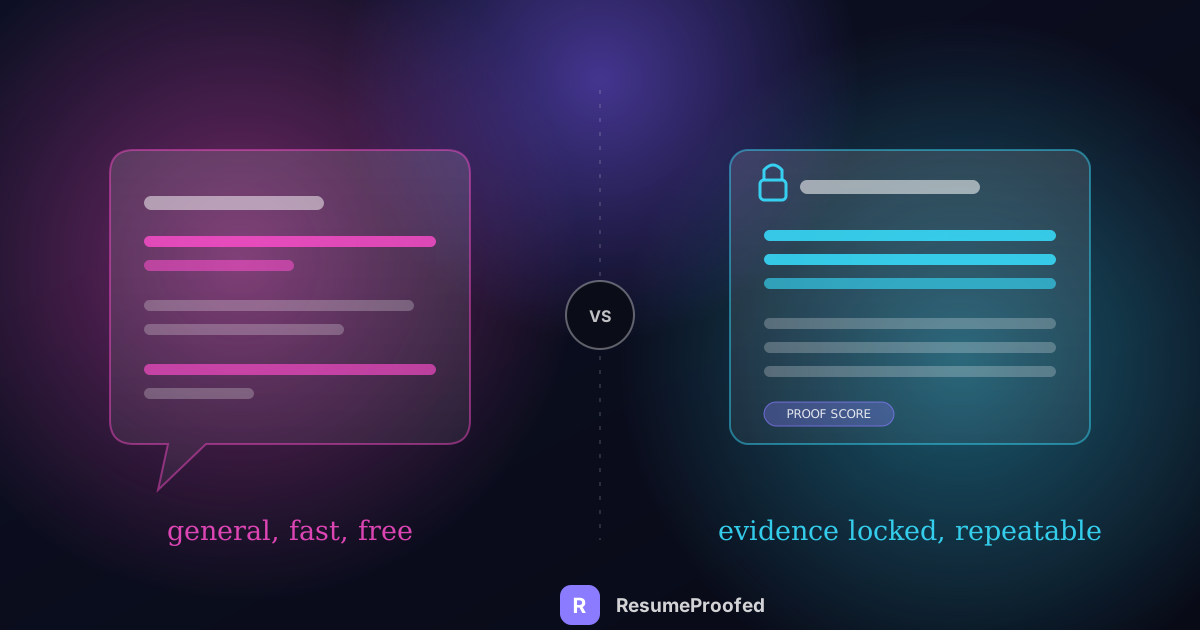
You already have ChatGPT open in another tab. It is free, or close enough to free, and it is good at writing. So before you consider paying for anything else, the honest question deserves an honest answer: what does a dedicated resume tailoring tool actually give you that ChatGPT does not?

Most articles that ask this question are secretly trying to sell you the tool. This one is not going to pretend ChatGPT is bad at resumes, because it isn't. It is going to draw the line accurately: where a general purpose chat model earns its place in your job search, and where the gap between "helpful" and "reliable across forty applications" starts to matter.
What ChatGPT is genuinely good at

Start with the case for ChatGPT, because it is a real case and understating it would be dishonest.
Rephrasing is close to a solved problem for a chat model. Give it a clunky sentence and a direction (tighter, more formal, more direct) and it will hand back three or four options in seconds. This is the single most common resume task, done well, for free.
Brainstorming achievements out of a vague job history is where it earns its keep. A lot of people freeze in front of a blank resume not because they lack accomplishments, but because five years in a role blur into "did the job." A back and forth conversation, "what did a normal Tuesday look like," "what changed after you joined," "what did your manager actually thank you for," can surface real material that a static form never would. This is genuinely one of the best uses of a chat model in the entire job search process, because it plays to exactly what conversational back and forth is good for: drawing detail out of a person who does not yet know what is in their own head.
Drafting a cover letter from a rough outline is a strong use case. Give it your key points and the tone you want, and it will produce a workable first draft faster than staring at an empty page. We have written separately about whether a cover letter is worth writing at all for a given application, but if you have decided yes, ChatGPT is a legitimate way to get past the blank page.
It is free, or close to it. As of August 2026, ChatGPT's free tier gives anyone a usable chat model with no card required, and ChatGPT Plus is 20 US dollars a month, a price that has not moved since 2023 even as the underlying model has been replaced several times over, most recently by GPT-5.6, which OpenAI released in July 2026 (OpenAI's GPT-5.6 announcement, reported the same week by CNBC and Axios). For someone applying to three or four jobs, the free tier is genuinely enough. There is no honest way to write this article and conclude otherwise.
None of that is faint praise. A model that rephrases well, brainstorms well, drafts a cover letter well, and costs nothing is a real tool. The question is not whether ChatGPT is intelligent enough to help with a resume. It clearly is. The question is what happens when you use it the way most job seekers actually apply for jobs: not once, but dozens of times, over weeks, under deadline pressure, late at night.
Where it falls down: repeatability and discipline
This is the actual comparison, and it has almost nothing to do with how smart the model is. It is about what a chat window is, and is not, built to do.
There is no persistent master resume. Every new chat starts cold, or drags along whatever context happens to still be in that one thread. There is no single, structured, evidence checked record of your career that the tool remembers by default, holds constant, and works from every single time. If you want that, you have to build and maintain it yourself, in a separate document, and manually paste the relevant parts into every conversation. Most people do not do this consistently, which means most people are re-explaining fragments of their own career to a chat window every time they apply, from memory, under time pressure. We have written a full breakdown of what a master resume actually is and why that one document is the difference between a ten minute tailoring session and an hour of reconstruction.
There is no consistent scoring. ChatGPT will tell you a resume "looks strong" or "could better reflect the job description" if you ask it to, but that judgement is not calibrated against anything, is not repeatable between sessions, and is not measuring the thing that actually matters, which is how much of the finished document is backed by something you can defend in an interview versus how much is confident sounding filler. Ask the same model to score the same resume against the same job ad twice, in two separate chats, and do not expect the same answer. That is not a criticism of the model. It was never built to be a consistent scorer. It was built to be a good conversational partner in the moment you are talking to it.
Formatting breaks the moment you copy it out. ChatGPT writes in markdown by default: asterisks for bold, pound signs for headings, dashes for bullets, sometimes tables. That looks clean inside the chat window. The moment you copy it into Word or Google Docs, you get literal asterisks sitting in your bullet points, headings that did not carry their formatting, or a table that pastes as one unreadable row. Multiple guides written specifically for job seekers using ChatGPT flag this as a recurring problem: content generated for on screen reading is not the same as a document built to survive an applicant tracking system's parser, and the two need different structures entirely. You can work around this by asking for plain text and rebuilding the formatting yourself in your resume file, but that is a manual step the tool will not do for you, and it is easy to forget at 11pm on application thirty of the week.
There is a real, well documented tendency toward inflated verbs and invented specifics. We have covered this in detail in our piece on whether recruiters can tell you used ChatGPT, so we will not repeat the full argument here, but the short version matters for this comparison: when a general model is asked to describe an achievement it does not have real data for, it fills the gap with something plausible sounding rather than leaving a blank. "Significantly improved efficiency" is what a model writes when it does not know the number was 31 percent, because it cannot know a fact you never gave it, and it will rarely just tell you that the sentence is empty. A tool built specifically around evidence has to behave differently here, because inventing a plausible number is the one failure mode it cannot be allowed to have.
It has no memory of what you already changed across forty applications. This is the one that compounds. Your third application and your thirtieth application to different but similar roles will each start from scratch unless you manually track what you sent where. Did you already emphasise the Salesforce migration for the last fintech role, or was that the healthcare one? Did you use "led" or "managed" in the version you sent Tuesday? A chat window has no concept of your application history unless you build and maintain that record yourself, outside the tool, and keep feeding it back in every time. By application twenty, most people stop doing this properly, and consistency quietly degrades exactly when volume makes consistency hardest to fake.
The real choice is workflow, not intelligence

Here is the actual framing, and it is worth being precise about it: this is not "ChatGPT is dumb and a tailoring tool is smart." The underlying language model doing the writing might genuinely be comparable, or in some cases the exact same model, licensed under the hood. The difference is what wraps around it.
A chat window is built for a conversation that starts and ends. A tailoring tool built for resumes is built for a process that repeats: capture your facts once, hold them constant, apply them differently to job forty than to job one, and score the output the same way every time so you can trust the number. That is a product design difference, not an intelligence difference, and it is the entire reason a dedicated tool exists at all in a world where everyone already has access to a capable chat model.
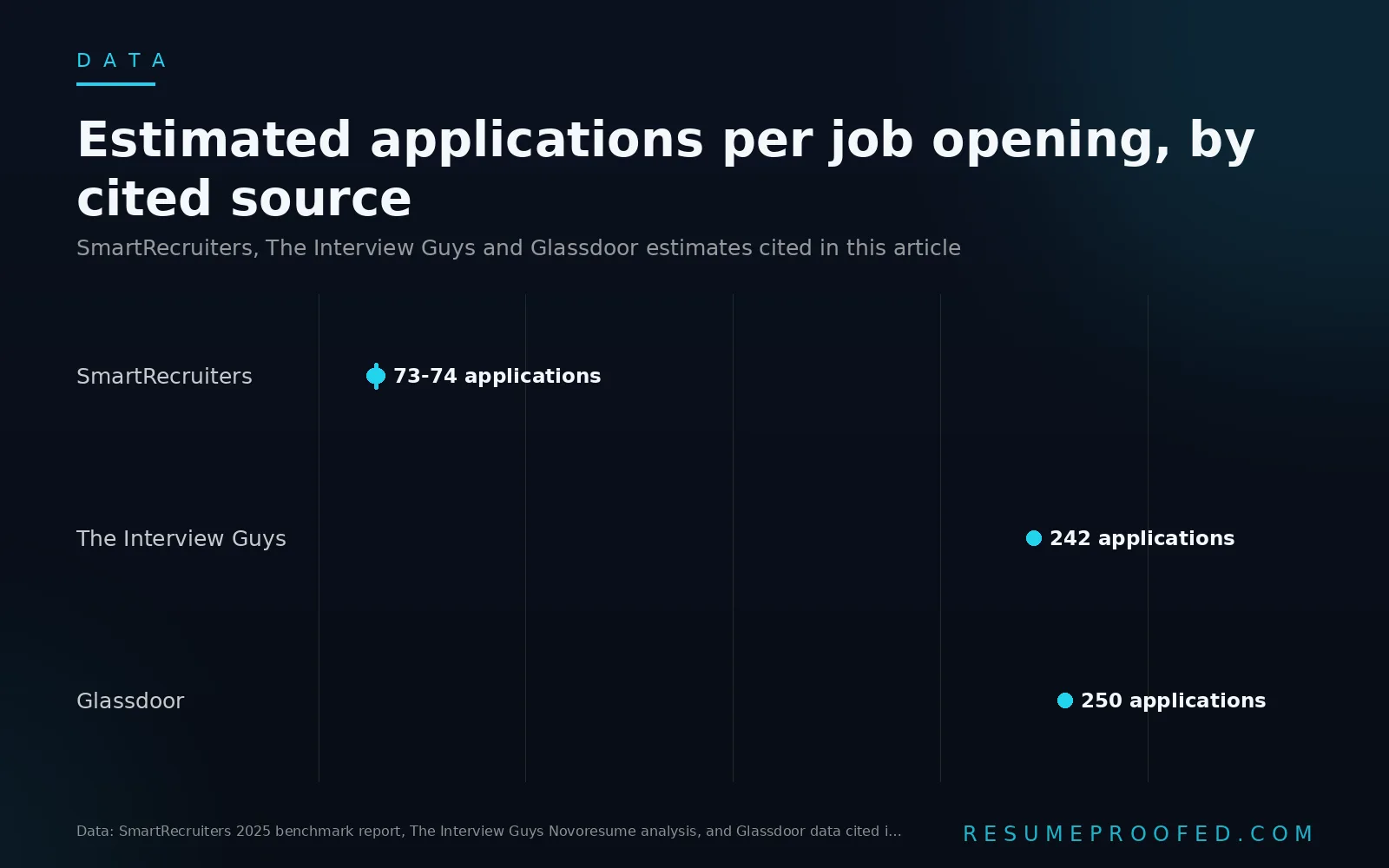
If your job search is three applications to roles you already know well, that difference barely matters, and ChatGPT is probably all you need. If it is thirty or more applications over a couple of months, consider what that volume is actually competing against: SmartRecruiters' 2025 benchmark report, drawn from nearly 90 million applications across 1.5 million job openings worldwide, puts the global average at roughly 73 to 74 applications received per opening. The Interview Guys cites a much higher figure, 242 applications per opening, sourced to Business Insider data via a February 2026 Novoresume analysis, alongside Glassdoor's own data putting the corporate average near 250 applications per role. The exact count varies a lot by source and industry, but every one of them describes a market where a single opening draws dozens to hundreds of competing applications, which is the real reason the lack of a persistent, structured system stops being a minor inconvenience and starts being the reason your strongest facts do not consistently make it into your strongest applications.
How to get better resume output from ChatGPT, if that is what you use
If you have read this far and decided the free option is right for you, here is how to get materially better results out of it, because that is worth more to you than a sales pitch.
- Feed it facts, not a job title. Do not ask "write me a resume bullet for a project manager." Give it the raw material: team size, the actual before and after numbers, what specifically changed. Let the model's job be compression and phrasing, not invention.
- Build a standing "facts" document and paste it in every time. A plain text file with every role, every number, every tool you have used, kept outside the chat. Paste the relevant section into each new conversation instead of relying on chat history or memory. This is the single highest leverage habit on this list.
- Ask it to flag, not fill, gaps. Add an explicit instruction: "if you do not have a number for this, write [NUMBER NEEDED] instead of guessing." This turns the model's biggest weakness into a visible to-do list instead of an invisible risk.
- Request plain text output, then format manually. Ask for "plain text, no markdown, no bold, no headers" and rebuild the structure yourself in Word. It is an extra step, but it avoids the copy-paste formatting mess entirely.
- Ask it to argue against the resume before you send it. A genuinely useful prompt: "read this resume as a skeptical recruiter and list every claim that sounds unsupported." Models are often better at critiquing text than generating it cleanly the first time, and this catches inflated language before a human reader does.
- Keep a simple per application log yourself. Company, role, what you emphasised, what wording you used. A spreadsheet is enough. This single habit replaces most of what a tailoring tool automates, at the cost of your own time and discipline to maintain it.
None of this requires paying for anything. It requires the discipline that a chat window does not supply by default, which is exactly the gap a dedicated tool is built to close for people who would rather not maintain it by hand.
Where ResumeProofed fits, specifically
To be concrete rather than vague about the alternative: ResumeProofed stores one master resume, built once through a guided evidence interview where you confirm every fact, role by role, before it is saved. When you tailor to a specific job ad, generation draws only from that locked, confirmed evidence, so it reorders, reweights and rephrases rather than invents. Every generated resume returns a Proof Score, a consistent measure of how much of the document is backed by a fact you actually confirmed, calculated the same way every time rather than a fresh, uncalibrated judgement per chat. As of August 2026, it costs 29 Australian dollars a month.
That is the whole pitch, and it is deliberately narrow. It does not claim to write better sentences than a capable chat model, because in a lot of cases it is not trying to out write one. It claims to remove the manual discipline, the standing facts document, the per application log, the formatting cleanup, described in the section above, and hold it consistent by default instead of by habit. Whether that is worth 29 dollars a month depends entirely on how many applications you are sending and how much you trust yourself to maintain the manual version under deadline pressure. For three applications, probably not. For thirty, the maths starts to look different, mostly because your own time stops being free once volume goes up.
Common questions
Can I use ChatGPT to write my whole resume for free?
Yes, and for a small number of applications it is a reasonable approach, provided you supply your own facts rather than letting the model invent plausible sounding claims from a job ad alone. The free tier is capable enough for this; the limitation is not intelligence but the manual discipline of tracking facts, formatting and application history yourself.
Is ChatGPT or a resume tailoring tool more accurate?
Accuracy depends entirely on what you feed in, not which tool you use. A general model given real numbers writes accurate bullets. A tailoring tool given the same real numbers does too. The difference is that a tailoring tool built around a locked evidence base makes it structurally harder to invent a number by accident, where a chat model will fill a gap with something plausible unless you explicitly instruct it not to.
Why does my resume look messy after I paste it from ChatGPT?
ChatGPT writes in markdown formatting by default, using symbols for bold text, headings and bullet points that display cleanly inside the chat window but paste as literal characters or broken tables into Word or Google Docs. Ask for plain text with no markdown, then apply your own formatting in your resume file to avoid this.
Does ChatGPT remember my resume between different chats?
Not reliably. Unless you are deliberately maintaining and re-pasting a standing facts document, each new conversation starts without a structured memory of your full career history, which is why consistency tends to drop as the number of applications goes up.
Is it worth paying for a resume tailoring tool instead of using ChatGPT?
It depends on volume. For a handful of applications to roles you know well, ChatGPT with good prompting is probably enough. Once you are applying broadly, commonly tens of applications over a job search, the time cost of manually maintaining facts, formatting and an application log by hand tends to exceed the cost of a tool built to hold that consistently for you.
What is the single biggest mistake people make using ChatGPT for a resume?
Asking it to write from the job description alone, with little or nothing about their own real experience supplied. With nothing real to draw on, the model produces plausible sounding, generic language shaped by the ad's own wording rather than your actual career, which is the exact pattern that reads as generic to an experienced recruiter.
Try ResumeProofed free: two tailored applications on the house, no card required.