How to write a cover letter for a career change (with example)
A career change cover letter has one job your resume can't do: explain the shift. Here is the three-part structure, a worked example, and what to cut.
- Cover letters
- Career change
- Résumé writing
You've reframed your resume around transferable skills, cut the old industry's jargon, and it still leaves an obvious question sitting unanswered on the page: why is this person, with years in one field, applying for a job in a completely different one? A resume has a few seconds of attention and no room to answer that. A cover letter has both, and if you're changing careers, it's doing a job no other part of your application can do.

The position worth stating early: for a career changer specifically, a generic cover letter is close to worthless and a genuinely tailored one earns more of its keep than it does for almost any other applicant. Most cover letter advice treats tailoring as a nice-to-have that lifts your odds somewhat. For a career change, the letter is where the explanation lives at all. Skip it, or phone it in, and a hiring manager is left to guess why you're a serious candidate rather than a curious one.
Why the cover letter has to carry this, not the resume
Our guide to writing a career change resume makes a deliberate call: cut the narrative explanation of why you're switching fields from the resume itself, because a document that gets a few seconds of initial scanning has no room for a story, only evidence. That explanation has to live somewhere, and the cover letter is it.
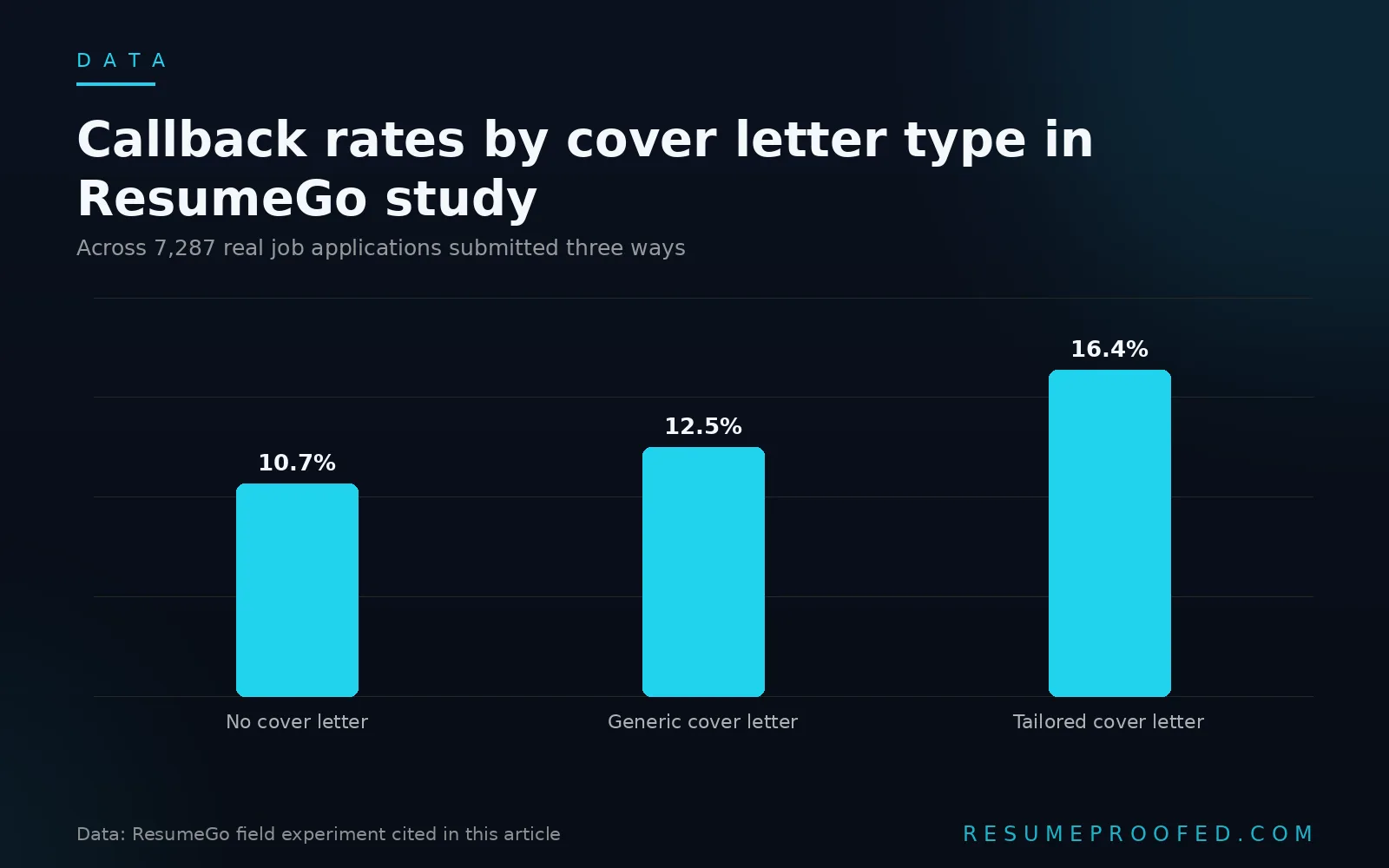
This isn't just a division-of-labour argument. The data on tailored cover letters backs it up directly. In our full breakdown of the cover letter research, we covered a ResumeGo field experiment that submitted 7,287 real applications split three ways: no cover letter, a generic one, and a letter tailored to the specific role. Callback rates came back at 10.7 percent, 12.5 percent and 16.4 percent respectively, meaning a tailored letter delivered a 53 percent lift over sending nothing, while a generic letter barely moved the number at all. That gap should worry a career changer more than most applicants, because a generic letter cannot explain a career change by definition. It has nothing specific to say about why you, with this background, want that role, which is precisely the question a career-change application raises and a same-industry application usually doesn't.
The three things a career change cover letter has to do

Career coach Monica Marcelis Fochtman, quoted in Jobscan's guide to career change cover letters, puts the core discipline in one line: "Flip your language to reflect the industry you want to go to." That's the opposite instinct from how most people draft this letter under pressure, describing their old role in its own terms and hoping the reader translates. The reader won't. You have to.
Beyond that language flip, a career change cover letter needs three specific things a same-field letter doesn't.
Name the change directly, early, without apologising for it. Burying the fact that you're switching fields, or worse, hoping the reader doesn't notice until they're already invested in your application, reads as evasive once they do notice, and they will, because your work history says it plainly. Naming it in the first or second sentence, framed as a deliberate move rather than a confession, sets the tone for everything that follows.
Connect two or three real achievements to the target role's actual language, not your old field's. This is the same translation work the resume does, but with room to explain the connection in a full sentence instead of compressing it into a bullet. Where a resume bullet has to imply the transfer, a cover letter sentence can state it outright: "this is the same skill, applied differently."
Make the case for why your different background is an asset, not a gap to explain away. A hiring manager weighing a career changer against a candidate with directly matching experience is implicitly asking what the career changer brings that the conventional candidate doesn't. Answer that question directly rather than leaving it as an unstated hope. A background in a different field is frequently a genuine source of perspective a team lacks entirely, not merely an absence of the "normal" background.
A worked example: hospitality operations to project coordination
Here's what those three elements look like assembled into a real letter. Dana Okafor has spent eight years in hospitality operations, most recently managing a mid-size hotel's day-to-day running, and is applying for a Project Coordinator role at a construction firm.
The generic version, the kind that could be sent for almost any role:
Dear Hiring Manager,
I am writing to apply for the Project Coordinator position. I have extensive experience managing teams and operations, and I am confident my skills would transfer well to this role. I am a fast learner, highly organized, and thrive under pressure. I would welcome the opportunity to discuss my application further.
Sincerely, Dana Okafor
This letter never says what field Dana is coming from, never says why construction specifically, and asks the reader to take "my skills would transfer well" on faith with nothing underneath it.
The tailored version, built around the same real background, naming the change directly:
Dear Hiring Manager,
I'm applying for the Project Coordinator role after eight years running day-to-day operations for a 140-room hotel, and I want to address the shift directly: I'm not moving into construction because hospitality has run out of challenges, I'm moving because the operational core of both industries is the same problem, coordinating multiple moving parts, vendors and deadlines under real time pressure, and I want to apply that discipline somewhere it compounds into something built rather than something that resets every night.
In my current role, I coordinate up to 12 vendor and contractor relationships at once, from maintenance to catering to events, tracking deliverables and resolving scheduling conflicts daily without a dedicated project management system. Your posting's emphasis on subcontractor scheduling and keeping multiple trades moving in sequence is the exact discipline I already run, just under a different name.
I also manage a budget of $1.8 million annually across departments, reconciling variances weekly rather than at project close, a habit I'd bring directly into tracking project costs against a build schedule. I'd welcome the chance to talk about how that operational background applies to your team.
Sincerely, Dana Okafor
Same person, same true facts. The second version names the industry switch as a decision rather than an accident, translates two real, numbered achievements into the target field's actual concerns, subcontractor scheduling and cost tracking, and makes an explicit case for why the hospitality background is relevant rather than merely not disqualifying.
A routine for building yours
- Write one sentence naming the change and the reason, stated as a decision. Not an apology, not a long biography, one sentence a reader can hold onto for the rest of the letter.
- Pull two or three of your strongest, most numbered achievements from your existing work, the same ones you'd want in a master resume if you've built one, rather than reaching for whichever memory surfaces first under deadline pressure.
- Read the job ad and identify its two or three real priorities, the same discipline covered in tailoring a resume to a job description, applied here to sentences instead of bullets.
- Translate each achievement into the target field's vocabulary, explicitly stating the connection rather than trusting the reader to infer it, the way Fochtman's advice above suggests.
- Add one sentence making the case for your different background as a genuine asset, not just an acceptable gap.
- Cut anything that restates your resume rather than explaining the connection. If a sentence could be replaced by a bullet with nothing lost, it isn't doing this letter's specific job.
Common questions
Should I mention my career change directly in the cover letter?
Yes, early and without hedging. Naming the shift as a deliberate decision in the first or second sentence sets the frame for the rest of the letter, and avoiding the subject reads as evasive once the reader notices from your work history anyway, which they will.
How do I write a cover letter for a career change with no direct experience?
Focus on transferable achievements translated into the target field's language, name the change directly, and make an explicit case for why your different background is a genuine asset rather than a gap. The structure matters more than having done the exact job before.
How long should a career change cover letter be?
The same length as any tailored cover letter, roughly three short paragraphs or 200 to 300 words. A career change doesn't justify extra length explaining the switch in detail; it means using the space you have more deliberately.
Should my career change cover letter use my old industry's terms or the new one's?
The new field's terms, consistently. Career coach Monica Marcelis Fochtman's advice, to flip your language toward the industry you're moving into rather than the one you're leaving, applies to nearly every sentence describing your past work, not just the summary.
Is a cover letter more important for a career change than for a normal application?
Functionally, yes. Research on tailored cover letters shows they lift callback rates meaningfully across all applications, but a career change specifically needs the explanatory space a resume doesn't have, so skipping the letter removes the one place that explanation could happen at all.
Can I use the same career change cover letter for multiple applications?
Not without losing most of its value. The letter's job is connecting your specific achievements to this specific role's stated priorities. A version generic enough to reuse across applications stops doing that job, the same problem that limits generic cover letters generally.
Where ResumeProofed fits, and where it doesn't
ResumeProofed generates a tailored cover letter alongside every tailored resume, built from achievements you've confirmed as true in your master profile rather than reconstructed from memory each time. It can translate your real, verified experience into a target role's language the way the worked example above does. It can't invent the case for why you're changing fields if that reasoning isn't genuinely there, and it won't manufacture an achievement to fill a paragraph. The explanation has to be real. What the tool removes is the time spent rebuilding that explanation from scratch for every application.
ResumeProofed opens soon. Join the waitlist to be first in.