Why candidates are ghosting employers, and what AI mass-applying has to do with it
New 2026 data shows 59% of recruiters see more candidate no-shows than two years ago, tied to AI mass-applying. Here's why, and what to do instead.
- Job search
- Interviews
- Career strategy
You used an AI tool to apply to sixty roles last month, maybe more, because it took the same effort as applying to six. Three recruiters called back for phone screens, and you didn't respond to any of them, not because you'd decided against the jobs, but because by the time they called you'd genuinely forgotten which posting was which. That's not a hypothetical. It's close to the experience a growing share of job seekers using AI to apply this way describe in 2026, and new survey data from the recruiter side confirms it's showing up as a measurable spike in no-shows and mid-process disappearances, not just an isolated bad habit.

The position worth stating first: occasional candidate ghosting is rarely a moral failure and mostly a volume problem, the mirror image of the employer ghosting this blog has already covered. Employer silence hit a multi year high partly because hiring teams got overwhelmed by AI scaled application volume. What's less discussed is the other direction: candidates are ghosting employers more too, and a meaningful share of that traces back to the same root cause, AI tools making it just as easy to apply without real intent as it is for a recruiter to receive more applications than they can individually answer. That doesn't make going silent free of cost, though. It measurably slows down how fast you hear back on the applications you actually care about, because recruiters are now actively screening for exactly this pattern before they invest time in anyone.
The numbers: how common candidate ghosting actually is in 2026

LHH's July 2026 survey of 500 HR and talent acquisition professionals at US companies, fielded by Censuswide between 23 June and 2 July 2026, found that 59 percent say candidate no-shows are happening more often than they were two years ago. Only 4 percent say they're happening less. In the past 12 months alone, 39 percent of organisations had a candidate fail to show up for a scheduled interview altogether, and a separate 39 percent had a candidate disappear midway through the process after the team had already invested real time, a resume review, a phone screen, sometimes a full interview loop. The knock on effect lands on recruiters directly: 69 percent report heavier workloads than two years ago, 76 percent say the share of their time spent sorting and screening applications has increased, and 48 percent say they've personally experienced burnout related to their hiring work in the past year.
On the candidate side, Pin's ghosting roundup, first published in April 2026 and updated in May, cites LiveCareer research finding that one in four job seekers, 25 percent, admit to having ghosted a potential employer, with the rate climbing sharply by generation: 41 percent of Gen Z admit to it, against 37 percent of Millennials, 26 percent of Gen X and 22 percent of Boomers, in Newsweek reporting that Pin cites. Pin also cites an iHire study breaking down where in the process it happens: 28 percent of candidates who ghost stop responding immediately after submitting an application, 16 percent drop off after a phone screen, and 20 percent disappear after a full interview, well past the point where a recruiter has invested real time. Separately, Pin cites Resume.org data finding that 54 percent of hiring managers say they've been ghosted by a Gen Z candidate after extending an offer, whether that meant the candidate accepted but never completed onboarding paperwork (27 percent), completed paperwork but didn't show up on day one (26 percent), or worked a few days and then disappeared (29 percent), the single most expensive point in the process for an employer to be left standing.
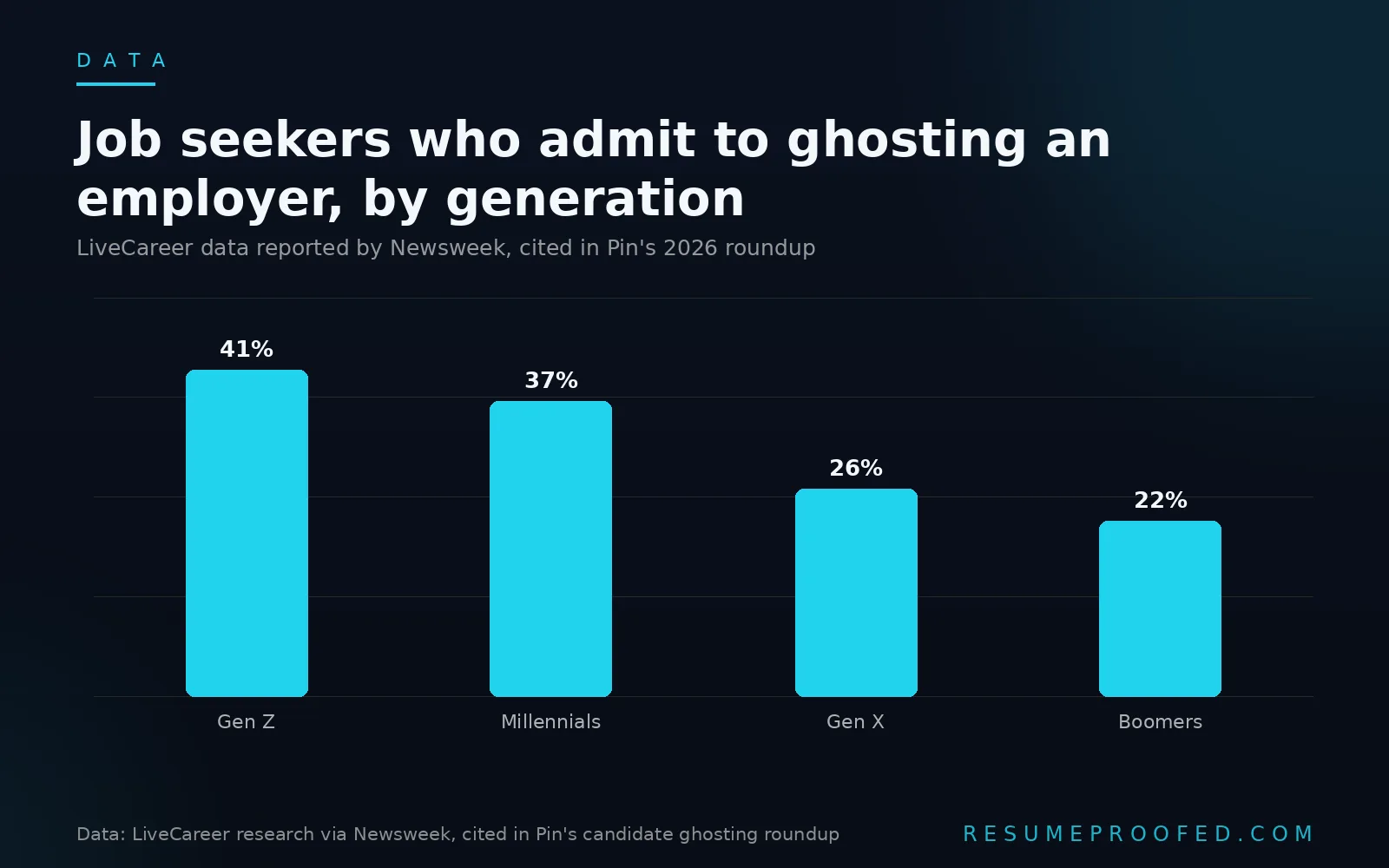
Put those two surveys side by side and the shape is consistent even though they measure different populations: candidate ghosting is common, it is getting more common, and it is concentrated at exactly the stages that cost an employer the most time to recover from.
Why AI mass-applying is driving the spike, not just bad manners
Both LHH's and Pin's research point at the same mechanism from opposite sides of the desk. LHH puts it plainly in its own summary of the findings: "Generative AI removed the cost. One-click and auto-apply tools removed what was left." Once submitting an application costs a candidate seconds rather than an evening of tailoring, applying stops functioning as a reliable signal of real interest, and quietly ghosting the roles you don't actually want becomes close to the default outcome rather than a deliberate choice. Forty seven percent of the HR professionals LHH surveyed specifically link their increased workload to no-shows and suspected AI-assisted candidates, not to hiring volume growth in general.
Pin's research supplies the auto-apply side of that equation directly: it cites Greenhouse data finding that 22 percent of job seekers now use bots to auto-apply to roles, rising to 31 percent among Gen Z, and cites Robert Half data finding that 67 percent of HR leaders say AI-generated applications have slowed their hiring down. Pin's own framing of the loop this creates is the clearest summary available: both sides are flooding each other, and both sides are going quiet in response. That lines up with the argument in our look at AI auto-apply tools meeting AI screening agents: once applying is automated on your side, an employer has less reason to believe any single application, including a genuinely strong one, reflects real intent, and less capacity to individually check which is which before deciding how much effort to spend chasing you. Silence becomes the practical management strategy for both an inbox holding 450 applications and a phone screen a candidate doesn't remember agreeing to.
What ghosting actually costs you, even though it feels low stakes

The temptation is to treat ghosting as a victimless shortcut: you applied for free in thirty seconds, so declining for free by simply not answering feels proportionate. Three things complicate that.
The first is reputational, and smaller than you'd think. Recruiters, especially agency recruiters working several client roles at once, keep notes across candidates, and a pattern of no-showing scheduled interviews follows you inside that recruiter's own pipeline even if it never reaches a formal blacklist. The second is that it slows down the roles you actually want. Hiring teams are building processes, screening questions, applicant to interview ratio tracking, exactly to filter out low intent volume, and once a recruiter has been burned by unresponsive candidates from a given channel or pattern, they deprioritise proactive outreach to anyone who resembles it, including candidates they'd otherwise be excited about. The third is specific to interviews: LHH's data shows no-showing an already scheduled interview is the behaviour recruiters remember and resent most, distinct from simply never responding to a cold outreach message, because it burns a fixed block of time a recruiter cannot recover that day and cannot easily reschedule around.
None of that means every unanswered application is a problem. It means the cost scales with how much the other side has already invested, and a scheduled call or interview is a very different point on that scale to a one-click submission nobody has looked at yet.
A short routine for declining without ghosting
Keep a one line tracker before you mass apply. A single spreadsheet row per role, company, title, date applied, one sentence on why you'd actually take it, takes under a minute and is the entire fix for the "I forgot which posting this was" problem that turns a phone screen into an accidental no-show.
The moment you know you don't want a role, decline it in writing. A two sentence email or a reply to the recruiter's message is enough: "Thanks for reaching out on the [role] position. I've decided to move forward with another opportunity, but I appreciate the time." That takes less effort than the anxiety of dodging a follow up call, and it's the single highest leverage habit in this whole routine.
If a phone screen gets booked for a role you're lukewarm on, take the call anyway. A fifteen minute conversation costs you little and gives you real information; declining after the call, once you actually know more, is a far better use of everyone's time than no-showing something you agreed to before you had that information.
If you accept a competing offer while mid process elsewhere, tell every other employer the same day. This is the single highest cost ghosting scenario for them, and it's also the easiest to avoid, since you already know exactly what happened and when.
Reserve genuine silence for the point before any human has responded to you. If you applied through an auto-apply tool and nobody has acknowledged it yet, not replying if you've changed your mind is a passive decline, not a ghost, and doesn't require a message. The norm shifts the moment a real person on their side has spent time on you specifically.
A worked example
Say you ran an auto-apply tool over a weekend and it submitted your resume to 40 postings loosely matching your title. Over the following two weeks, three come back: a phone screen request for a logistics coordinator role you don't remember much about, an interview confirmation for a customer success role you do want, and an automated rejection for a data entry posting you'd honestly forgotten existed. The routine above handles all three differently. For the logistics role, you take the fifteen minute call rather than skipping it cold, and use it to actually decide whether you want to proceed, rather than guessing from the job title alone. For the customer success role, you show up prepared, because your tracker confirms it's one you genuinely want. For the rejection, there's nothing to do, since the employer closed the loop themselves. What you don't do is let the logistics phone screen sit unanswered in your inbox for a week while you decide, because that's the exact behaviour showing up in the 39 percent mid-process disappearance figure above, and it's the one that costs a real person real, budgeted time on their calendar.
Common questions
Why are candidates ghosting employers in 2026?
Largely because applying got cheap. LHH's July 2026 survey found 59 percent of HR and talent acquisition professionals say candidate no-shows are more frequent than two years ago, and 47 percent tie their increased workload specifically to no-shows and suspected AI-assisted candidates, whose low-effort, high-volume applying makes ghosting the roles they don't want the path of least resistance.
Is it OK to ghost a job application?
It depends on how much the employer has invested. If you applied and nobody has responded yet, quietly moving on isn't really ghosting, it's a passive decline. Once a recruiter has scheduled a call, confirmed an interview, or otherwise spent real time on you specifically, sending a brief decline instead of going silent takes under a minute and avoids the reputational and practical costs of a no-show.
Is AI mass-applying really connected to the rise in candidate ghosting?
Yes, according to the two most current pieces of research on the topic. LHH's July 2026 survey links 47 percent of recruiters' increased workload directly to no-shows and suspected AI-assisted candidates, and Pin's 2026 roundup cites Greenhouse data showing 22 percent of job seekers, and 31 percent of Gen Z, now use auto-apply bots, alongside Robert Half data finding 67 percent of HR leaders say AI-generated applications have slowed their hiring.
Should I tell an employer I'm no longer interested?
Yes, as soon as you know, especially once you've had any direct contact like a phone screen or interview. A short message, thanking them and stating you're pursuing another opportunity, closes the loop for them and takes less time than avoiding their calls would.
Is it normal to ghost a company after a job interview?
It happens often enough to show up clearly in survey data, but it's also the point recruiters remember and resent most. Pin's research cites a 20 percent ghosting rate at the single-interview stage specifically, and LHH's data shows scheduled interview no-shows are the behaviour most closely tied to recruiter burnout, because it wastes a fixed block of time that can't be recovered that day.
What are the latest candidate ghosting statistics for 2026?
The clearest current figures: 59 percent of recruiters say candidate no-shows are up compared with two years ago (LHH, July 2026), 25 percent of job seekers admit to having ghosted an employer, rising to 41 percent among Gen Z (LiveCareer and Newsweek data, cited by Pin), and 39 percent of employers had a candidate disappear mid-process after real time was already invested (LHH, July 2026).
Where ResumeProofed fits, and where it doesn't
ResumeProofed can't send your decline emails or manage your pipeline for you, that discipline is entirely on you, and no tool honestly replaces a one line tracker and a habit of writing back. What it does is reduce the underlying cause of a lot of accidental ghosting: it's built for applying to a smaller number of roles you've actually read and genuinely want, each tailored on purpose, rather than a volume of postings a bot submitted on your behalf overnight. If you don't remember why you applied somewhere, you're far more likely to let a call go unanswered than if you chose that role deliberately in the first place.
Try ResumeProofed free: two tailored applications on the house, no card required.