Employer ghosting is at a record high: what to do when they go quiet
New data shows 72% of candidates in live hiring talks hear nothing for 30+ days, and employer ghosting hit a three year high in 2025. Here's what to do.
- Job search
- Interviews
- Career strategy
You made it to a second interview, maybe a third, and then nothing. No rejection email, no "we've decided to move forward with other candidates," not even the courtesy of a form letter. Just silence, stretching from one week into a month, then two. New behavioural data on how hiring teams actually communicate says that experience is not unusual and it is not a verdict on you personally: it is close to the typical outcome for a candidate in active conversation on a still open role right now.
The position worth stating first: employer silence at this scale is a structural response to volume, not a personal read on your candidacy, and treating it as the latter wastes energy you could spend on a search that's still moving. That doesn't mean waiting indefinitely for a reply that may never come is the right response either. It means the useful move is a fixed follow up routine and a clear rule for when to stop waiting, not more anxious refreshing of your inbox.
The numbers: how common employer silence actually is right now
Pin's Employer Ghosting Index, published 26 May 2026 from behavioural data across more than 200,000 active recruiter to candidate conversations tracked on its platform between January 2024 and May 2026, found that 72 percent of candidates in live conversation with a hiring team, on a role that is still posted and open, go more than 30 days without a single logged follow up. Among the prospects that do stall out this way, the median length of that silence runs 75 days, roughly two and a half months of hearing nothing at all about a role you are still, technically, being considered for.
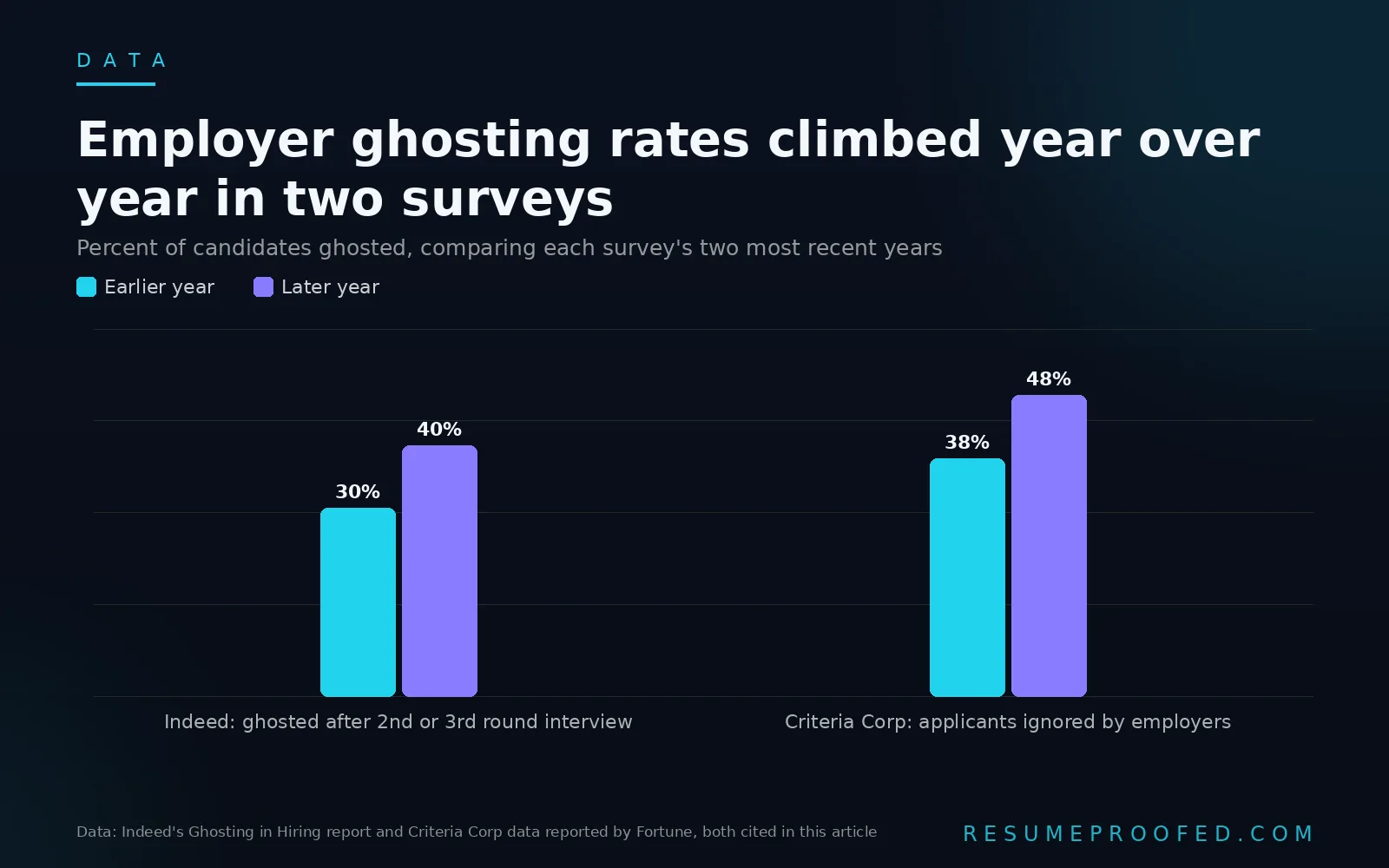
That sits alongside a broader employer side ghosting rate that has been climbing for three straight years. Fortune's reporting, published 20 March 2026 and based on Criteria Corp's Candidate Experience data, found that 48 percent of applicants were ignored by employers in 2025, up from 38 percent in 2024, a three year high. Older but still the most specific public breakdown of where in the process that silence tends to land is Indeed's Ghosting in Hiring report, published December 2023 from a survey comparing 2022 to 2023: it found 35 percent of applications were never acknowledged at all, and 40 percent of candidates were ghosted after making it through a second or third round interview, up from 30 percent the year before. That data predates the 2025-2026 figures above by a few years, so treat it as older context rather than part of the current wave, but the shape of it, silence getting more common rather than less the further into a process you get, is exactly the point where you've invested the most time and started to believe the role is real.
Why employers are going quiet now, not just being rude

Pin's index and the Criteria Corp data reach a similar explanation from two different angles: both tie the spike directly to hiring teams being overwhelmed by application volume that AI tools have made trivially easy to generate. A recruiter who used to receive 50 applications for a role and could send a personal note to everyone who interviewed is now often working through several hundred, many of them AI assisted or AI generated in bulk, for the same headcount and the same amount of time in the week. Something has to give, and in most hiring teams right now, what gives first is proactive communication with candidates who are not actively being pursued that week, even candidates who made it through a real interview.
This matters for how you read your own silence, because it reframes what's actually happening on the other end. A recruiter who has gone quiet on you after a second interview has, in a large share of cases documented above, not made a final decision to reject you. They are more likely still deciding, distracted by a hiring manager who hasn't signed off, or simply buried under a queue of other candidates and requisitions, with your file sitting exactly where it was the day of your interview. That's a genuinely different situation from a firm no, and it changes what following up can realistically achieve: a well timed, low pressure check in is closing a genuine information gap on their end as much as it is advocating for yourself.
A follow up cadence that doesn't read as desperate

The instinct after a week of silence is either to go quiet yourself, assuming the worst and waiting to be told, or to send an anxious message every few days. Neither works well. A fixed, low frequency cadence does the job better than either extreme, because it signals continued interest without signalling that you have nothing else going on.
Immediately after the interview. A short thank you note within 24 hours, referencing one specific thing discussed in the conversation, not a generic template. This isn't a follow up on silence yet, it's the baseline courtesy that also puts your name back in front of the interviewer while the conversation is still fresh.
At the two week mark, if you haven't heard anything. One brief message: restate your interest in the role, ask if there's an updated timeline, and offer to provide anything further that would help the decision. Keep it to three or four sentences. This is the message most people skip out of fear of seeming pushy, but two weeks of silence after a real interview is well within normal territory to check in on, not early.
At the four to five week mark, if still nothing. A second, shorter check in, along the lines of confirming whether the role is still active and whether you remain under consideration. This is also the point to be honest with yourself: if you have another opportunity moving faster, it's reasonable to mention that you're weighing a timeline, without issuing an ultimatum.
Past roughly six to eight weeks with no response to either message. Treat the role as closed for planning purposes, even if it technically isn't. Given the 75 day median stall length the data above documents, plenty of these roles do eventually come back to life, sometimes with an offer, well past this point. But you cannot run your search on the assumption that any specific one will, and continuing to treat it as live past two unanswered check ins mostly just delays you fully re-engaging elsewhere.
A worked example
Say you interviewed for a marketing coordinator role three weeks ago, the second of two rounds, and the recruiter said they'd be in touch "within a couple of weeks." At the two week mark, having heard nothing, you send: "Hi [Name], I wanted to check in on the marketing coordinator role. I remain very interested after our conversation about the Q3 campaign calendar, and I'd be glad to provide anything further that would help your decision. Do you have an updated sense of timeline?" That message does three things at once: it restates interest with a specific, memorable reference, it offers something concrete rather than just asking for news, and it invites a timeline update without demanding one. If two more weeks pass with no reply, a second, shorter message following up on the same thread is reasonable. If that also goes unanswered, the honest move is to keep applying elsewhere as your primary focus rather than continuing to check your inbox for this specific role, while leaving the door open if they do eventually resurface.
The rule for when to stop waiting and move on
The single clearest rule the data above supports: once you've sent two reasonable follow ups across roughly six to eight weeks and heard nothing back to either, stop treating the role as an active part of your search. Keep the thread open (there's no reason to formally withdraw from a role that hasn't rejected you), but move your attention, and any competing offers you're weighing, onto opportunities that are actually responding. Given a documented median stall of 75 days among roles that do go quiet, a genuine reply after two months is entirely possible. Planning your search around the hope of one, rather than around what's currently moving, is the actual mistake, not the silence itself.
This connects to a broader diagnostic worth running if silence is a pattern across most of your applications rather than one or two roles: our diagnostic checklist for why you're not getting interviews covers the earlier stage failure points, searchability, tailoring, formatting, that produce silence before an interview ever happens. Post interview ghosting, the subject of this article, is a distinct and later stage problem: you've already cleared the bar that checklist is about, and what happens next is largely out of your hands.
Common questions
Why do employers stop responding after an interview?
Recent data points to hiring teams being overwhelmed by application volume, much of it AI assisted, without a corresponding increase in recruiting staff or time. A recruiter managing several times the applicant volume of a few years ago often deprioritises proactive updates to candidates not being actively pursued that week, even ones who interviewed well, rather than making a firm decision to reject them.
Is it normal to hear nothing for weeks after a good interview?
Yes, uncomfortably so by current data. Pin's Employer Ghosting Index found 72 percent of candidates in an active hiring conversation go more than 30 days without any logged follow up, with a median silence of 75 days among those who do stall. It reflects a widespread pattern, not a signal specific to your interview performance.
How many times should I follow up after an interview before giving up?
Two reasonable follow ups is a sensible ceiling: one around the two week mark and a second around four to five weeks, both brief and specific rather than repeated generic check ins. Past roughly six to eight weeks with no response to either, treat the role as closed for planning purposes even if you never receive a formal rejection.
Does following up after an interview actually help?
It can, because a meaningful share of documented employer silence reflects an undecided or backlogged process rather than a firm rejection already made. A short, specific message that restates interest and offers to help the decision closes a real information gap on the employer's side, without the pressure of repeated or anxious messaging.
Is employer ghosting getting worse or has it always been this common?
It's getting worse on the current data. Criteria Corp's research, reported by Fortune in March 2026, found 48 percent of applicants were ignored by employers in 2025, up from 38 percent in 2024, a three year high, with the increase widely attributed to hiring teams being overwhelmed by AI scaled application volume.
Should I follow up with the hiring manager directly if the recruiter goes quiet?
A single polite message to the hiring manager, if you have their contact details from the interview itself, is reasonable if the recruiter has already gone unanswered for several weeks. Keep it brief and avoid contacting multiple people at the company simultaneously about the same silence, which can read as pressure rather than genuine interest.
Where ResumeProofed fits, and where it doesn't
ResumeProofed can't make a hiring team reply to you, and no honest tool can promise that; once you're past the resume stage and into an actual interview process, what happens next is largely outside anything a resume tool touches. What it can do is help make sure the applications still open in your search, the ones actually likely to respond, are tailored specifically enough to convert, so a handful of roles going quiet doesn't have to mean your whole search stalls while you wait on them.
Try ResumeProofed free: two tailored applications on the house, no card required.