Which industries are actually hiring in Australia right now
The national jobs headline hides a very uneven picture. Here is what ABS and Indeed's own data say about where demand is rising and where it is shrinking.
- Australia
- Job search
- Career strategy
You've read that the Australian job market is tight, applications per ad are at a record high, and you've adjusted your search accordingly, applying more broadly and tailoring less carefully because it feels like every industry is equally hard right now. That framing is doing you a disservice, because "the job market" isn't one market, and the industry you're aiming at matters more than the generic national headline suggests.
The position worth stating early: national vacancy figures average together industries moving in opposite directions, some genuinely expanding and others genuinely contracting in the same quarter, and knowing which is which changes where your tailoring effort is likely to pay off.
What the most recent quarterly data actually shows
The Australian Bureau of Statistics released its job vacancies figures for the quarter to May 2026 on 25 June 2026, and the headline is a national fall: total vacancies dropped 2.1 percent to 329,500, split between a 1.4 percent fall in the private sector (4,000 fewer vacancies) and a steeper 7.9 percent fall in the public sector (3,000 fewer vacancies).
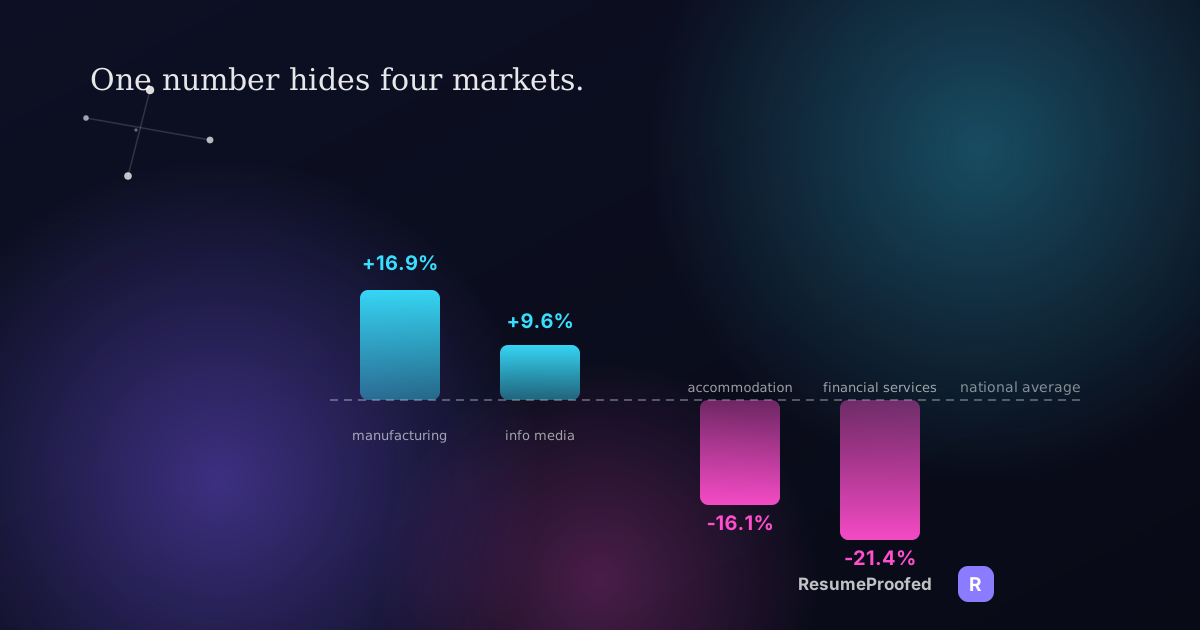
That national figure is the number most coverage repeats, and it's also the number that hides the more useful data sitting one level down. In the same quarter, manufacturing vacancies rose 16.9 percent and information media and telecommunications vacancies rose 9.6 percent, while financial and insurance services vacancies fell 21.4 percent, the largest drop of any sector, and accommodation and food services fell 16.1 percent. Two industries expanded meaningfully in the same three months that two others contracted sharply, all folded into a single "vacancies fell 2.1 percent" headline that tells you nothing about which industry you're actually competing in.
What the industry levels look like, not just the quarterly swing
The ABS figures above measure change, growth or decline against the previous quarter, which is useful for direction but doesn't tell you how much actual demand exists in a sector in absolute terms. Indeed's Hiring Lab publishes that side of the picture in its 2026 Australian jobs and hiring trends report, released 30 January 2026: the national job vacancy rate sits at 2.0 percent, itself 45 percent above the 2010 to 2019 average of 1.4 percent, meaning the overall labour market remains historically tight even where quarterly momentum has cooled.
Broken down by sector, mining carries the highest vacancy rate at 3.8 percent, followed by accommodation and food services at 2.9 percent, while education and training sits at 1.0 percent and agriculture at just 0.6 percent, the lowest of the sectors reported. Indeed's report notes that vacancy rates remain above their historical average in every industry it tracks except financial and insurance services, which is worth pairing directly with the ABS figure above showing that sector's vacancies falling 21.4 percent in the most recent quarter: two independent sources agree that financial and insurance services is the clearest example of a genuinely softening sector right now, not just a noisy quarter.
The employment growth slowdown sitting underneath both figures
Indeed's report also flags a broader shift worth knowing about even if you're not job hunting in the affected sector directly: total employment growth across Australia weakened substantially through 2025, with job gains of only 165,400 people for the year, well below 2024's 386,000 and 2023's 369,000. A large share of that slowdown, roughly 80 percent by the report's estimate, is attributed to a single sector, healthcare and social assistance, where annual growth decelerated to just 1.4 percent after several years as one of the country's strongest-hiring industries.
That matters beyond healthcare specifically because it explains part of why the national picture reads as tighter than any single industry snapshot suggests: one very large sector slowing down pulls the national average down with it, even while sectors like manufacturing and information media are independently expanding in the same period. Our piece on the record-high applications-per-job-ad figure covers the competitive pressure side of this picture; the industry breakdown here explains part of why that pressure isn't evenly distributed across every kind of role.
What this means for where you put your effort
If you're job hunting broadly, without a strong existing tie to a specific industry, this data gives you a genuine, current reason to weight your search toward manufacturing, information media and telecommunications, or mining, where the numbers show either strong recent momentum or a consistently high vacancy rate, rather than treating every sector as equally competitive. It doesn't mean roles in financial and insurance services or accommodation and food services have vanished, but it does mean you're working against a shrinking pool of openings in those sectors specifically, which is a meaningfully different problem than a merely competitive but stable one.
If you're already working in a contracting sector, this isn't a reason to panic, but it is a reason to be honest about what you're up against, and it strengthens the case for genuinely showing how your specific skills transfer to an expanding sector rather than assuming a same-industry move is the only realistic option. Our guide to writing a resume for a career change with no direct experience covers exactly this translation work, and it's more urgent when the data shows your current sector genuinely contracting rather than merely feeling slow from the inside.
A worked example: reading the data before you commit a search strategy
Say you work in retail banking operations, a role that sits inside financial and insurance services, the sector the ABS data shows falling 21.4 percent in the most recent quarter. You have two realistic paths: search within financial services and compete for a shrinking number of openings, or look at where your actual skills (reconciliation, compliance documentation, process control) transfer.
Manufacturing's 16.9 percent quarterly rise and information media and telecommunications' 9.6 percent rise are both sectors with real, current demand growth, and both have operational and compliance-adjacent roles that draw on the same underlying skill set you already have, quality control coordination in manufacturing, or platform compliance and trust-and-safety operations in information media. Naming that transfer explicitly, the way our guide to tailoring a resume to a job description covers, and applying into a sector the data shows is actually expanding gives you a meaningfully better base rate than applying only within the sector you happen to already be in.
A short routine for using this data in your own search
- Check whether your current or target industry appears in the sectors above, either in the ABS quarterly change figures or Indeed's vacancy-rate levels, before deciding how broadly or narrowly to search.
- If you're in a contracting sector (the ABS data above currently points to financial and insurance services and accommodation and food services as the clearest examples), spend real time identifying which of your skills genuinely transfer to an expanding sector, rather than assuming the only option is competing harder within a shrinking one.
- If you're in an expanding sector or considering a move into one, lean into that demand directly in your applications, naming the sector's specific growth where it's genuinely relevant to explain why you're targeting it now.
- Re-check the data periodically. The ABS releases job vacancy figures quarterly, and a sector showing strong growth in one quarter isn't guaranteed to hold that momentum. Treat this as a current snapshot to weight your effort, not a permanent map.
- Don't over-index on a single quarter's swing. A 16.9 percent quarterly rise in one sector is a genuine signal worth acting on, but pair it with the vacancy-rate level data where you can, since a sector can swing sharply in one quarter off a small base.
Common questions
Which industries are hiring the most in Australia right now?
Manufacturing and information media and telecommunications showed the strongest quarterly vacancy growth in the ABS's most recent release (quarter to May 2026), up 16.9 percent and 9.6 percent respectively, while mining holds the highest overall vacancy rate at 3.8 percent according to Indeed's 2026 report.
Which industries are struggling to hire in Australia right now?
Financial and insurance services showed the sharpest vacancy decline in the ABS's most recent quarterly data, down 21.4 percent, and separately is the only sector Indeed's report identifies as below its historical average vacancy rate. Accommodation and food services also fell sharply, down 16.1 percent in the same quarter.
Is the Australian job market actually improving or getting worse in 2026?
Both, depending on the sector. The national vacancy figure fell 2.1 percent in the quarter to May 2026, but that average combines sectors expanding significantly, like manufacturing, with sectors contracting sharply, like financial services, so a single national number understates how uneven the picture actually is.
Why did healthcare hiring slow down so much in 2025?
The exact cause isn't detailed in the available reporting, but Indeed's 2026 report attributes roughly 80 percent of the national employment growth slowdown in 2025 to decelerating growth in healthcare and social assistance specifically, a sector that had been one of the country's strongest for hiring in prior years.
Should I change industries based on this data alone?
Not on this alone, but it's a legitimate input. If you're already considering a move and your current sector shows genuine, current contraction in the data above, that's a real reason to weight a transferable-skills search toward an expanding sector rather than treating all industries as equally viable by default.
How often does this kind of industry vacancy data get updated?
The ABS releases job vacancy figures quarterly, and Indeed's Hiring Lab publishes an annual trends report along with more frequent shorter updates. Checking the most recent release before committing to a search strategy is worth the ten minutes it takes.
Where ResumeProofed fits, and where it doesn't
ResumeProofed tailors your resume to a specific job description, which includes translating your real, confirmed achievements into the language and priorities of a target role, even one in a different sector than your current one. It doesn't tell you which industry to search in, and the data above is a better source for that decision than any tool can be. What it handles is the tailoring work once you've picked a direction, so the skills-transfer case reads as genuine rather than generic.
Try ResumeProofed free: two tailored applications on the house, no card required.