Payday Super is here: what to check on a new job offer or first payslip
From 1 July 2026, super must land the same day as your pay, not quarterly. Here's exactly what to check on a new job offer and your first few payslips.
- Australia
- Job applications
- Career strategy
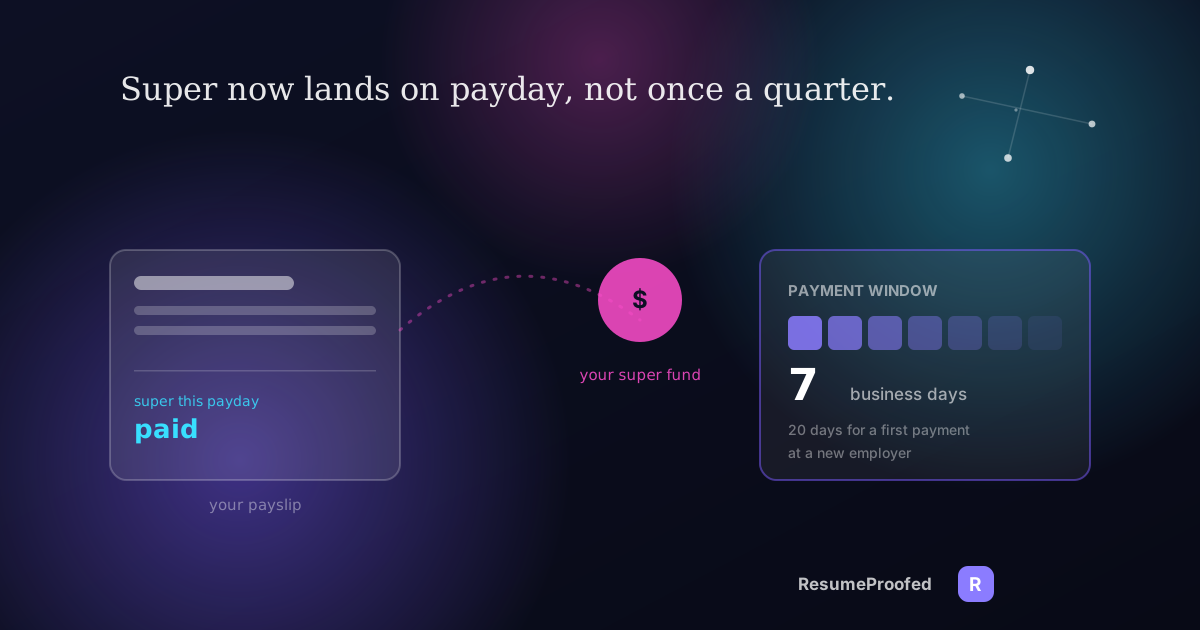
If you've started a new job in the last few months, or you're about to, there's a new line item worth understanding before you sign anything or file your first payslip away unread. Since 1 July 2026, Australian employers have had to pay superannuation at the same time as wages, not once a quarter, and the mechanics behind that shift, what gets checked, by when, and what a new starter should actually look for, are genuinely new to almost everyone currently changing jobs.
The position worth stating first: this isn't fine print you can safely ignore until tax time. Payday Super changes what a normal, on-time super payment looks like for you personally, and it gives you a concrete, checkable timeline for the first time your new employer pays into your fund. Knowing that timeline is a small thing that takes five minutes to check and can catch a genuine problem early, well before it becomes a bigger one.
What actually changed on 1 July 2026
Before this reform, employers only had to pay superannuation guarantee contributions quarterly, which meant a new employee could start a job and not see their first super contribution land for up to three months, buried inside a much longer payment cycle that was hard to check against any single payday. BDO Australia's explainer on the legislation confirms the reform commenced on 1 July 2026 and requires employers to pay super contributions "within seven business days from the date of salary and wage payment," replacing the old quarterly cycle entirely. Rest Super's guidance for employers confirms the same start date and frames it plainly: from 1 July 2026, employers must pay super at the same time as wages, whether that's weekly, fortnightly, or monthly.
In practice, that means your super contribution is no longer a distant quarterly event you have to trust is happening somewhere in the background. It's tied directly to your payday, which means you can check it directly against your payday too.
The payment window: seven business days, or twenty for your first payment
The standard rule is that contributions need to reach your super fund within seven business days of the payday they relate to. That's the number to hold onto for every payday after your first one at a new employer.
Your very first payment at a new job works a little differently. Rest Super's guidance is specific on this: for new hires, or the first time an employer pays into a particular fund for you, the timeframe extends to 20 business days rather than seven. That's a meaningful difference, and it's worth knowing in advance so a slightly longer wait on your very first contribution doesn't read as a red flag when it's actually the standard rule for a first payment.
Why the first payment gets extra time
The longer window for a first payment exists because of a new administrative step that has to happen before that first contribution can be processed at all.
Member Verification Requests: the new first-payment checkpoint
The first time your employer pays super into your fund, they're now required to submit a Member Verification Request, a digital check that confirms you're actually a member of the fund you've nominated and that the fund is able to accept a contribution on your behalf. Rest Super describes this as mandatory specifically "when you are contributing to a super fund for the first time for that employee," which is exactly the scenario a new starter sits in during their first pay cycle at a new job.
This is a genuinely new step in the system, not paperwork your employer is inventing to explain a delay, and it's the practical reason the first-payment window is longer than every payment after it. If your first super contribution takes closer to three weeks than one, that's very likely this check working as designed rather than something to worry about.
The new "Qualifying Earnings" calculation
Payday Super also introduces a new earnings definition, Qualifying Earnings (QE), that employers now use to calculate how much super you're owed on each payday. Rest Super's guidance explains that the day your employer runs payroll becomes the "QE day," and your super contribution for that payday is calculated based on your Qualifying Earnings for that specific payroll run, which generally includes your ordinary time earnings along with certain bonuses or lump sum payments.
You don't need to calculate this yourself. But it's useful to know the term exists, because it's the figure your payslip's super line should now be based on for every single payday, not a single quarterly lump sum calculated some other way.
What to check on the offer letter itself, before you accept
Payday Super also changes what's worth confirming in writing before you sign a new offer, not just what you check once you've started.
Confirm whether the stated salary is inclusive or exclusive of super. This isn't new to Payday Super, but it matters more now that super is a per-payday line item you'll be checking from your very first pay cycle rather than a quarterly abstraction you might never look at closely. A written offer should state the base salary and super separately, or state clearly that the figure quoted already includes super.
Ask which fund your super will be paid into if you don't nominate your own. Most employers default to a nominated fund if you don't choose your own, and knowing that fund's name in advance means you'll know exactly where to check for your first contribution once your Member Verification Request clears.
Don't read a longer wait for your very first contribution as a sign the employer is behind on payroll. Since the 20 business day window for a first payment is now the standard rule under Payday Super rather than an employer-specific delay, it's worth knowing this before you start so you're checking against the right number from day one, rather than assuming a slow first payment reflects badly on a new employer who is, in fact, just following the standard first-payment process.
What to actually check on your first few payslips
Here's the practical routine worth running in your first month at a new job, now that super is tied to every payday rather than a distant quarterly cycle.
Check that a super contribution line appears on every payslip, not just some of them. Under Payday Super, a contribution obligation exists for every payday, so a payslip with no super line at all, more than once, is worth a direct question to your employer or payroll contact.
Expect your very first contribution to take up to 20 business days, not seven, because of the Member Verification Request step described above. Don't treat this longer first wait as a warning sign on its own.
From your second payday onward, expect the standard seven-business-day window. If a contribution is meaningfully later than that on an ongoing basis, it's reasonable to ask your employer directly when it was paid and to check your own super fund account or app to confirm it landed.
Log into your super fund's app or portal directly, rather than relying on your payslip alone. Your payslip shows what your employer says they're paying; your fund account shows what's actually landed. Checking both is the only way to be sure the two match.
If you're comparing a new job offer to your current one, factor Payday Super into how you read the offer, not just the headline salary. If you're weighing multiple offers, our piece on reading salary information in job ads covers how to evaluate the full compensation picture, and Payday Super's new same-day-as-wages rule is now part of that picture: a super contribution that used to be a quarterly abstraction is now something you can verify against every single payday from your very first one.
A worked example
Say you start a new marketing coordinator role on a Monday, paid fortnightly, with your first payday landing two weeks later. Your first payslip shows a super contribution line, but nothing has appeared in your super fund account by the following week. Rather than assuming something has gone wrong, you check the timeline: your employer has up to 20 business days from that first payday to complete the Member Verification Request and land the contribution, which at a fortnightly cadence could stretch close to your second or even third payday before it clears. You make a note to check your fund account again around the 20 business day mark rather than after the first week, and you separately confirm your second payday's super contribution lands within the standard seven business days, since that's the number that applies from your second contribution onward. If either check comes back wrong, you now have a specific, dated figure to raise with payroll rather than a vague sense that something feels off.
What to do if a contribution genuinely looks late
If you're past the relevant window, 20 business days for a first payment or seven for every payment after that, and nothing has landed in your fund, ask your employer's payroll team directly and specifically: which payday the contribution relates to, and when it was actually submitted. Most delays at this stage are administrative rather than deliberate, and BDO's coverage of the legislation notes that the ATO has set up a graded, three-tier compliance risk system for the first year of the reform, with low-risk employers who are making genuine good-faith efforts to adjust facing no compliance action at all. That's a reasonable amount of context to hold alongside your own checking: a single short delay while a new employer's payroll system adjusts to the reform is a different situation to a pattern of missed or unexplained contributions, and it's the pattern, not a single short delay, that's worth escalating.
Common questions
When did Payday Super start in Australia?
Payday Super commenced on 1 July 2026. From that date, employers must pay superannuation contributions at the same time as wages, rather than quarterly as under the previous system.
How quickly does my employer have to pay super now?
Standard contributions need to reach your super fund within seven business days of the payday they relate to. Your very first contribution from a new employer has a longer window, up to 20 business days, because of a new mandatory verification step.
What is a Member Verification Request?
It's a digital check your employer must complete the first time they pay super into a particular fund on your behalf, confirming you're a member of that fund and that it can accept the contribution. It's the reason a new starter's first super payment can take longer than every payment after it.
What is "Qualifying Earnings" for super?
Qualifying Earnings is the new earnings definition employers use to calculate how much super you're owed on each specific payday, generally covering ordinary time earnings plus certain bonuses or lump sum payments. It replaces the old quarterly calculation with a per-payday figure.
Should I be worried if my first super payment takes three weeks?
Not necessarily. The standard window for a first payment to a new fund is up to 20 business days, longer than the seven-business-day window that applies from your second payment onward, because of the new Member Verification Request step. A single delay within that window isn't a red flag on its own.
What should I do if my super contributions are genuinely late?
Ask your employer's payroll team directly which payday the contribution relates to and when it was submitted, and check your own super fund account rather than relying on your payslip alone. A pattern of missed or unexplained contributions, rather than a single short delay, is what's worth escalating further.
Where ResumeProofed fits, and where it doesn't
ResumeProofed doesn't handle payroll, super, or anything after you've accepted an offer, that's between you and your new employer's payroll team. What it can do is help you get to the offer stage faster, by tailoring your resume and application to the specific role you're applying for, so evaluating the full picture of a new job, pay, super, and everything else covered here, is a problem you actually get to have.
Try ResumeProofed free: two tailored applications on the house, no card required.