Should you list salary expectations on a SEEK application? What the data shows
Only about a third of SEEK job ads list a salary, yet disclosed pay drives 47 percent more applications. Here is how to read and react to that gap.
- Australia
- Job applications
- Career strategy

You've found a role on SEEK that looks right on paper, and then you hit the salary field, blank, and the application form asks you for your expectations instead. Do you name a number, guess conservatively, or leave it vague and hope the interview sorts it out. It's a genuinely awkward moment, made worse by the fact that most ads leave you guessing in the first place, and SEEK's own data on how often that happens is worth knowing before you decide how to answer.

The position worth stating first: most SEEK ads still don't disclose a salary, even though SEEK's own data shows the ones that do get meaningfully more applications, and that gap between what drives applications and what employers actually publish is the real story here. It changes how you should read a blank salary field, and it gives you a more informed way to answer the "salary expectations" question than a guess.
What SEEK's own data actually shows

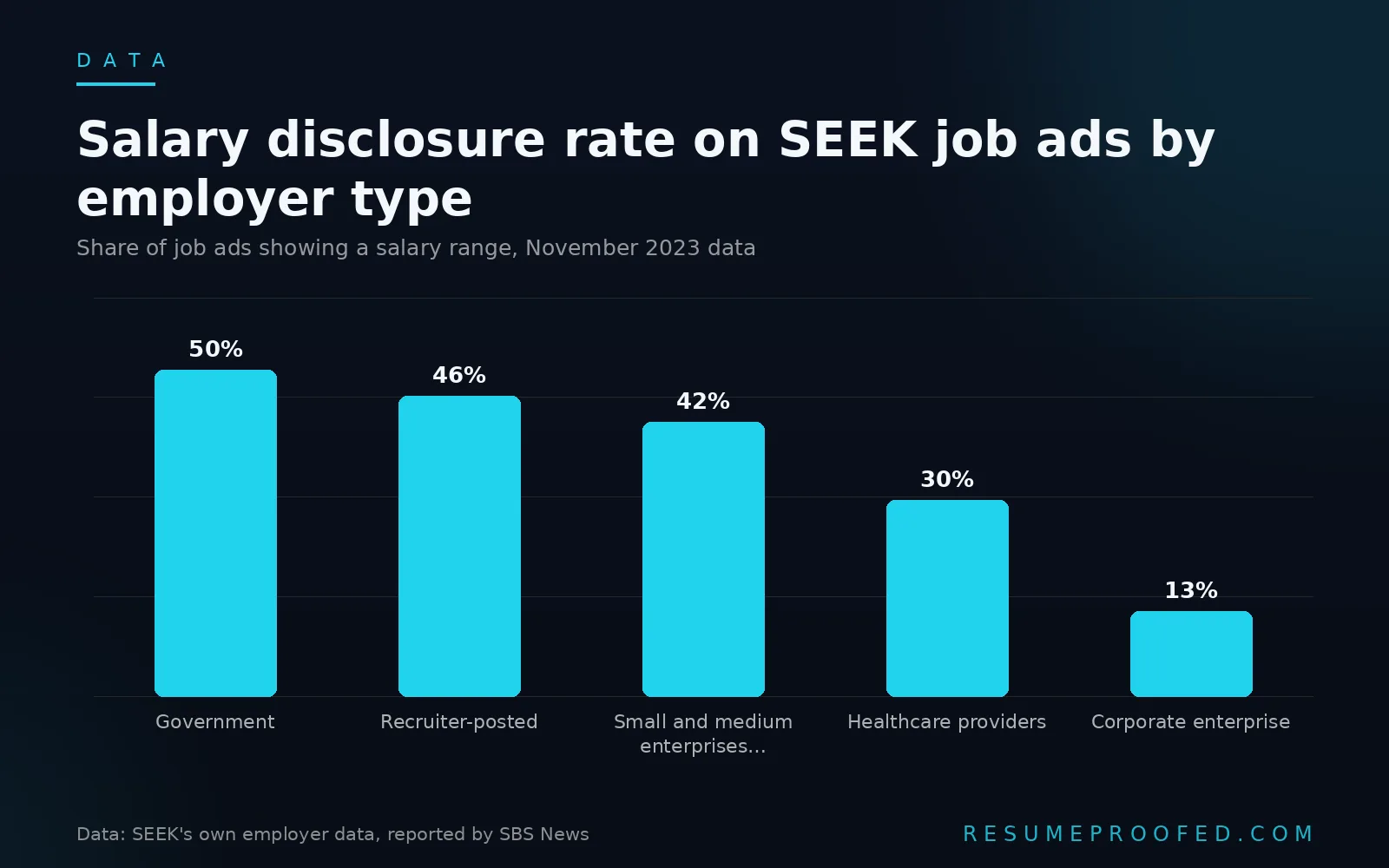
Only 34.5 percent of job ads posted on SEEK in November 2023 disclosed a salary range, meaning roughly two thirds left it blank, according to SEEK's own employer data, reported by SBS News. That overall figure hides a wide spread by employer type: government roles disclose a salary around 50 percent of the time, recruiter-posted roles around 46 percent, small and medium enterprises around 42 percent, healthcare providers around 30 percent, and corporate enterprise listings, the lowest of the group, just 13 percent. If you're applying to a large corporate employer specifically, a blank salary field is closer to the norm than the exception, while a government or recruiter-posted role is more likely, though still not guaranteed, to include one.
That disclosure gap sits against clear evidence that showing a salary works in the employer's own interest. SEEK's own analysis of job ad performance, reported on SEEK's employer hub, shows job ads that include a salary range get an average of 47 percent more applications than ads that don't. On the applicant side, independent research conducted by Nature on behalf of SEEK, interviewing 4,800 Australians annually, found in its August 2023 wave that 69 percent of job seekers say they're more inclined to apply for a role when a salary range is shown, more than 25 percent say they simply won't apply at all without one, and 62 percent say it's actively frustrating when an ad leaves it out. A later wave of the same Nature-conducted survey, published in February 2024, found 87 percent of job seekers say knowing the salary of a job before applying is extremely important.
Put together: employers gain a real, measured benefit from disclosing salary, most job seekers actively want it, and yet most ads, especially from larger corporate employers, still don't include it. That's not really a data mystery so much as an internal-process one, pay bands are often locked behind approval chains, negotiation flexibility, or a preference to assess a candidate before naming a number, but it's worth knowing the gap is structural and not a signal about the specific role or company.
What a blank salary field actually tells you, and what it doesn't
A missing salary figure on a SEEK ad is common enough, given the 65.5 percent of listings that omit one, that it shouldn't be read as a red flag about that specific employer or role. It's closer to a statistical default than a deliberate signal. What it does tell you is that you'll likely need to either research the range yourself before applying, or be ready to answer a salary expectations question without an anchor from the ad itself.
Where it's worth paying closer attention is the employer type. A corporate enterprise listing with no salary shown is following the norm for that category, 87 percent of corporate listings omit one, so it tells you very little on its own. A government listing with no salary, by contrast, is the less common case for that category, since half of government listings do disclose, which makes it slightly more worth a direct, early question about the range if you get to a conversation with the employer, rather than assuming it's simply unavailable.
How to answer "salary expectations" when the ad doesn't say
- Research the likely range before you're asked, not during the application. Compare the specific title, seniority level and location against publicly available salary data, industry reports, or ranges disclosed on similar current listings from comparable employers, ideally ones in a category with a higher disclosure rate like government or recruiter-posted roles, which can anchor your estimate for a similar corporate role that hasn't disclosed one.
- Give a range, not a single number, when the form requires an answer. A range gives you room to negotiate without appearing to have quoted an arbitrary figure, and it signals you've thought about the market rather than guessed.
- Anchor the range to your research, and say so if there's a free text field. "Based on my research into similar roles at this level, I'm targeting $X to $Y" reads as informed rather than presumptuous, and it invites the employer to correct you early if your range is off, which is a far better outcome than finding out at an offer stage.
- If the form forces a single figure and you're genuinely unsure, lean toward the higher end of your honestly researched range rather than the lower end. It's generally easier to negotiate down from a number that reads slightly ambitious than to negotiate up from a number that reads like a ceiling you've already accepted.
- Treat a mandatory salary field with no free text option as useful information about the employer's process, not as a trap. Some SEEK applications require a number with no explanation field. Answer honestly based on your research rather than either lowballing out of fear of being screened out, or inflating past what your research actually supports.
A worked example

Say you're applying for a "Marketing Manager" role at a large corporate SEEK listing with no salary shown, which is the most statistically likely scenario for that employer type. Before applying, you check three comparable listings for similar Marketing Manager roles at government or recruiter-posted employers in the same city, both categories with meaningfully higher disclosure rates, and find a consistent range of roughly $95,000 to $115,000 across them. Rather than guessing blind, you enter "$100,000 to $115,000, negotiable based on the full scope of the role" into the application's salary expectations field. That's a materially stronger answer than either an arbitrary single figure or leaving the field as vague as possible, because it's grounded in comparable, disclosed data from listings you could actually check, applied to a listing that didn't disclose one itself.
This same research discipline, checking real, comparable postings rather than guessing, is the same habit covered in more general terms in our guide to tailoring a resume for SEEK job ads: the specific wording and requirements of the ad you're responding to should shape your answer, not a generic template response.
Current salary versus salary expectations: SEEK asks for both, and they're different questions
Many SEEK application forms include two separate salary fields, current or most recent salary, and salary expectations for this role, and it's worth treating them as genuinely different questions rather than filling both in on autopilot.
Your current salary is a factual answer about your existing situation. There's rarely a good reason to misstate it, and doing so can create real problems later if an employer verifies it during reference checks. What you can control is context: if your current salary is unusually low relative to the market, for reasons like an early-career starting point, a non-profit or public sector role, or a long tenure without renegotiation, a short, factual note alongside the figure, where the form allows free text, can prevent the number from anchoring the employer's offer lower than it needs to be. Something like "current salary reflects three years in the non-profit sector; researching this role's market range separately" does that work without overexplaining.
Salary expectations, by contrast, is a forward-looking, negotiable answer, and it's the field the research routine above is really for. Don't let a low current salary pull your stated expectation down to match it. The two numbers are allowed to be quite different, and a hiring manager reading a well-reasoned, research-backed expectation that's meaningfully above your current pay is a normal, common pattern, not an eyebrow-raising one, provided your reasoning is grounded in comparable market data rather than an arbitrary jump.
A second worked example: when the form only allows one number
Some SEEK applications collapse both questions into a single mandatory field with no free text option at all. In that case, treat the field as asking for your expectation, not your current pay, since that's the number more directly relevant to whether you'd accept the role being advertised. If your research from comparable listings points to $100,000 to $115,000 as covered in the example above, and the form only accepts one figure, entering something close to the midpoint of that range, say $107,000, is a more defensible answer than either your current, lower salary or the top of your range, since it signals a realistic, research-backed expectation rather than an anchor pulled from an unrelated context.
Common questions
How many SEEK job ads actually show a salary?
About 34.5 percent, according to SEEK's own data for November 2023, meaning roughly two thirds of ads leave salary blank. The rate varies significantly by employer type, from around 50 percent for government roles down to just 13 percent for corporate enterprise listings.
Does listing a salary actually help employers get more applicants?
Yes, according to SEEK's own data. Ads that disclose a salary range receive an average of 47 percent more applications than ads that don't, and more than a quarter of job seekers say they won't apply at all without a visible salary figure.
Should I include a salary expectation if the SEEK application asks for one?
Generally yes, and it's worth answering with a researched range rather than a guess. Base it on comparable listings, ideally from employer categories with higher disclosure rates like government or recruiter-posted roles, rather than an arbitrary number.
Is it a bad sign if a job ad doesn't show a salary?
Not on its own. Given that roughly two thirds of SEEK ads omit a salary, especially from corporate employers, it's closer to a statistical default than a specific red flag about that role or company.
Should I give a single number or a range for salary expectations?
A range is generally the safer answer when a form allows it, since it signals research and leaves room to negotiate without appearing to have quoted an arbitrary figure. If a form forces a single number, lean toward the higher end of your genuinely researched range.
Why do most Australian job ads leave out the salary?
SEEK's data doesn't identify a single cause, but the pattern likely reflects internal approval processes, negotiation flexibility employers want to preserve, or a preference to assess a candidate before naming a figure, rather than being a signal about any specific role.
Where ResumeProofed fits, and where it doesn't
ResumeProofed doesn't have visibility into what a specific employer will pay, and no honest tool can promise that for you. What it can do is help you spend less time on the parts of an application it can actually see, tailoring the resume itself to the specific SEEK ad's language from a confirmed history of what you've done, so the research time you do have is available for the parts, like the salary question above, that genuinely need it.
Try ResumeProofed free: two tailored applications on the house, no card required.