AI layoffs reversal 2026: companies are quietly rehiring
Some employers who cut jobs for AI in 2026 are quietly rehiring into the same roles. Here's the evidence, and how to position your resume around it.
- AI resumes
- Career strategy
- Job search
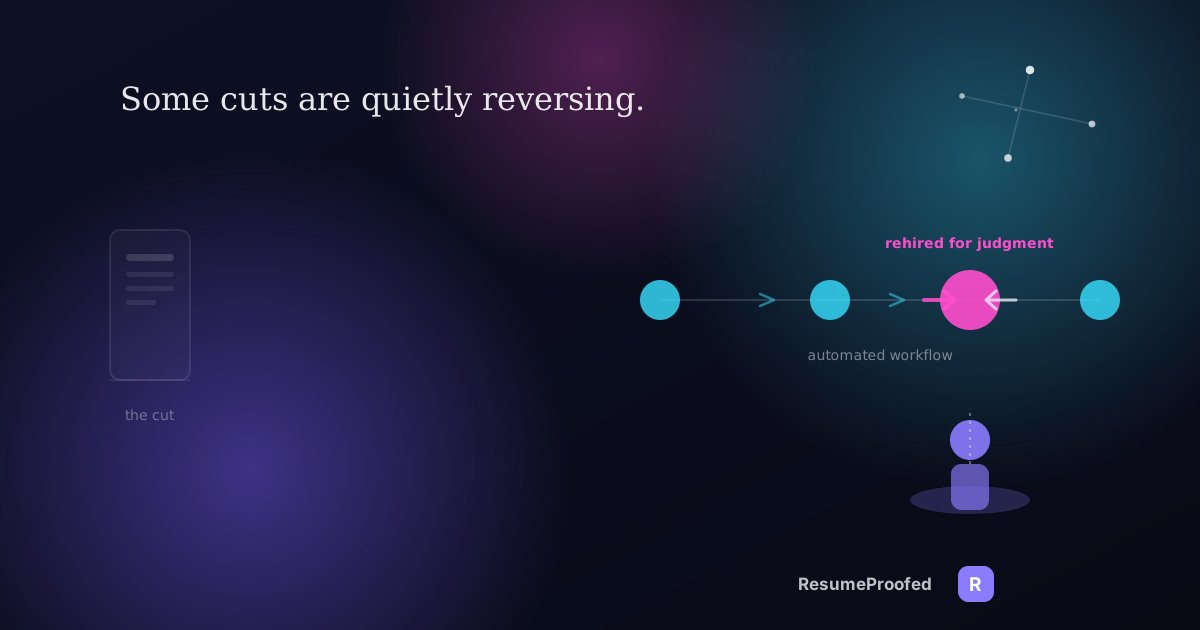
If a round of AI layoffs took a role like yours in the past year or two, you've probably absorbed the narrative that comes with it: the work is gone for good, AI does it now, and there's no version of that job to go back to. That narrative is already cracking, with real numbers behind the crack, and it's worth understanding exactly what's happening before you rebuild your resume around a story that isn't as settled as it sounds.
The position worth stating first: nobody is claiming AI layoffs didn't happen, or that they won't keep happening. They did, and they will. What's changed is that a measurable share of the companies that made those cuts are now quietly admitting the AI-only version of the role didn't hold up, and rehiring into a judgment-heavy version of the job they cut. That's not a reason to relax. It's a reason to be specific about what employers are discovering they still need a person for, and to make sure your resume says exactly that.
The reversal, by the numbers
This isn't a vibe or a single anecdote. A Robert Half survey found that 29% of organisations that cut employees due to an AI-related reduction have already rehired into the positions they cut, as reported by Forbes. Other coverage of what appears to be the same April 2026 Robert Half research puts the figure at 32% of hiring managers who scrapped a role primarily because of AI and later brought the work back. The exact number shifts a little depending on which outlet and which slice of the survey you're reading, but not by much: every version lands at roughly three in ten employers who made an AI-driven cut having already reversed at least part of it, within the same reporting window the cut happened in.
The same Forbes article cites Forrester research estimating that 55% of executive decision-makers who replaced employees using AI will regret the decision within 18 months. Capitol Technology University's write-up of the same underlying Forrester "2026 Future of Work" report frames that finding as roughly half of AI-attributed layoffs being quietly reversed. That's one study described two ways, not two separate analyses arriving at the same conclusion independently, but it's still worth taking seriously on its own terms: whichever way you frame Forrester's numbers, they describe a majority or near-majority of the executives making these calls already expecting, or already experiencing, buyer's remorse.
Gartner adds a forward-looking version of the same prediction, specific to one function: by 2027, at least half of companies that cut customer-service jobs due to AI will be hiring back employees into the same or very similar roles. Customer service was one of the first functions to see AI-driven headcount reductions, and it's also the function Gartner expects to see the reversal show up in fastest and most visibly.
What happened at Klarna
The clearest named example of this pattern is Klarna. The buy-now-pay-later company publicly said its AI agent could handle the equivalent work of 700 customer service representatives, a number that got widely repeated as a preview of what AI would do to service jobs generally. According to Capitol Technology University's reporting, Klarna began quietly hiring customer service reps back after the promised returns did not materialise.
Klarna's case matters less as a scandal and more as a preview of the shape this keeps taking: a confident public number about what AI can replace, followed by a quieter, less publicised correction once the AI-only version of the workflow meets the actual volume of edge cases, exceptions and judgment calls the original job absorbed without anyone noticing they were happening.
Why the reversal is happening: the ROI gap

The uncomfortable detail behind these numbers is that the workforce cuts and the promised payoff don't appear to be reliably connected. A separate Gartner study of 350 executives at billion-dollar companies found that although 80% of companies piloting AI reported workforce reductions, there was no meaningful correlation between those cuts and higher ROI, per the same Capitol Technology University reporting. Companies cut headcount at a high rate. The financial return that was supposed to justify the cut often didn't show up alongside it.
That gap is the honest explanation for why rehiring is happening at all. If AI genuinely and reliably replaced the full scope of a role, there'd be no commercial reason to rehire into it eighteen months later. The fact that a meaningful share of employers are doing exactly that suggests the AI handled a real, valuable slice of the work, often the highest-volume, most repetitive slice, while quietly dropping the slice that required a person to notice something was unusual and decide what to do about it. Employers cut for the volume the AI could absorb. They're rehiring for the volume it couldn't.
What the reversal is not saying
It's worth being precise here, because overclaiming this trend would be exactly the kind of dishonest reassurance this piece is trying to avoid. Is AI actually replacing jobs in 2026? Yes, plainly, in real and measurable numbers, and that's not in dispute anywhere in this data. A rehire rate in the roughly three-in-ten range also means most AI-driven cuts, somewhere around two-thirds to seven in ten, have not been reversed, at least not yet and not visibly. This is not a story where the disruption turns out to have been fake. It's a story where a specific, identifiable slice of the disruption is proving to be miscalibrated, and where the miscalibration is landing in a consistent, describable place: judgment, exceptions and context, rather than volume and repetition.
If you've read our piece on whether AI is actually killing graduate jobs in Australia, the same distinction applies here. The honest read is never "AI is coming for everyone" or "AI is overhyped and nothing changes." It's narrower and more useful than either: AI is reliably absorbing high-volume, low-judgment work, and employers are discovering, sometimes the expensive way, exactly where that boundary sits in their own operations.
What this means for your resume
The practical implication is specific, not general. If a role like yours was affected by an AI-driven cut, the version of that role employers are now quietly rehiring for isn't the same job description as before. It's a narrower, judgment-heavier version of it, built around the exceptions and contextual decisions that the AI system in place couldn't reliably handle. A resume that describes the old, full-volume version of the role is aiming at a job that may genuinely no longer exist. A resume that leads with the judgment slice is aiming at the job employers are discovering they still need to pay a person for.
Lead with the calls you made, not the tasks you completed. Most resumes describe a role by volume: how many tickets closed, how many invoices processed, how many calls handled. That's exactly the part of the job most exposed to automation, and the part employers are least likely to be short-staffed on now. What an AI system still struggles with is the moment a case doesn't fit the pattern, and someone has to decide what to do. That's the part worth foregrounding.
Name the exceptions explicitly. "Handled customer escalations" is vague. "Identified when a standard refund policy didn't apply to a customer's specific circumstances, and negotiated an alternative resolution that kept the account" is a judgment call an automated workflow routes to a human precisely because it can't reliably make that call itself. If you can recall two or three specific moments like that from your actual work, they belong near the top of your resume, not buried under routine duties.
Describe the context you were reading, not just the decision you made. A judgment call is only impressive if the resume shows what information you were weighing. "Overrode the automated pricing recommendation for a long-standing client after noticing the standard discount tier didn't reflect a multi-year contract already in place" shows the reasoning, not just the outcome. That reasoning is the specific thing a rehire decision is trying to buy back.
A worked example: rewriting a customer service bullet
Say your current resume, from a customer service role that was later partly automated, includes a line like: "Resolved customer inquiries via phone and chat, maintaining a high satisfaction score across a high-volume queue." That's a true, honest description, and it's also almost exactly the description of the work an AI agent is built to absorb first. Here's how to rework it in three steps.
Step one: pull out the moments where the standard process didn't apply. Not the average day, the days something was genuinely ambiguous, a policy conflict, a customer situation the script didn't cover, a case where two systems disagreed with each other.
Step two: describe what you weighed, not just what you decided. What information did you have that a rules-based system wouldn't have surfaced on its own: tone, history, a detail buried in an earlier ticket, a business relationship the policy didn't account for.
Step three: state the outcome in concrete terms. Rewritten, the bullet becomes: "Identified recurring cases where standard refund policy conflicted with long-term account history, and built a judgment-based escalation path that resolved them without formal complaint, handling roughly a dozen such cases a month alongside routine queue work." The volume language is still there, honestly, but it's no longer the headline. The judgment is.
How to tell if a role is being rehired for the right reasons

Not every reopened role after an AI cut is actually the judgment-heavy version described above, and it's worth checking rather than assuming. A few signals worth reading in the job ad and the interview itself: does the description mention exception handling, escalation, or override authority, or does it read like a rewritten version of the exact volume role that was cut. Does the interview ask you to describe a specific ambiguous situation and how you resolved it, or does it stay at the level of general competency questions. Employers who've genuinely learned the lesson tend to ask more specifically about judgment than they did the first time they hired for the role, because that's the gap they're now trying to close.
If you're weighing whether a skills section still leads with the right things for this kind of role, our guide on restructuring a resume's skills section around evidence covers the same underlying principle from a different angle: employers are screening for demonstrated capability, not a list of tools or duties, and a judgment-heavy rehire is one of the clearest current examples of exactly that.
What not to do with this information
Don't use this trend to argue, in an interview or on a resume, that AI doesn't work or that your old role should simply come back unchanged. That's not what the data shows, and overstating it will read as defensive rather than informed. The honest, useful version of this argument is narrower: you understand where automated systems reliably add value, and you can point to the specific kind of judgment call in your own experience that a system in place couldn't make on its own. That's a claim you can back with real examples. "AI doesn't really work" is not, and it will not land well with an employer who has just spent real money finding out where it does and doesn't.
Common questions
Are companies actually rehiring after AI layoffs?
Some are, in measurable numbers. A Robert Half survey found 29% of organisations that made an AI-related workforce cut have already rehired into the positions they cut, other coverage of the same research puts the figure at 32%, and Gartner expects at least half of AI-driven customer service cuts to be reversed by 2027.
Do employers regret AI layoffs?
A meaningful share appear to, based on available data. Forrester research cited by Forbes estimates 55% of executives who replaced employees with AI will regret the decision within 18 months, and Capitol Technology University's coverage of that same Forrester report frames the finding as an expected reversal rate of roughly half of AI-attributed layoffs.
Is AI actually replacing jobs in 2026?
Yes, in real and significant numbers, and that's not in dispute. What's also true is that a specific, measurable slice of those cuts is being reversed, concentrated in roles where the work involved more judgment and exception handling than the original AI rollout accounted for.
What happened with Klarna and AI customer service jobs?
Klarna publicly said its AI agent could handle the equivalent work of 700 customer service representatives, then began quietly hiring reps back after the promised returns did not materialise, according to reporting from Capitol Technology University.
How do I put judgment skills on my resume for an AI-affected role?
Lead with specific moments where you handled an exception, an ambiguous case, or a decision a standard process or automated system couldn't resolve on its own, and describe the context you were weighing, not just the outcome. That's the slice of the work employers are discovering they still need to pay a person for.
Should I mention AI layoffs directly in my job application?
Generally no, not as a talking point about the industry. Focus your resume and interview answers on the specific judgment and exception-handling evidence from your own experience rather than on the broader trend, since that's what a hiring manager is actually screening for.
Where ResumeProofed fits, and where it doesn't
ResumeProofed can't tell you whether a specific role was cut for AI reasons or predict which employers will reverse a cut, that read is genuinely yours to make from the job ad and what you learn in the process. What it can do is help you pull the judgment-heavy, exception-handling evidence out of your own experience and put it where a hiring manager screening for exactly that will actually see it, for the specific role you're applying to.
ResumeProofed opens soon. Join the waitlist to be first in.