Skills-based hiring overtook degrees in 2026: how to lead your resume with proof
70% of employers now hire on skills over degrees, and a third of entry roles screen for AI competency. How to restructure your resume's skills section.
- Résumé writing
- AI resumes
- Career strategy
If your resume still leads with a degree and treats your skills section as an afterthought list of software names, it's built for a hiring process most employers have already moved past. Skills-based hiring isn't a niche HR trend anymore, it's the default screening approach at most employers hiring entry-level and graduate talent in 2026, and it comes with a newer, more specific wrinkle: a meaningful share of entry-level roles now explicitly screen for whether you can actually use AI tools, not just whether you've heard of them.
The position worth stating first: this is genuinely good news if your resume can prove what you can do rather than what you studied, and genuinely bad news if it can't. A resume that leads with credentials over evidence is now working against the exact thing employers say they're screening for. The fix isn't complicated, but it does mean rebuilding your skills section around proof rather than a list.
The shift, by the numbers
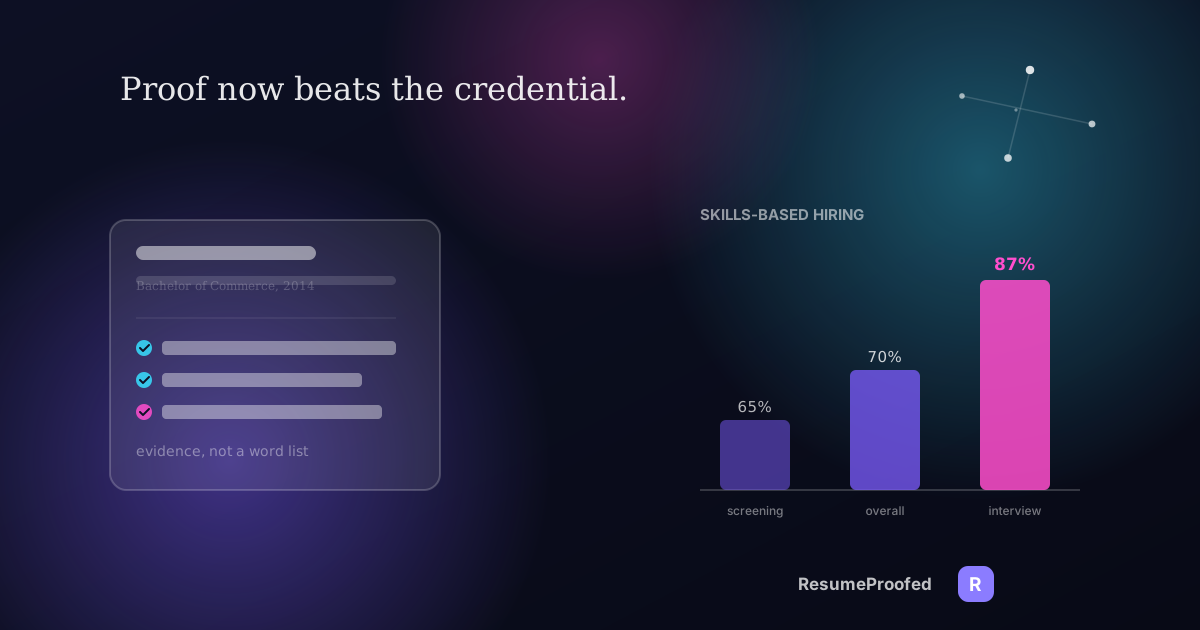
NACE's Job Outlook 2026 survey found that 70 percent of employers now report using skills-based hiring, up from 65 percent the year before, with 71 percent of this year's skills-based employers using the approach at least half the time. That's not a fringe practice at a handful of progressive companies. It's the majority approach, and it grew again this year rather than plateauing.
The same survey breaks down where in the hiring process this shows up most: 87 percent of employers use skills-based evaluation at the interview stage, and 65 percent use it during screening, meaning your resume and application materials are being read against a skills-first standard well before you ever get to a conversation.
The clearest sign of the shift: GPA screening is collapsing
NACE's data offers a genuinely useful proxy for how fast this has moved. In 2019, 73 percent of employers screened candidates by GPA. This year, that figure has fallen to just 42 percent. A credential-based screening method that nearly three-quarters of employers used five years ago is now something fewer than half still rely on, replaced by direct evidence of what a candidate can actually do.
Degree requirements are dropping even faster than that
The GPA decline is significant, but a newer, more specific data point shows the same shift moving even faster at the entry level. Forbes reported on 10 August 2026 that 53 percent of employers have now eliminated degree requirements entirely, up from just 30 percent the year before, close to doubling in a single year. If you've been holding off applying to roles because you don't have the exact degree listed in the job ad, that specific barrier is disappearing faster than most job seekers have caught up with.
The newest wrinkle: AI competency is now part of the screen
The Forbes reporting adds a more specific and more recent data point worth taking seriously if you're applying to entry-level or early-career roles: more than a third of entry-level jobs now require some demonstrated AI competency, nearly triple the share reported in fall 2025. That's not a slow-moving structural shift like the GPA decline. It's a specific, fast-moving requirement that's roughly tripled in under a year, which means a resume that doesn't address it at all is falling behind a moving target, not a settled one.
The reasoning behind why this is happening so quickly is straightforward: a multi-year degree cycle can't keep pace with a skill set that's changing this fast, so employers have shifted to screening for the specific, current tool fluency they actually need rather than trusting a credential earned years earlier to still reflect it.
The data here is entry-level specific, but the fix isn't
Worth being precise about scope: NACE's skills-based hiring and GPA figures and Forbes' degree-requirement and AI-competency numbers all describe entry-level and new-graduate hiring specifically. Neither source measures how employers screen candidates with a decade or two of experience, and this piece won't claim they do. But the underlying fix carries no downside at any career stage: a resume built around recent, demonstrated evidence beats one that leans on a credential, whether that credential is a GPA fresh out of university or a degree finished twenty years ago. A senior candidate whose resume still leans on a degree from decades ago as its lead credential is making the same structural mistake as a graduate leading with GPA, just at a different career stage. The fix is the same regardless of seniority: lead with what you've actually done recently, backed by specifics, and let credentials sit as supporting context rather than the headline.
How to restructure your resume's skills section around evidence
The practical fix isn't adding more skills to your list. It's converting the ones you already have from a list into evidence, since a skills-based screen is looking for proof you can do the thing, not confirmation you've heard of it.
Replace bare skill names with a specific outcome attached to each one. "Project management" as a bullet point proves nothing to a skills-based screener. "Led a cross-functional team of six through a systems migration, delivered two weeks ahead of schedule" proves the same skill with evidence attached. Do this conversion for every skill currently sitting as a bare word on your resume.
Pull the specific language from the job ad and match it to a real example, not a synonym. Our guide on finding the right resume keywords in a job ad covers how to identify the specific phrases a job ad is actually screening for. Once you have those phrases, the work under a skills-based system is matching each one to a genuine example from your own experience, not just inserting the keyword itself, since a skills-first reviewer is checking for evidence behind the word, not the word's presence alone.
Move your skills evidence above your education, not below it. If your resume still lists education before experience out of habit, and skills-based hiring means employers are actively deprioritising credentials in favour of proof, a resume structured credential-first is working against the exact standard it's being screened by. Lead with experience and evidence, and let education sit further down as supporting context rather than the header act.
If your path included a trade or VET qualification rather than a degree, this shift specifically works in your favour. Our piece on writing a resume for a trade or VET qualification in Australia covers how to position that experience when a job ad still lists a degree, and the broader skills-based trend covered here is the structural reason that positioning has gotten considerably easier over the past year.
A worked example
Say your current resume lists "Excel, data analysis, communication" as a flat skills line with no further detail. Rewritten around evidence, that becomes three separate bullets under your relevant role: "Built a weekly sales tracking model in Excel that replaced three separate spreadsheets and cut reporting time from two days to two hours," "Analysed six months of customer support tickets to identify the top three recurring complaint categories, presented findings to the product team," and "Presented quarterly results to a cross-functional group of twelve, including two senior stakeholders outside my usual team." Each one still contains the original skill, Excel, data analysis, communication, but now carries a specific, checkable outcome a skills-based screener can actually evaluate, rather than a bare word they have to take on faith.
How to show AI skills specifically, without just listing "AI"
Given that AI competency screening has nearly tripled at the entry level in under a year, this deserves its own specific fix rather than being folded into general skills advice.
Name the specific tool and what you used it for, not the category. "AI" as a bare skill listing tells a screener nothing checkable. "Used ChatGPT to draft and iterate customer email templates, cutting first-draft time by half" is specific, checkable, and honest. Name the actual tool, whether that's a general assistant, a specific analytics platform, or an industry tool with AI features built in.
Describe the workflow, not just the tool. A skills-based screener evaluating AI competency is checking whether you can integrate a tool into real work, not whether you've opened it once. A line like "Use AI-assisted research tools to shortlist sources before verifying manually" shows judgment about when and how to use the tool, which is closer to what's actually being screened for than a bare mention.
Don't overstate it, and don't understate it either. If your AI tool use so far has been genuinely light, a single honest, specific example beats an inflated list of tools you've barely touched. Given that this is a newly fast-moving requirement rather than an established one, even a modest, honest example of real use is meaningfully more useful to a screener than a vague, padded list.
Common questions
Is skills-based hiring actually more common now than a degree requirement?
Yes, on current data. NACE's Job Outlook 2026 survey found 70 percent of employers now use skills-based hiring, up from 65 percent the year before, and Forbes reported in August 2026 that 53 percent of employers have eliminated degree requirements entirely, up from 30 percent a year earlier.
Do employers actually check GPA anymore?
Far fewer than they used to. NACE's data shows GPA screening has fallen from 73 percent of employers in 2019 to just 42 percent this year, a clear structural decline as skills-based evaluation has taken over as the primary screening method.
Do entry-level jobs really require AI skills now?
A meaningful and fast-growing share do. Forbes reported that more than a third of entry-level roles now require some demonstrated AI competency, nearly triple the share reported in fall 2025, making it one of the fastest-moving specific requirements in the current job market.
How do I show AI skills on my resume if I haven't used AI tools much?
Use one honest, specific example rather than a padded list. Name the actual tool and what you used it for, for example drafting content, summarising research, or analysing data, since a specific, modest example is more credible to a skills-based screener than a vague or inflated list of tools.
Where in the hiring process does skills-based evaluation matter most?
Mostly at interview and screening. NACE's data found 87 percent of employers apply skills-based evaluation at the interview stage and 65 percent during screening, meaning your resume and application materials are assessed against this standard before you ever reach a conversation.
Should I remove my degree from my resume entirely?
No. Keep it listed, but don't lead with it. With skills-based hiring now the majority approach and degree requirements dropping fast, a resume structured around evidence first and education as supporting context, rather than the other way around, matches how employers are actually screening in 2026.
Where ResumeProofed fits, and where it doesn't
ResumeProofed can't invent skills or experience you don't have, the evidence has to be real and yours. What it can do is help you match the specific language and evidence a job ad is screening for against your actual experience, so your skills section reads as proof rather than a list, for the exact role you're applying to.
Try ResumeProofed free: two tailored applications on the house, no card required.