Huntr alternatives (2026): three tools worth checking first
Huntr's Pro plan is $40 a month. Here's what you actually get for that, and three alternatives at $0, $29 and $50 that cover the same ground.
- Tools
- Job search
- Comparison
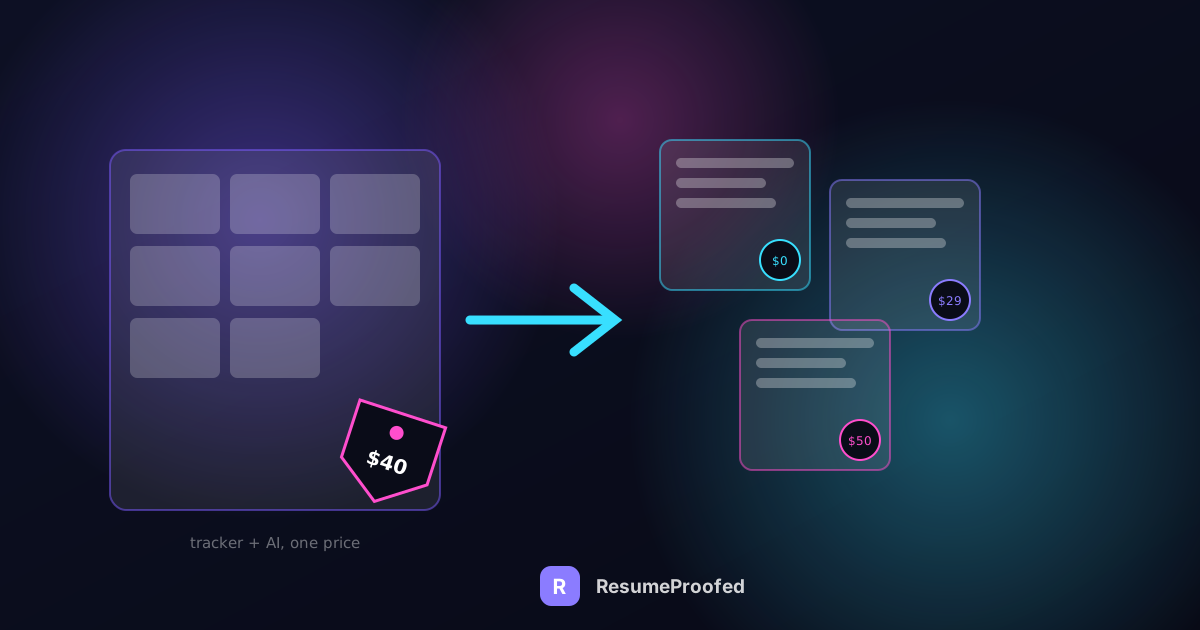
Huntr's free plan tracks up to 100 jobs and gives you two AI tailored resumes to try. Past that, Pro costs $40 a month, or $26.66 a month if you commit to six months up front, according to Huntr's own pricing page. That is a real number worth sitting with before you search for an alternative, because it means the honest question is not "is Huntr bad," it is "does a $40 tracker with AI resume generation attached beat a $0 tracker, a $29 tracker with lighter AI, or a $50 tool that does something Huntr does not do at all."
The position worth stating early: most "Huntr alternatives" posts you will find are affiliate roundups that list five tools with no current pricing and no distinction between what is genuinely free and what is a trial. This one checks three specific alternatives against Huntr's actual current plan, at three different price points, so you can pick based on what you would actually pay, not a vibe.
What Huntr's $40 a month actually buys you
Huntr's free tier is more generous than most competitors': unlimited base resumes with PDF export, job tracking for up to 100 positions, unlimited contact management, application autofill, and up to 100 document uploads, per the pricing page above. What is capped is the AI layer: two job tailored resumes and two "application packets" total, ever, on the free plan.
Pro removes that cap. It adds unlimited AI tailored resumes, unlimited AI cover letters, unlimited AI resume reviews with role targeted critique, full keyword visibility in job matching, and unlimited job tracking and document uploads. If you are applying to more than two roles that need a genuinely tailored resume, the free plan will not get you there, and that is the entire case for paying $40.
Four alternatives, from $0 to $50
Careerflow: the closest free swap
Careerflow's free tier tracks up to 10 jobs, gives you one tailored resume with basic ATS scoring, a LinkedIn profile optimizer, and limited application autofill. That is a smaller free allowance than Huntr's 100 tracked jobs, but the LinkedIn optimizer is a genuine feature Huntr does not offer at any price. Careerflow's paid tier, Premium at $23.99 a month, unlocks unlimited resumes and tracking, an AI cover letter generator, and a full ATS resume optimizer. A Premium Plus tier at $44.99 a month adds an AI mock interview simulator on top.
If what draws you to Huntr is the tracker and the tailored resume together, Careerflow is the direct structural match: same two features, smaller free allowance, cheaper paid tier if you do subscribe. The trade is 10 tracked jobs instead of 100 for free, in exchange for a LinkedIn tool Huntr does not have.
Teal: unlimited tracking for free, AI behind the paywall
Teal's free plan is the most generous tracker on this list at $0: unlimited job tracking, a Chrome extension that logs listings as you browse, 10 resume templates, and a Match Score tool that shows your top five missing keywords per job description for free. What is gated is the AI writing layer, drafted bullets, summaries, and cover letters, and the full keyword breakdown beyond the top five.
Teal+ runs about $29 a month, cheaper than a quarterly or annual Huntr Pro commitment, and unlocks unlimited AI credits and the full Match Score breakdown. Our Teal vs Jobscan comparison covers Teal's numbers in more depth if you are weighing it against a pure ATS scoring tool rather than a tracker. For a straight Huntr swap, Teal's case is simple: unlimited tracking for free beats Huntr's 100 job cap for free, and $29 a month for AI writing beats $40.
Jobscan: not a tracker, but the $50 alternative worth knowing about
Jobscan is not a job tracker, it is a resume-to-job-description scoring tool, and it costs $49.95 a month, confirmed in our own Jobscan review. It earns a place on this list because "Huntr alternative" searches often really mean "I want to know if my resume matches this job ad," which is a different problem than tracking applications, and Jobscan answers that specific question with a more mature single-scan report than either Huntr or Teal. Even Jobscan's free plan gives five full scans a month with the complete keyword and formatting breakdown, not a partial one.
If tracking is solved for you already, whether on paper, in a spreadsheet, or on Huntr's free plan, and what you actually want is a sharper answer to "will this resume pass the keyword scan," Jobscan is the $50 option worth the separate look, not a straight swap for Huntr's $40.
Simplify: the free autofill specialist worth pairing, not switching to
One more tool comes up constantly in the same searches: Simplify's Copilot extension, which fills job application forms from a saved profile automatically. Its free tier includes unlimited autofill, an AI-matched job board, and an application tracker, with no volume cap on any of them according to independent testing rounded up across several 2026 reviews of the tool. A paid Simplify+ tier exists at roughly $39.99 a month or a per-week option, adding features like resume tailoring on top of the free autofill.
Simplify is not really a Huntr swap on its own, because its core strength is the browser-side autofill, not the tracker or the resume generation. The realistic use case is running Simplify's free autofill extension alongside whichever tracker wins your comparison above, since autofill and tracking are not mutually exclusive tools and Simplify's free tier does not require you to also use its tracker.
A worked comparison: choosing at 15 applications a month
Take a realistic case: you are applying to around 15 roles a month, want AI help tailoring at least half of them, and want to track everything in one place.
On Huntr Pro ($40/month): unlimited tailored resumes and cover letters, full tracking, one bill. Cost per application at 15 a month: about $2.67.
On Careerflow Premium ($23.99/month): unlimited resumes and tracking, plus the LinkedIn optimizer Huntr does not offer. Cost per application: about $1.60. You lose Huntr's "application packet" bundling, but gain LinkedIn profile scoring.
On Teal free plus Teal+ some months ($0 to $29/month): unlimited tracking always, pay $29 only in months you need heavy AI drafting, skip it in slower months. Average cost across a year of mixed volume tends to land below either paid alternative, but you do the keyword-matching legwork yourself in months you stay on the free tier.
Running Jobscan alongside a free tracker ($49.95/month plus $0): track applications in a spreadsheet or Huntr's free plan, and spend the $49.95 purely on getting the sharpest possible match score before you submit your highest-priority applications. This works if scoring accuracy matters more to you than AI-drafted content, and it is the only option here that gives you a second, independent read on your resume rather than the same tool building and scoring it.
None of these is the objectively correct choice. The one that fits depends on whether your bottleneck is tracking volume, AI drafting volume, or scoring confidence, and those are three different problems that happen to get marketed under one "job search tool" label.
A short routine for switching without losing your data
- Export what you can from Huntr first. Job tracker entries and resume PDFs are the two things worth pulling out before you downgrade or cancel; Huntr does not lock exports behind Pro.
- Pick one alternative and commit to its free tier for two weeks before paying for anything. Two weeks is enough to tell whether a 10 job tracking cap (Careerflow) or a top five keyword limit (Teal) actually bites for your search volume, rather than guessing from a pricing page.
- Re-enter only your active applications, not your full history. Rebuilding six months of dead leads in a new tracker wastes time you could spend applying.
- Decide the AI question separately from the tracker question. If a new tool's free tracker works for you but its AI writing feels weak, that is a reason to pair it with a separate tailoring tool, like ResumeProofed, not a reason to reject the tracker.
- Keep the receipt on why you switched. If cost was the driver, check back against Huntr's pricing in three to six months. Job search tools change plans often, and today's alternative may not be cheaper by the time your next search rolls around.
Common questions
Is there a genuinely free alternative to Huntr?
Yes. Teal's free plan offers unlimited job tracking with no cap, ahead of Huntr's free 100 job limit, though its free AI writing credits are more limited than Huntr's. Careerflow's free plan also has no cost but caps tracking at 10 jobs, a smaller allowance than either Huntr or Teal.
Is Huntr worth $40 a month compared to its alternatives?
It depends on what you value most. Huntr Pro's unlimited AI tailored resumes and cover letters are priced above Careerflow's equivalent Premium tier ($23.99/month) and above Teal+ (about $29/month), so if AI drafting volume is your main need, either alternative is cheaper for similar functionality. Huntr's advantage is bundling tracking and AI generation at a higher usage ceiling per feature.
What is the best free job tracker if I do not need AI resume tailoring?
Teal's free plan, since it tracks unlimited jobs at no cost with no cap, unlike Huntr's 100 job limit or Careerflow's 10 job limit. You give up deeper AI features on the free tier of any of these tools, but if tracking alone is the need, Teal's free allowance is the largest of the three.
Is Jobscan a replacement for Huntr?
No, they solve different problems. Huntr is primarily a job tracker with AI resume generation attached; Jobscan is a resume scoring tool with no tracking feature at all. If you want both jobs tracked and a resume scored, you likely need two tools, or a tracker plus a separate tailoring product.
Do any of these alternatives offer a LinkedIn profile check?
Yes. Careerflow includes a LinkedIn Profile Optimizer even on its free plan, and Teal offers a separate free LinkedIn Profile Review tool with no paid plan required. Huntr does not offer a LinkedIn feature at any price tier.
How often do these prices change?
Often enough that you should confirm current numbers before subscribing to any of them. The figures in this piece reflect each provider's own pricing page or, for Jobscan, our own previously verified review, checked in 2026, but job search tools adjust plans and introduce new tiers with some regularity.
Where ResumeProofed fits, and where it doesn't
ResumeProofed does not track applications and has no plan to build a kanban board, that job is already well served by the free tiers of Teal and Careerflow covered above. What it does instead is the tailoring step none of these trackers do particularly well: confirm real, verified facts about your career once, then generate a resume and cover letter matched to one job ad's specific language each time you apply. If you already have a tracker you like, pairing it with a dedicated tailoring tool is a reasonable setup, and it does not require abandoning whichever tracker won the comparison above.
Try ResumeProofed free: two tailored applications on the house, no card required.