Should you ask your old employer for your job back? What the data says
Boomerang hires make up over a third of new hires in some sectors, with real pay bumps on return. Here's when going back is a smart move, not a step down.
- Career strategy
- Job search
- Résumé writing
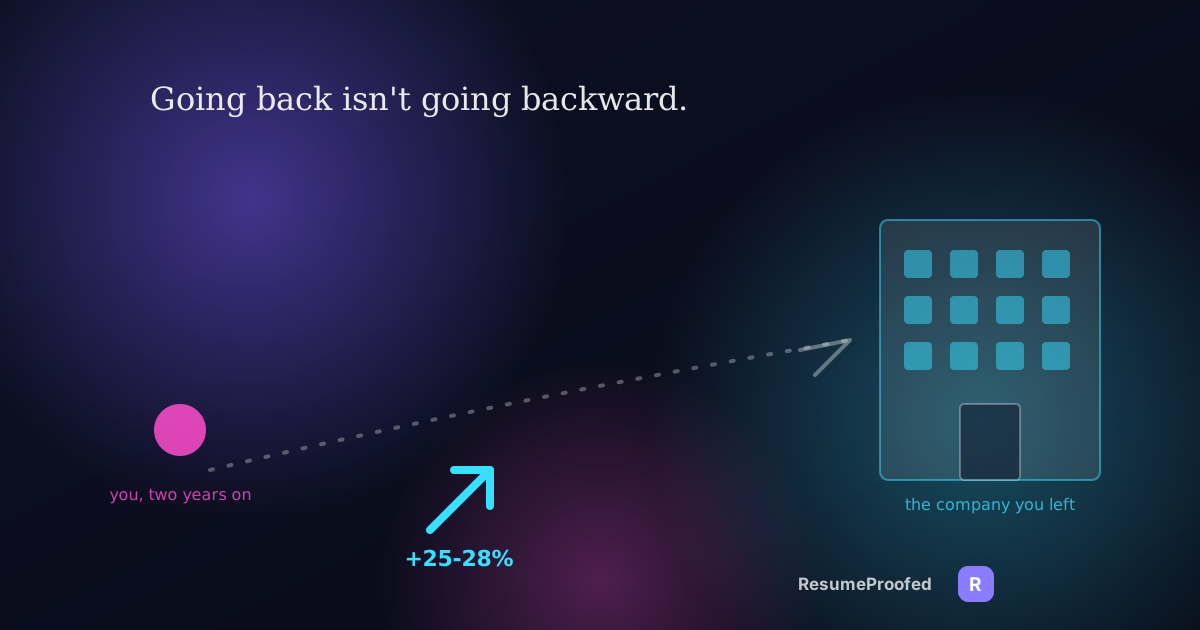
Somewhere between "I made a mistake leaving" and "I'm too embarrassed to ask," most people who consider going back to a former employer talk themselves out of it before finding out whether it's actually a reasonable move. Current hiring data says that hesitation is often misplaced. Returning to a company you already left, what recruiters call being a boomerang employee, has gone from a slightly awkward exception to a genuinely mainstream hiring pathway, one companies are now actively encouraging rather than merely tolerating.
The position worth stating first: this isn't a universal recommendation to go back, and a return that isn't handled deliberately can still read as a step backward. But the data below shows it's frequently the opposite, a move that's increasingly common, actively courted by employers, and often comes with a faster ramp up than a typical new hire, provided you approach the outreach and the resume framing the right way rather than quietly hoping the door is still open.
The trend: boomerang hiring is surging, not niche
Forbes reported on 19 August 2026 that boomerang hiring is actively surging, with companies increasingly courting former employees to return rather than waiting for them to ask. That's a live, current trend rather than a one off study from years ago, and it sits on top of dated figures that already showed the shift well underway. The hiring-rate data below is US-sourced (ADP is a US payroll processor), so treat the exact figures as directional for an Australian job search rather than a local measurement.
The Interview Guys' analysis, drawing on ADP Research data, found that boomerangs made up 35 percent of all new hires in March 2025, up from 31 percent the year before, a four percentage point jump in a single year. The rate varies sharply by sector: in the information sector specifically, boomerangs accounted for 68 percent of new hires, meaning more than two in three people hired into that sector that month were returning to a company they'd already worked for, not joining one for the first time.
Why the numbers make it worth considering
The case for a return isn't just that it's common, it's that companies are treating it as a genuine opportunity rather than a fallback. Forbes reported that returning employees often come back with better pay, a stronger title or more flexibility than they had before, precisely because employers are actively competing to win them back rather than merely accepting an application. That's worth sitting with if your instinct is that going back must mean settling for less: on the current reporting, it's often the opposite. Specific percentage figures for boomerang pay bumps circulate on some job-search blogs, but they trace back to uncited analysis rather than a named, checkable study, so treat the direction (pay often goes up on return) as reliable and any precise number you see quoted elsewhere with some scepticism.
It also stands to reason that someone who already knows the culture, the systems and the people ramps up faster and integrates more smoothly than someone starting cold, which is part of why employers are courting boomerangs in the first place. Robust, independently verifiable data comparing long-term retention of boomerang hires against new hires isn't publicly available, though, so that's a reasonable inference from how employers are behaving rather than a documented statistic.
Why employers actively want this now
The advantage runs in both directions, and understanding why employers are courting former staff helps you frame your own outreach with more confidence than a hesitant "I don't suppose there's anything going" message would carry. A returning employee needs less onboarding because they already understand how the organisation actually works, not just its formal processes. They also come back having spent time somewhere else, exposed to different tools, different management approaches and different ways of solving the same kinds of problems, which is a genuine value add rather than a gap to explain away. Framed this way, reaching back out is less a favour you're asking and more a proposal that a hiring manager, on the current numbers, has real incentive to say yes to.
How to approach the outreach
Reconnect with a specific person, not a generic application. A direct message to a former manager, a colleague still there, or someone in a leadership role you worked with, carries far more weight than submitting a cold application through the careers page and hoping someone connects the dots to your history. If you left on reasonably good terms, this person already has context a stranger reviewing your resume doesn't.
Lead with what's different now, not just that you miss the place. The strongest version of this conversation names something concrete: a new skill, a broader scope you're now qualified for, or a specific reason the timing makes sense, rather than a general sense of nostalgia. "I've spent the last two years leading a team of twelve and want to bring that back here" is a stronger opening than "I've been thinking about coming back."
Be upfront about what you're looking for. If you want a more senior role or a different function than the one you left, say so early rather than assuming you'll be slotted back into your old position. Boomerang hires frequently return at a higher level than they left, and a pay bump on return mostly happens because people actually ask for the upgraded scope and pay rather than assuming a return means picking up exactly where they left off.
Give it time to work through the process properly. Even with a warm internal contact, an actual opening, budget approval and interview process still generally need to happen. Treat the initial outreach as opening a conversation, not securing an offer on the spot.
A worked example
Say you left a mid-size logistics company two years ago as a senior operations analyst, moved to a smaller company for broader exposure, and have since led two supply chain projects end to end. Rather than sending a generic message asking if anything is open, you message your former manager directly: "I've been following [Company]'s growth since I left, and I wanted to reach out directly. Since leaving I've led two end-to-end supply chain projects and picked up hands-on experience with [specific system], and I'd genuinely welcome bringing that back to the team if there's a fit at a senior or lead level. Would you be open to a conversation?" That message does the work the data above supports: it names a specific person, states what's changed and improved since you left, and signals you're not assuming a return means the same role at the same level, all of which positions the conversation as a mutual opportunity rather than a favour.
How to frame the return on a resume and in a cover letter
The instinct with a boomerang move is to treat the earlier stint as old news and lead entirely with what you did elsewhere. That undersells the exact advantage the data shows employers value: institutional knowledge. On your resume, list the earlier stint at the company plainly in your chronological history as you normally would. In your cover letter or the opening line of a reconnection message, name the return deliberately rather than letting the resume imply it by coincidence: "Returning to [Company] after two years leading supply chain projects at [Second Company], bringing hands-on experience with [specific system] the team didn't have when I left." That framing does two things at once: it shows the gap between your two stints was productive, not a placeholder, and it signals the return is a deliberate, informed choice rather than a fallback, which is exactly the read you want a hiring manager to take away from it. If you're also weighing whether now is generally the right time to be making any kind of move, our piece on job mobility in Australia hitting a near record low covers how a voluntary move, including one back to a former employer, tends to draw closer scrutiny in a market where fewer people are changing jobs at all right now.
Common questions
Is it normal to ask for your old job back?
Increasingly, yes. Boomerang hires made up 35 percent of new hires in March 2025 according to ADP Research, up from 31 percent a year earlier, and Forbes reported in August 2026 that companies are now actively courting former employees back rather than only accepting requests to return.
Do boomerang employees get paid more when they return?
Often, yes, though the exact scale is hard to pin down from published data. Forbes reported that companies are increasingly courting former employees back with better pay, titles or flexibility than they had before, since employers are competing to win them back rather than simply accepting an application. Specific percentage figures for boomerang pay bumps that circulate online trace back to uncited blog analysis rather than a named study, so treat the direction as reliable and any exact number with some scepticism.
Do employers actually want former employees back?
Current reporting says yes, and increasingly so. Forbes described boomerang hiring as actively surging in August 2026, with companies courting former staff directly rather than waiting to be asked, largely because returning employees ramp up faster and already understand the culture.
How do I ask my old employer for my job back?
Reach out directly to a former manager or colleague rather than submitting a cold application, and lead with what has changed since you left, a new skill, broader scope, or specific relevant experience, rather than general nostalgia for the role. Be clear about the level and scope you're now looking for rather than assuming you'll return to your old position unchanged.
Do boomerang employees stay longer than new hires?
It's a reasonable inference rather than a firmly documented one. Someone who already knows the culture, systems and people is generally a safer, faster-integrating hire than someone starting cold, which is part of why employers are courting boomerangs in the first place. But the specific three-year retention comparisons that circulate online for boomerang hires don't trace back to a named, checkable study, ADP Research's own published data covers hiring rates, not retention, so treat those particular figures as unconfirmed.
Will going back to a former employer look bad on my resume?
Not if it's framed as a deliberate decision. List the return plainly in your chronological work history, and use your cover letter or outreach message to state clearly what you're bringing back that you didn't have before you left, which reads as a considered choice rather than a step backward or a lack of options elsewhere.
Where ResumeProofed fits, and where it doesn't
ResumeProofed can't make the introduction back to a former employer or guarantee there's an open role waiting, that outreach has to come from you. What it can do is help you tailor your resume and framing for a returning application so the gap between your two stints reads as genuine growth rather than an unexplained placeholder, matching the specific role and level you're now applying for rather than the one you left.
Try ResumeProofed free: two tailored applications on the house, no card required.