Resume for your first job with no experience
No paid work history? Here is what goes on a resume for your first job, how to turn school, volunteering and projects into evidence, and a worked example.
- Resumes
- First job
- Entry level
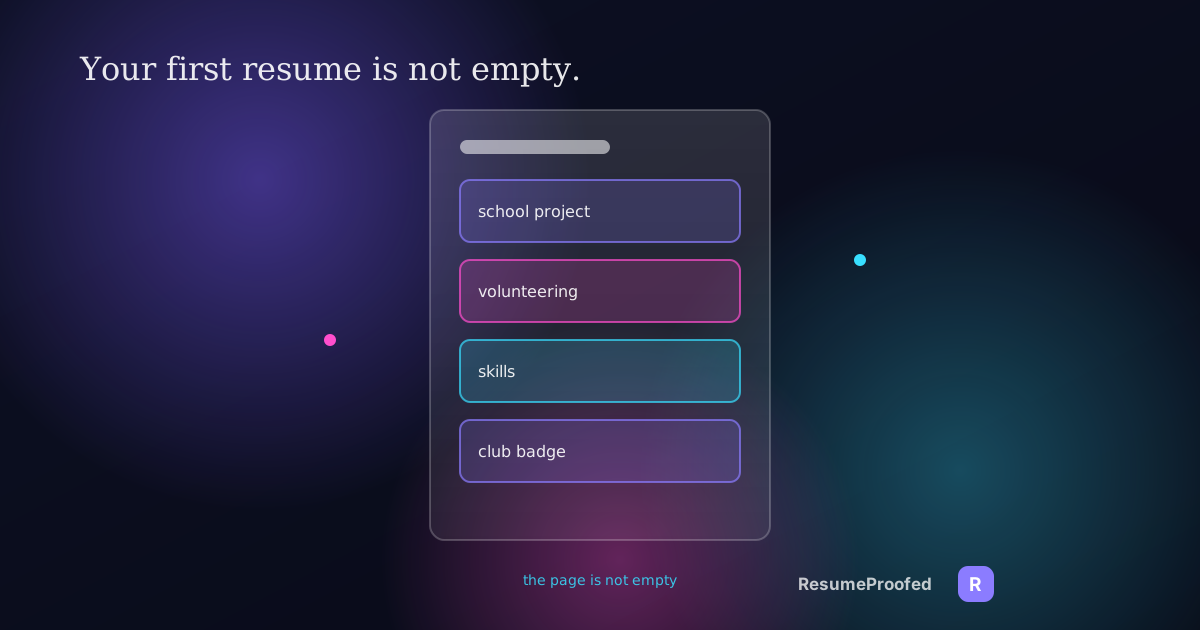
If you are writing a resume for your first job, the page is not empty. It only looks empty because you are searching it for the wrong thing. You are looking for job titles, and you do not have any yet. An employer hiring for an entry-level role is not really looking for job titles either. They are looking for evidence that you turn up, finish things, and can learn quickly, and you already have that evidence in school, volunteering, projects and activities. The work is in writing it down in a form a stranger can scan in under a minute.
This guide is for school leavers, teenagers applying for a first part-time job, and students or graduates chasing an internship. It is different from our piece on a resume for a career change with no experience, which assumes you have a work history in another field. Here there is no prior field. The position we will argue for is simple: a first-job resume wins by being specific, not by being impressive.
What a first-job resume needs to do
Recruiters do not give a first resume a gentler read. In a June 2024 survey of 753 American recruiters and HR professionals by Zety, 72% said they spend less than two minutes reviewing a resume, and the same survey found that skills (39%) and work experience (37%) are the first things they look at. Treat those as US figures from one vendor's survey, not a law of nature. But the practical lesson holds anywhere: the top third of your page has to show a relevant skill and a relevant piece of evidence fast.
For a first job that means your resume has three tasks:
- Prove you are a safe, reliable choice (you finish things, you show up).
- Show at least two or three skills that match the ad.
- Make it effortless to read, with no wall of text and no mistakes.
The sections to include, in order
SEEK's career advice team, in an article on writing a resume with no experience (updated 30 September 2026), lists the sections worth considering: contact details, a profile summary or objective, education and relevant coursework, skills, projects, volunteering or community involvement, activities and achievements, and references only when requested. Its advice is to include only the sections that are relevant to the role. That last part is the useful bit. A first resume does not need every heading. It needs the three or four that carry real content.
A sensible order for most first-job applicants:
- Contact details. Name, a professional email address, a mobile number. Nothing else is needed. Skip your home address beyond suburb or city, and include a social profile only if it is employer-appropriate.
- A two-line summary. Who you are, what you are applying for, and one concrete strength.
- Skills. Ahead of education if the skills are what the ad asks for.
- Experience in the broad sense. Volunteering, projects, informal work, clubs and sport.
- Education. Move it to the top instead if you are a current student applying for an internship, since your course is your main credential.
- Referees. "Available on request" is fine.
Where your "experience" actually comes from
Most people with no paid work have more material than they think. These are the places to dig.
School and university projects
A project is a mini job. It has a goal, a deadline, a method and a result. A group assignment where you ran the data collection is evidence of reliability. A final-year project with a measurable output is evidence of skill. Name the project, say what you did, and give one concrete detail. "Built a budget spreadsheet for a school fundraising event" is a start. "Built a budget spreadsheet for a 120-person school fundraising event and tracked spending against it weekly" is better because it has a number and a repeated action.
Volunteering
SEEK's guidance for volunteer experience is to describe what you did, who you supported, the tools or skills you used and the result. That is a useful four-part template. "Helped at a food drive" tells the reader almost nothing. "Packed and sorted donations for a weekend community food drive, working in a team of eight, and trained two new volunteers on the sorting system" tells them you were trusted with a task and passed it on.
Informal and unpaid work
Babysitting, mowing lawns, tutoring a younger sibling, helping at a family business, running a small online shop. None of these needs to be dressed up as a job title. Write what you did and for how long. Reliability over months matters more than the label, and a stranger can tell whether a line was written honestly.
Clubs, sport and activities
SEEK suggests including activities, hobbies or interests when they show skills, commitment or experience relevant to the opportunity. Captaining a netball team shows leadership and consistency. Being treasurer of a school club shows you can be trusted with money. A list of general hobbies with no link to the job does not help; cut it.
Certificates and short courses
A first aid certificate, a food handling or responsible service of alcohol certificate (where the role requires one), a short online course in a tool the job uses. These are cheap, fast and directly relevant, and they tell an employer you took a step before being asked.
A worked example: before and after
Here is a realistic first-job situation. Sam, 17, is applying for a part-time role in a cafe. Sam has no paid work history. Sam has done a year of school hospitality classes, volunteered at a sausage sizzle fundraiser, and looked after a younger cousin two afternoons a week. These details are illustrative, not from any real applicant.
Before:
Objective: To obtain a position where I can use my skills and grow. Experience: None Skills: Hard worker, good with people, fast learner Hobbies: Music, gaming, friends
Every line could belong to anyone, and the word "None" is an invitation to stop reading.
After:
Sam Taylor | Brisbane, QLD | 04xx xxx xxx | sam.taylor@email.com
Summary. Year 12 student with hospitality training, applying for a part-time cafe role. Reliable, punctual and comfortable working at pace in a team.
Skills. Coffee machine basics (school training cafe), food safety fundamentals, cash handling and till use at fundraisers, friendly customer service, available weekday afternoons and weekends.
Experience and activities.
- Volunteer, school fundraising sausage sizzle (2 days, 2026): served customers, handled cash and change for a queue of up to 30 people, and cleaned down the station at close.
- Hospitality class, school training cafe (1 year): prepared drinks and simple food orders for staff and students during a weekly service.
- Regular carer for a younger cousin (2 afternoons a week, 8 months): managed after-school routines and meals independently.
Education. Year 12, Northside State High School, expected completion 2026.
The second version has no invented achievements. It simply names the real things Sam did, in the vocabulary the cafe's ad is likely to use, and it states availability, which is often the single most practical piece of information for a casual employer.
Writing the bullet points
A first-job bullet has the same anatomy as any other: an action verb, a task, and a detail that makes it checkable. If you want a longer treatment of how to attach numbers to what you did, our guide to quantifying resume achievements applies in full. You do not need big numbers. Counts, durations, frequencies and group sizes are all quantities: "weekly", "for eight months", "a team of five", "around 40 customers a shift".
Two rules keep this honest:
- Only use numbers you can defend. If an interviewer asks how you knew there were 30 people in the queue, "that was the busiest stretch" is a fine answer. Making up a figure is not.
- Do not claim a skill you have never used. Skills lists invite questions. SEEK recommends using accurate descriptors like basic, conversational, proficient or fluent, and that precision is worth copying.
The summary or objective
Keep it to two lines and make each sentence carry information. A weak summary talks about what you want ("seeking a challenging role to grow my skills"). A better one says who you are, what you are applying for and why you fit: "Second-year commerce student applying for the finance internship, with coursework in financial accounting and experience running a club budget of around $2,000." If the second number is something you cannot honestly state, leave it out and use something you can.
Tailoring a first resume to each ad
Even with a short resume, read the ad before you send it. Pull out the two or three words it uses most often, such as "customer service", "reliable", "team environment" or "cash handling", and check whether you can honestly use them in your skills or experience lines. Our post on pulling resume keywords from job ads walks through the method. For a first job the effect is bigger than usual, because your page is short and each line is doing more work.
Format and length
One page is the right length for a first resume. Use a plain layout with a clear heading for each section, a readable font size, and consistent date formatting. Avoid photos, tables of skill bars, and decorative graphics. They add nothing for the reader and can scramble automated parsing. Save as PDF unless the employer asks for a Word file.
Mistakes that are common on first resumes
- Writing "None" or leaving gaps. If a section has no real content, delete the heading.
- An unprofessional email address. Create a plain firstname.lastname address for job applications.
- Listing duties from a school handbook. Write what you did, not what the role could include.
- One resume for every application. Change the summary and the top skills for each one.
- Skipping proofreading. Ask a parent, teacher or friend to read it, and read it aloud yourself.
A one-hour routine to build your first resume
- Ten minutes: brain dump. List every project, activity, volunteer role, informal job, course and certificate. Do not filter.
- Ten minutes: add one detail to each. A number, a duration, a tool, or a result.
- Ten minutes: read an ad you actually want. Highlight its repeated words.
- Fifteen minutes: write. Build the page in the order above, using only the lines that match the ad.
- Ten minutes: check. Spelling, dates, phone number, email, consistent fonts, one page.
- Five minutes: save and name. "Sam-Taylor-Resume.pdf" beats "resume final v3.pdf".
Common questions
What do I put on a resume if I have no work experience?
Put school and university projects, volunteering, informal work such as babysitting or tutoring, clubs and sports roles, certificates and relevant skills. The aim is to show reliability and a few ad-relevant skills, so describe what you did and give one concrete detail for each item.
How long should a first-job resume be?
One page. A first resume rarely has enough material to justify more, and a short, specific page is faster to scan than a padded one. If it spills onto a second page, cut the weakest items first.
Should a high school student or teenager include their school grades?
Include them only if they help your case. Strong results in a subject related to the job are worth a line. If your results are not a selling point, list your school, year level and relevant subjects instead.
Do I need a cover letter for my first job?
Not always, but a short one can help when you have little experience, because it lets you explain why you want this particular role. Check whether the ad asks for one. Our guide on whether you need a cover letter covers the evidence.
Can I use a template for a first resume?
Yes, as long as it is plain and single-column. Templates with photos, graphics, skill bars or multiple columns can look good but add little, and some are harder for software to read. Use the template for structure and write every line yourself.
How do I make a resume for an internship with no experience?
Lead with your course, relevant units and any project work, then add skills, then activities and volunteering. If the internship is in a specific field, make sure the projects and coursework you list use that field's vocabulary from the ad.
Where ResumeProofed fits, and where it doesn't
ResumeProofed is built around tailoring a resume to a specific job ad using facts you have confirmed about yourself. It will not invent experience you do not have, and that is the right limit for a first resume: the strongest page is the one that honestly describes your real projects, volunteering and skills. If you have never written a resume before, the hardest step is the brain dump above, and that one is yours to do. Once your facts are written down, ResumeProofed can reorder and reword them against each ad you apply for, without adding anything you did not say.
Try ResumeProofed free: two tailored applications on the house, no card required.