Resume tips for older workers in Australia, now that ageism starts earlier
Australian employers now call workers 'older' at a younger age than two years ago. Here is what the data shows and how to frame your resume around it.
- Australia
- Career strategy
- Résumé writing
If you're in your early-to-mid 50s and your job search has gone quieter than you expected, it's worth considering a possibility that has nothing to do with your resume's formatting or your skills: Australian employers now start applying an "older worker" label at a younger age than they did two years ago, and that shift alone can explain interviews that used to come more easily and now don't.
The position worth stating first: this isn't a reason to hide your age or your experience, and trying to would be both difficult and counterproductive on a resume that lists dates and job titles. It's a reason to be deliberate about what you lead with, how much history you include, and how you frame it, so the page works with how employers are actually reading it in 2026 rather than how they read it five years ago.
How much earlier "older" now starts, according to Australian employers
The clearest evidence for this shift comes from "Older and Young Workers: What do Employers Think?", a 2025 survey of 148 Australian employers and HR professionals run by the Australian Human Rights Commission and the Australian HR Institute, the fifth in a national series of surveys tracking this question. ABC News's reporting on the findings states that nearly a quarter of HR professionals now classify workers aged 51 to 55 as "older," up from just 10 percent of recruiters holding that view two years earlier. (ABC News's own figure for the survey's sample size, 138, appears to be a transcription slip: other outlets covering the same AHRC/AHRI survey, including HCA Mag, put it at 148, which matches the survey's published sector breakdown.) That's not a small drift. It's a sharp move in what counts as an "older worker" in an employer's own head, and it lands squarely inside an age range a lot of active job seekers sit in without expecting to be there yet.
This matters for how you read your own search. If interviews have slowed compared to a few years ago at a similar experience level, part of the explanation may not be your resume's content at all, it may be that the age at which employers start applying an unspoken discount has moved down to meet you earlier than it used to.
Why this connects directly to your resume, not just to interview bias
It would be easy to read the finding above as an interview-stage problem only, something that happens once you're in the room. The same report doesn't stop there. Among its recommendations, it explicitly calls for employers to conduct audits of AI resume screening tools for age-related bias, a direct acknowledgement that the bias this data documents can be built into the software reading your resume before a person ever sees it, not only into a hiring manager's private judgement at interview.
That's corroborated by the Diversity Council Australia's "Age, Assumptions and Access at Work" report, produced with the Australian Human Rights Commission using the 2025-2026 Inclusion@Work Index. It found only half of older workers had access to career development opportunities at work, and less than one in five had access to a mentor, figures that were worse again for older women specifically. The same report notes that while age is among the most common reasons Australians report experiencing discrimination or harassment at work, formal complaints under the Age Discrimination Act 2004 represent only around 5 percent of the Australian Human Rights Commission's caseload, a wide, well-documented gap between how often age bias is experienced and how often it's ever formally raised.
Put together, the practical implication is this: age bias in Australian hiring right now isn't confined to a face-to-face moment you could theoretically charm your way past. It can sit inside automated screening, and it's under-reported precisely because it's diffuse and hard to point at directly, which makes the resume itself, the one part of the process you fully control, worth getting right rather than treating age bias as purely an interview-room problem. This site's coverage of the Workday AI hiring lawsuit covers a related, though legally distinct, US case alleging that a specific AI screening product disadvantaged older candidates, if you want the fuller picture of how automated age bias has already played out in a real, litigated example.
What leading with recent, relevant achievements actually looks like on the page
The right response to this data isn't to obscure your graduation year or leave off a decade of solid experience. It's to be deliberate about structure and emphasis, so the page leads with what's most relevant to the role you want next.
How far back to list work history
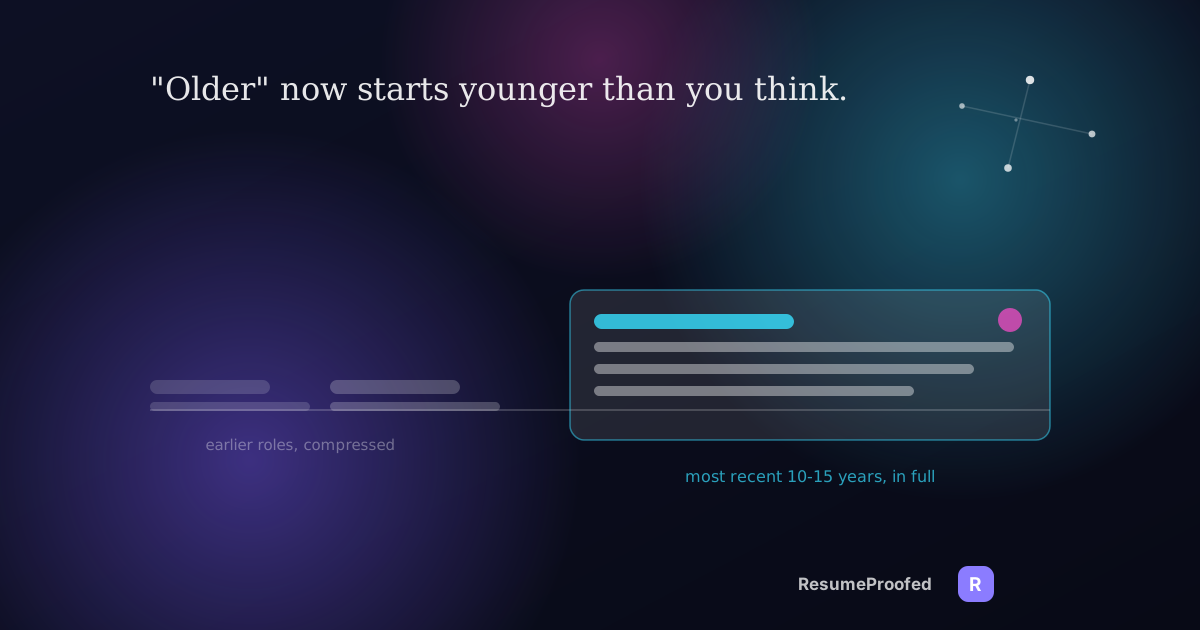
A useful working rule is to detail your most recent 10 to 15 years of experience fully, with specific achievements and outcomes, and to compress anything older into a shorter, title-and-company-only summary line rather than a fully detailed entry. This isn't about hiding that you worked in the 1990s or early 2000s. It's about matching the level of detail on the page to what's actually relevant to the role you're applying for now, which is a reasonable editorial choice regardless of age, and one that happens to also reduce how easily an unspoken age assumption gets triggered by a resume that reads as a complete career archive rather than a targeted pitch for a specific next role.
Framing older qualifications and roles
Where an older qualification or role is still genuinely relevant, keep it, but frame it in terms of the capability it built rather than the era it happened in. "Led a national systems migration" reads as a current, relevant capability regardless of which year it happened in; a heavy cluster of dates and version numbers from two decades ago reads as dated even when the underlying skill still applies. The goal is to let the substance of what you did carry the entry, not the decade it happened in.
The skills section as a currency signal
A skills section that's obviously current, naming the specific tools, platforms, or methods used in your field today rather than ones that were standard a decade ago, does real work here. It's a fast, scannable signal to both a human reader and an automated screener that your capabilities are active and current, which is exactly the assumption an age bias risks working against by default. Our guide on finding the right resume keywords in a job ad covers how to identify which specific terms belong in that section for a given role, rather than guessing at what "sounds current."
A worked example
Say you're 54, with 28 years of experience in operations management, and you're applying for a supply chain manager role at a mid-size retailer. Instead of a resume that lists all seven roles you've held since 1998 in full detail, you write full, achievement-led entries for your most recent three roles, covering roughly 12 years, each with a specific result: "Reduced warehouse stock discrepancies by 22 percent over 18 months by redesigning the cycle-count schedule." Your earlier four roles from the 1990s and early 2000s get a single compressed line each: "Operations Coordinator, [Company], 1998 to 2003." Your skills section leads with the specific inventory and logistics platforms the job ad names, not the ones you used when you started your career. The resume still honestly reflects 28 years of experience, nothing is hidden or falsified, but it reads as a targeted, current pitch for this specific role rather than a full career archive that leads with a decade far less relevant to the job in front of you.
Common questions
At what age do Australian employers start considering workers "older"?
According to a 2025 AHRC/AHRI survey of 148 Australian employers, nearly a quarter of HR professionals now classify workers aged 51 to 55 as "older," up sharply from just 10 percent two years earlier. That's a younger threshold than most job seekers in that age range would expect.
Should I remove old jobs from my resume to avoid age discrimination?
Not by hiding or falsifying your history. A better approach is to detail your most recent 10 to 15 years fully and compress older roles into brief, title-and-company summary lines, which keeps your resume honest while focusing the reader's attention on your most current, relevant experience.
Can AI resume screening tools be biased against older candidates?
The same AHRC/AHRI report that documents the shift in how employers classify "older" workers explicitly recommends employers audit their AI resume screening tools for age-related bias, acknowledging the risk exists. It's a documented concern regulators are actively flagging, not a fringe theory.
How do I make my resume look current if I have decades of experience?
Lead with your skills section using the specific tools, platforms, and methods your target role's ad actually names, and make sure your most recent roles carry the fullest, most specific detail. Both signal active, current capability rather than a career that stopped updating years ago.
Is age discrimination in hiring common in Australia?
It's reported as one of the most common reasons Australians experience workplace discrimination, according to the Diversity Council Australia and Australian Human Rights Commission's Inclusion@Work data, yet formal Age Discrimination Act complaints make up only around 5 percent of the AHRC's caseload, suggesting most experiences of it are never formally raised.
Should I mention my age or graduation year on my resume?
There's no requirement to volunteer your age directly, but your work history dates already convey your general career length, so there's little practical benefit to omitting a graduation year specifically. The more effective response to age bias is structural: emphasise recent, relevant achievements rather than trying to conceal how long you've been working.
Where ResumeProofed fits, and where it doesn't
ResumeProofed can't remove age bias from a hiring manager's judgement or from a screening tool an employer hasn't audited, and no honest tool can promise that. What it can do is help you build a resume that leads with your most recent, most relevant achievements and matches the specific language of each role you apply for, which is exactly the structural response the data above supports, regardless of which employer or system is reading it next.
Try ResumeProofed free: two tailored applications on the house, no card required.