Resume mistakes to avoid, ranked by what recruiters say
The resume mistakes recruiters actually cite, from untailored content to typos, ranked using a 753-recruiter survey, with a fix and example for each.
- Resumes
- Job search
- Career advice
Most lists of resume mistakes to avoid are written from opinion. Someone decides that fonts matter or that objectives are dead, and the list grows to 30 items with no way to tell which ones cost you interviews. A better approach is to start from what recruiters report. This guide ranks the common resume mistakes using a single survey, then adds the failures that survey does not measure but that we see repeatedly. Each section ends with a fix you can apply in a few minutes.
The position we take is that the mistakes worth fixing first are the ones about substance, not decoration. Recruiters in the survey below rank dishonesty, formatting and lack of tailoring close together, and ahead of nearly any stylistic choice. If you have an hour, spend it there.
The survey behind the ranking
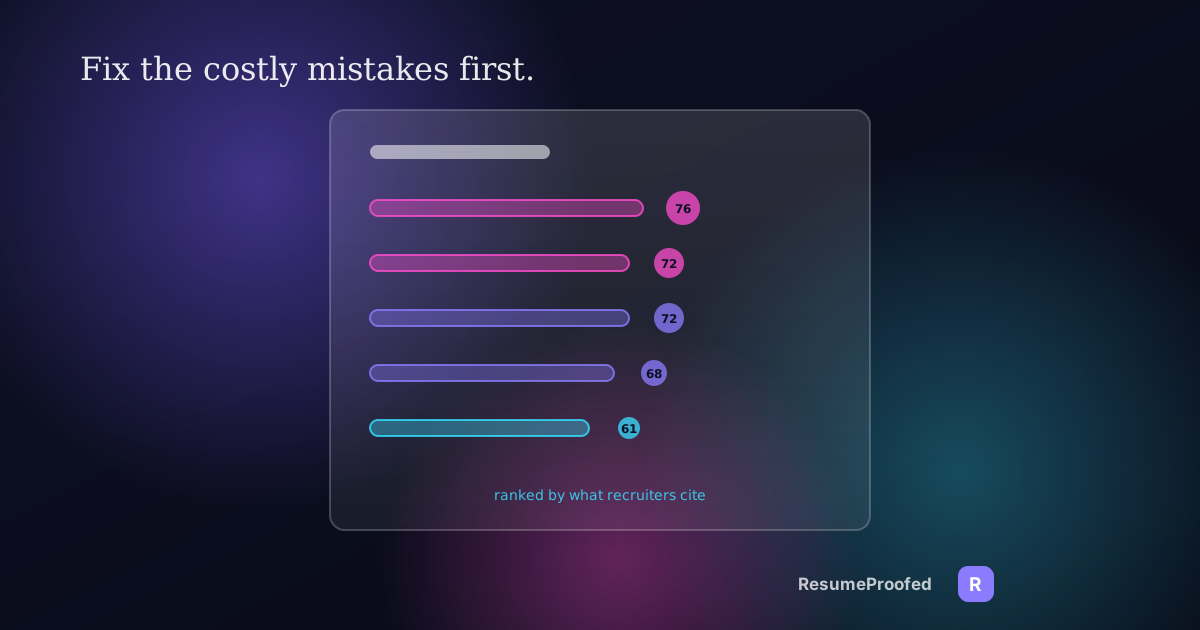
In June 2024, Zety surveyed 753 American recruiters and HR professionals online. The results were published in a Recruiting Preferences Report. It is one vendor's survey of a US sample, so the exact percentages will not transfer neatly to another country, but the ordering is a useful guide. The reasons recruiters gave for rejecting a candidate's application materials were:
| Reason for rejection | Share of recruiters |
|---|---|
| Lies or exaggerations | 76% |
| Poorly formatted materials | 72% |
| Resume not customised to the role | 72% |
| Typos in the application | 68% |
| Unprofessional email address | 61% |
The same report found that 72% of recruiters spend less than two minutes reviewing a resume, with 1 to 2 minutes the most common answer (33%). So every mistake below is being judged by someone moving quickly.
Mistake 1: exaggerating or inventing
At 76%, this is the most cited reason in the survey. It also tends to be self-inflicted: the "led" that should have been "contributed to", the title upgraded by one rung, the tool listed as a skill after one tutorial. The trouble is that a resume is a set of claims an interviewer will probe.
Fix: Write what you did, at the scale you did it. "Contributed to a four-person campaign that grew revenue 200%" survives a follow-up question. "Single-handedly grew revenue 200%" does not. If you are tempted to round up, ask yourself whether you could explain the number to your former manager. Our guide to quantifying resume achievements covers how to find honest numbers.
Mistake 2: formatting that fights the reader
Poor formatting is cited by 72% of recruiters. The survey does not itemise which formatting choices were the offence, so be careful about claiming specifics. The common-sense failures are clear enough: inconsistent fonts and spacing, dense paragraphs where bullets belong, dates that change format between jobs, and layouts that are hard to follow.
Fix: Use one plain, single-column layout. Make every job entry follow the same pattern: title, employer, dates, then bullets. Use consistent date formats and a readable font size. Print it, or view it at the size a recruiter will, and check that the eye can find your latest job within two seconds. Saving as PDF usually protects layout; if you are unsure how parsers handle it, see our post on whether an ATS can read PDF resumes.
Mistake 3: the same resume for every job
Another 72% cite a resume that is not customised to the role. This is the mistake that costs the most time to fix honestly and is also the one most job seekers admit to, because sending the same file to 40 ads feels efficient.
Fix: Keep one master document of everything you have done, and for each application select and reorder the parts the ad asks for. You are not inventing anything, just choosing. Start by reading the ad and marking its repeated terms, then check your top third of the page uses them where true. Our walkthrough on tailoring a resume to a job description takes this step by step, and the post on similar jobs shows how to do it faster when ads overlap.
Mistake 4: typos and small errors
Typos in the application are cited by 68%. The word to notice is "application": it counts across the resume and everything attached to it. A single wrong number, a misspelled employer name or a phone number with a digit missing can undo otherwise careful work, and the last of these is worse than an error because the recruiter cannot reach you.
Fix: Read the document aloud, slowly. Then read it backwards, line by line, which breaks the habit of skimming what you expect to see. Check phone, email, employer names and dates against another source. Ask someone else to read it, since you will not see your own errors.
Mistake 5: an unprofessional email address
Cited by 61%. It is the cheapest fix on the list.
Fix: Create a plain firstname.lastname address for your job search. Make sure the address in your resume matches the one on your application forms.
Mistake 6: no measurable results
The same report found that 54% of recruiters usually reject resumes without measurable data. We would read this as a statement about attitude, not a rule: most recruiters like to see numbers, and a resume made only of duties gives them nothing to compare. A duty tells the reader what the job was. A result tells them what you did with it.
Before: "Responsible for customer complaints and social media."
After: "Resolved around 25 customer complaints a week and cut average response time on social channels from two days to under six hours."
The second line has two checkable numbers and an outcome. If you do not track numbers, estimate conservatively and say "around". Never invent precision.
Mistake 7: the wrong length for your career stage
In the Zety survey, 57% of recruiters preferred two pages, 37% preferred one, and 6% preferred more than two. So "one page only" is not the universal rule people repeat, and a stretched-out single page with tiny margins is a worse sin than a clean second page. At the same time, a first-job resume with a lot of padding is not helped by length. Our post on one page or two separates the human-reader question from the ATS question.
Fix: One page if you have under roughly five to ten years of experience and enough relevant content to fill it honestly. Two pages if you have a long record of relevant results. Never shrink the font below readability to force a fit.
Mistake 8: burying the strongest evidence
Zety's recruiters said the first things they look at are skills (39%) and work experience (37%), ahead of the summary (15%) and education (9%). If your best evidence sits at the bottom of page two, many readers will not reach it.
Fix: Put the most relevant content in the top third. That usually means a short summary with one concrete strength, a skills block matching the ad, and your most relevant role first with its strongest bullets leading. For summary ideas, see our guide to resume summary examples.
Mistake 9: unexplained gaps and unclear dates
Gaps are not a mistake by themselves. A blank where the reader expects an explanation is. A recruiter with two minutes will not go looking for the reason.
Fix: State the reason briefly and factually, such as "Career break for caring responsibilities" or "Full-time study", with the dates. Our post on explaining a career gap on your resume has wording you can adapt.
Mistake 10: duties instead of scope
"Answered phones and filed documents" is true and tells nobody anything. Scope means size, frequency, budget, team, tools and outcome.
Fix: For each role, answer these questions in one line each: how much, how often, with whom, using what, with what result? Pick the best answers for the bullets.
A fifteen-minute audit you can run today
- Honesty check (3 min). Highlight every number, title and tool. Mark any you could not explain in an interview.
- Tailoring check (4 min). Read the ad, underline its repeated terms, and see whether your top third uses the true ones.
- Format check (3 min). Same font, same date style, same bullet style, one column.
- Error check (3 min). Read aloud, then backwards. Verify phone and email.
- Evidence check (2 min). Does each recent job have at least one bullet with a number or outcome?
What this survey cannot tell you
A few honest limits. The Zety sample is American, from one vendor, and the survey asked about what recruiters say, not what they do on a given day. It does not tell you how any particular ATS handles your file, and it does not give a causal estimate of how much fixing a mistake raises your chances. Treat the ranking as a prioritisation guide, not a guarantee. For the software side of the question, our explainer on whether an ATS automatically rejects resumes covers what is and is not known.
Common questions
What is the biggest resume mistake?
In Zety's 2024 survey of 753 recruiters, lies or exaggerations were the most cited reason for rejecting application materials, at 76%. Poor formatting and a resume not customised to the role followed closely, both at 72%.
How many pages should a resume be?
It depends on your experience. In the same survey, 57% of recruiters preferred two pages and 37% preferred one. A clean one-page resume suits early careers, and two pages suit a longer record of relevant results.
Do typos really get a resume rejected?
Recruiters say so: 68% in the survey named typos in the application as a reason for rejection. Since the cost of checking is small, read the document aloud and have someone else check it.
Is it a mistake to use the same resume for every job?
Usually yes. Seventy-two percent of surveyed recruiters cited a resume not customised to the role. You do not need to rewrite from scratch, just reorder and reword real achievements to match each ad.
Should I put an objective on my resume?
A short summary that states who you are and one concrete strength is more useful than a generic objective about what you want. Only 15% of recruiters in the survey looked at the summary first, so make sure the skills and experience beneath it carry the weight.
Are there mistakes that only matter to ATS software?
Some formatting choices can affect how software reads a file, but the evidence on this is mixed and tools differ. Stick to a plain layout, standard headings and text that can be selected, and avoid relying on any claim about a specific ATS score.
Where ResumeProofed fits, and where it doesn't
ResumeProofed addresses two of the mistakes above directly: untailored content and unsupported claims. It builds each resume from facts you have confirmed and matches them to the job ad's language, and it will not add an achievement you did not state. It does not proofread your typing for you, judge your formatting taste, or promise that fixing these mistakes leads to an interview. Treat the fifteen-minute audit as the baseline, and use the tool for the repetitive tailoring work.
Try ResumeProofed free: two tailored applications on the house, no card required.